Wednesday, January 18, 2012

Random Book Babble

Despite the wide open spaces surrounding my four walls here on the edge of America, a familiar closing in kind of mood crept up yesterday, signaling that a few hours escape to Daytona was in order, a drive to help blow away the metaphoric cobwebs. Daily views around home are unfailingly those of distant vistas, panoramic swaths of deep blue and sandy white and people at either at rest or play. Infrequently it’s good to get away from a day of losing oneself in cloud formations and sandy sculptures, to jump into the liveliness of people hustling about their daily work or on errands in crowded shops and streets.


All that is probably just an excuse for me to spend some time in the big Barnes & Noble store in Daytona. I tried a temporary fix the other day by visiting the local Bookland store (a small bookstore owned by Books A Million), but it’s the mini-stop of bookstores and more often than not a waste of time, a useless placebo for book junkies. So it was off to Daytona and the big B&N.


The past two weeks have been a designated re-read period for me, and while keeping up with what’s new on bookstore shelves and in related newsletters, focus has been more on a second look at three books read over the last few years. Not an unusual plan, being one who enjoys returning to a book after a passage of years, this time it was a Julia Glass book from 2002, Three Junes, Haruki Murakami’s novel, Kafka on the Shore (2002) and Edward Rutherfurd’s 2009 historical novel, New York. As it happened, a pre-ordered new release arrived in my mailbox and I squeezed it in between the Murakami and Rutherfurd books; that was Michael Connelly’s latest, The Drop.


Three Junes is a book I would recommend to anyone unreservedly—a fine, fine book. The wonder and skill of Murakami’s latest book 1Q84 is precisely what sent me back to his earlier Kafka on the Shore. Another one to recommend without hesitation. Before the third book on my reread list, I took a couple of days to work my way through the latest Michael Connelly featuring his long established Los Angeles detective, Harry Bosch. Such economic writing from Connelly, not a wasted word or phrase that doesn’t propel his story. Stories about New York, be they old, fictional, historical, contemporary or non-fictional are right down my line. I have always liked the epic books of Edward Rutherfurd and his 2009 book, New York is another historical novel, surpassingly picturesque and studded with fascinating facts concerning the city’s development.


Tuesday in Barnes & Noble was rewarding as usual. There was really only one book on my mind as I entered the store, but you know how that goes. Read the other day on NPR an excerpt of the new Alan Bennett book Smut, and was hoping to lay my hands on that. Took some digging but it was there between two distracting stacks on an out-of-the-way table. On a nearby shelf I came across a book unheard of, unmentioned, or at least in my world; a small 2011 hardback release by Lou Beach titled 420 Characters: Stories. The first thing that caught my eye was a quote from Jonathan Lethem: “Holy sh*t! These are great!” Each of the stories is limited to 420 characters, including letters, spaces and punctuation. Sound familiar? They we're each written as a status update on the author’s Facebook page. One example…

‘The storm came over the ridge, a rocket dropped rain like bees, filled the corral with water and noise. I watched lightning hit the apple trees and thought: “Fritters!” as we packed sandbags against the flood. There was nowhere to go that wasn’t wet, the squall had punched a hole in the cabin roof and the barn was knee-high in mud. We’ll bury Jess later, when the river recedes, before the ground turns hard again.’

That’s it; the end. A haiku-like story that leaves the reader to fill in the blanks.


The last was a totally unexpected find, a new release of Haruki Murakami’s popular 1987 novel, Norwegian Wood. I read this book at the time of it’s first release when I was living in Japan, a time when Murakami was still undiscovered outside of Japan. Since reading 1Q84 I have been thinking again of this and other Murakami books. The new release is in conjunction with the release of a new movie version of the novel. It is a Japanese production, but has been released outside of Japan recently.

Tuesday, January 17, 2012

The Master Architect’s Home

Some might call A. Hays Town the premier southern architect of the twentieth century, but while that may be the case, too few outside of architects and Louisiana natives are familiar with the name. My own introduction to Town and his work was boosted by my growing up in Baton Rouge, where the sight of his designs was not rare. I can even add that my father worked at a lumber mill that did the millwork for most Hays Town designs, and my aunt worked for years as his personal secretary. But teenagers have other things on their mind and take little notice of architecture. It is my regret that I never took advantage of proximity to gain better understanding of a major architect. As Cyril E. Vetter writes in The Louisiana Houses of A. Hays Town, ‘Like jazz and jambalaya, Hays Town’s houses contribute to the sui generis nature of Louisiana life.’ The distinct nature of Louisiana life is clear, but I missed a valuable part of it in those youthful years when architecture was overlooked by young eyes mostly interested in fun. Though a couple of weeks late, think of the photographs below as commemoration of the architect’s death in January 2005, age 101.


Mr Town often recommended that clients supplement his design with a dog, preferably a German shepherd.


The photo above shows a view across the front lawn of the A. Hays Town home on Stanford Avenue in Baton Rouge. Since the architect’s death it has been the home of his son, A. Hays Town Jr. Stanford Avenue is located in an old section of Baton Rouge near Louisiana State University, and the house is diagonally across the street from one of two lakes. Not visible in this photograph is the second story located farther toward the back of the house.


In this photograph, looking through a brick arch we see into the backyard and garden. Directly in front is a small outbuilding used as a toolshed. The pigeonnier in the left background serves to evoke an earlier time. The architect added a pigeonnier to a number of his designs, but the homeowners most often used them for storage.


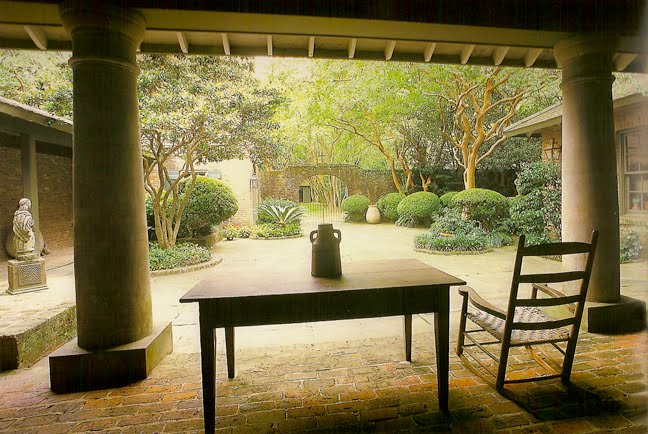
This offers a look at the back patio and a worktable with rocker under the deep gallery. From this view it is easy to see how the architect used native crepe myrtle trees to add twisted lines among the straight lines and angles within the patio.


Through the archway at the end of the patio above are again the irregular branches of crepe myrtle, this time framing another small outbuilding. The walls are made of crisscrossed lath and serve to house a statue. Notice the green algae growing on weathered gray roof shingles—illustration of how Mr Town incorporated the effects of nature into his design.


The photograph here shows two sets of antique doors the architect found while traveling in France. He shipped them home and installed them opposite each other across a hallway.


We see in this photo what the architect called the “morning room” with its window wall providing a sight line to a small statue outside.


Many might consider the study to be the most beautiful room in the house. A note about the artwork: All of the artwork in the house—a quite valuable collection—is carefully guarded by temperature control as well as protection from direct sunlight.


This photograph gives a look into the “Spanish room” which Mr Town added on to the house in the 1970s. He used it primarily as a home office for client meetings.


This offers a glimpse of the formal living room, and very likely a room not often used except on the occasion of parties and other gatherings. There is a formality, unmistakably a beautiful formality, but one that doesn’t encourage relaxed living.


Other views of A. Hays Town designs can be found here, here and here.

Monday, January 16, 2012

The Crunch is the Thing

In April of last year I remarked in these pages that poet Dorianne Laux has affected me more strongly than any poet I have read in some time. Nine months later that feeling is much the same. Dorianne Laux is a magical poet and continues to be under-appreciated and under-read; she deserves a wider audience. Sunday was a day I decided to reread her latest book of poems published last year, The Book of Men.


As well as this most recent, her work includes Facts About the Moon (2005), Smoke (2000), What We Carry (1994) and Awake (1990). Facts About the Moon was a recipient of the Oregon Book Award and also chosen as a finalist for the National Book Critics Circle Award, and the collection Awake was nominated for the San Francisco Bay Area Book Critics Award for Poetry. One of Ms Laux’s peers, the poet Tony Hoagland said about her work, “Her poems are those of a grown American woman, one who looks clearly, passionately, and affectionately at rites of passage, motherhood, the life of work, sisterhood, and especially sexual love, in a celebratory fashion.” Laux lives with her husband, poet Joseph Millar in Raleigh, North Carolina, where she teaches in the MFA Program at North Carolina State University. The poem below is from her latest collection, The Book of Men.


Though it does not speak of rites of passage, motherhood, the life of work, sisterhood or sexual love, “A Short History of the Apple” is evidence of the poet’s range.


A SHORT HISTORY OF THE APPLE

The crunch is the thing, a certain joy in crashing through

living tissue, a memory of Neanderthal days. — Edward Bunyard, The Anatomy of Dessert, 1929


Teeth at the skin. Anticipation.

Then flesh. Grain on the tongue.

Eve’s knees ground in the dirt

of paradise. Newton watching

gravity happen. The history

of apples in each starry core,

every papery chamber’s bright

bitter seed. Woody stem

an infant tree. William Tell

and his lucky arrow. Orchards

of the Fertile Crescent. Bushels.

Fire blight. Scab and powdery mildew.

Cedar apple rust. The apple endures.

Born of the wild rose, of crab ancestors.

The first pip raised in Kazakhstan.

Snow White with poison on her lips.

The buried blades of Halloween.

Budding and grafting. John Chapman

in his tin pot hat. Oh Westward

Expansion. Apple pie. American

as. Hard cider. Winter banana.

Melt-in-the-mouth made sweet

by hives of Britain’s honeybees:

white man’s flies. O eat. O eat.


For more poems from The Book of Men look here and here and here.

Sunday, January 15, 2012

Nero in Sunglasses


Like any modern open stadium, glare was a problem for spectators in Rome’s Coliseum back in the day of the Emperor Nero. History tells us that to reduce the sun’s glare Nero watched the gladiator spectacles through “glasses” made of a polished green gem. According to Roman historian Pliny, the gem was emerald, known then as smaragdus and emperor Nero viewed the games by means of a polished smaragdus lens. The word ‘emerald’ comes to us through a corruption of the Latin smaragdus.


Spectacles resembling modern sunglasses were used in China prior to the fifteenth century, kept in place with weights that hung down behind the ears. The quartz lenses in these early glasses were not intended to reduce glare, but rather smoke-tinted especially for Chinese magistrates who wore them to conceal their eye expressions during court proceedings. Later vision-correcting eyeglasses were imported into China from Italy and they too were darkened for judicial use.


In the nineteenth and early twentieth centuries yellow-amber and brown-tinted spectacles were prescribed for people with syphilis because sensitivity to light was a symptom of the disease. But the popularity of sunglasses is a phenomenon like so many others, stemming from military research. The Army Air Corp was looking for something to cut high-altitude glare for pilots. Physicists and opticians for Bausch & Lomb developed a dark green tint that absorbed light in the yellow band of the spectrum and not much later the public was able to purchase glasses called Ray-Ban aviator glasses. Foster Grant is the oldest American sunglasses company. Founder Sam Foster sold his first pair of sunglasses at a five-and-dime store on the boardwalk in Atlantic City, but it wasn’t until their 1960s advertising campaign that sunglasses became chic. Foster Grant’s “Sunglasses of the Stars” ad campaign featured Hollywood celebrities like Elke Sommer and Anita Ekberg wearing the glasses, with copy asking, “Isn’t that…behind those Foster Grants?” Well-known fashion designers along with movie stars escalated the craze and by the 1970s Hollywood and the fashion industry were having a huge impact on the sunglasses market.


There was a time in the past when women cultivated an allure with the use of fans or an umbrella tilted over the face. In our day modern women, as well as men do it with sunglasses.

Saturday, January 14, 2012

The Seagull

Friday was a cold day in beachtown, leaving the water and wind-stirred stretches of sand for hardier specimens. A long part of the afternoon was washed in clear sunlight common to colder months along the east coast and I took advantage of it to wander off on a walk. It was one of those times when the sand was clean and hard-packed, easy for walking and free of anything to turn you from a straight line. At first were a couple of gulls standing a good distance apart, an everyday sight of normally social birds having some solitary time away from the colony.


And then there was a huge gathering of them, all facing north at the water’s edge. For reasons beyond me, they suddenly took off in a fluttering cloud, made one low circular swoop out over the water and returned to settle again in the same spot. A moment after touching down every bird was once more stationary in a northward gaze. Gulls are very aware of attention, and when one of us large flightless creatures stops to watch them, they become nervous and edge farther away. Several times in my picture-taking, bird or birds felt threatened by my ‘stare’ and scuttled away.


Where numbers of gulls have gathered for their cryptic rituals at surf’s edge, there is always a scattering of left-behind tokens of their temporary stay, and if luck is on your side, a shed feather untrammeled and still dry makes a delicate and naturally beautiful picture. Too often the harsh setting makes quick work of these dropped plumes, quickly turning them into crusted, splintered leavings denuded of their beauty.


A few more yards down the beach and I came upon a near-perfect set of gull footprints, looking in their webbed shape like two tiny kites waiting for lift-off. Not quite sure how these isolated and static prints are left in the sand, but they appear with no beginning or end, a stamped image telling that one bird stood here looking north.


Whatever we may imagine about the presence of seagulls on a beach, one fact is certain: they are forever and always on the lookout for the next tasty bite of food. And obviously they do pretty well in their established habitat or we wouldn’t see them for long. Eating means eventual defecation, and if you pay any attention to it, seagull excrement is not the unsightly and malodorous discharge common to many land animals. More often than not it is a pure white splash on the sand, with now and then a dark speckle. The best thing about is that it’s gone in the next wash of surf.


Gulls are typically a coastal or inland species, rarely venturing far out to sea. In size they are generally medium to large birds, typically grey or white, often with black markings on the head or wings. They have thick, longish bills and webbed feet. The larger gulls take four years to attain full adult plumage, but two years is typical for smaller birds. Most are ground nesting carnivores, which will eat live food—crabs and small fish—or scavenge opportunistically. Like snakes, gulls have unhinging jaws which allow them to consume large prey. As strange as it sounds, gulls have been observed preying on live whales, landing on the whale as it surfaces to peck out pieces of flesh. Some gulls rely on what scientists call kleptoparasitism, a form of feeding where one animal takes prey from another.


The larger species in particular are resourceful and highly-intelligent birds, demonstrating complex methods of communication and a highly-developed social structure, with typically a harsh wailing or squawking call. They nest in large, densely packed noisy colonies, lay two to three speckled eggs in nests composed of vegetation and the young are born with dark mottled down, are mobile upon hatching and able to feed themselves almost immediately.

Friday, January 13, 2012

Death of a Baseball Cap

Shouldn’t have put it in the washing machine, but a close look at the battered old baseball cap worn for beach walks told me that it was in bad need of a wash and I thought, 100 percent cotton so why not? Looking a tad grubby and sweat stained, maybe an ounce of sea salt soaked into the cotton, I can’t even remember where the cap came from, or when, but it must have been from a local shop selling beach gear and at the time probably four or five dollars. So, I tossed it in the wash and unknowingly turned it into a clump of useless shredded cotton. An hour later I was looking for a new baseball cap.


Place names or brand names are not a ‘design’ feature I like on shirts, shorts and caps. Plain is fine, but clothing manufacturers today have found a way to make plain more expensive, so most of the time we get stuck with names on our shirts and caps. In a store up the road that specializes in beachwear and equipment I found something like 2,000 baseball caps—all but three of them with NEW SMYRNA BEACH embroidered on the peak. The three exceptions were pink with glitter sparkles. But after all, a baseball cap is a trifling thing not worth anguishing over, and so my new baseball cap carries the name of where I live just like ninety percent of all the other baseball caps on the beach.


The baseball cap as we know it today was first worn by the Brooklyn Excelsiors in the mid 1800s. It became an official part of the baseball uniform on April 24, 1849 when the New York Knickerbockers unveiled their club uniform. In 1860, the Excelsiors wore the ancestor of modern rounded-top baseball caps, and by 1900 the cap with a long visor and a button on top became popular. Modern baseball caps evolved in the 1940s as latex rubber replaced coarse cotton as the stiffening inside the visor. The brim or visor was much shorter and the cap has also become more structured and unlike the floppy style seen in earlier years. By 1954, the New Era Cap Company was producing a uniform cap for each professional baseball team, and today they provide about 2,000 caps per team each season. There are more than 200 styles of Yankees caps, nearly 200 choices for the Dodgers, 175 for the Red Sox.


Good bet that most of us would prefer pink with glitter sparkles to any of the old styles shown above. But retuning to the idea of washing your baseball cap, the suggestion from a young lady in the beach shop was to wash a baseball cap in the dishwasher rather than the washing machine. That never would have occurred to me but then I suppose it is a gentler wash.

Thursday, January 12, 2012

Could Have Been a Clock

English singer-songwriter Nick Drake enjoyed only minor popularity during his short lifetime. He recorded just three albums before his death at age 26: Five Leaves Left (1969), Bryter Layter (1970) and Pink Moon (1972). Drake suffered from depression and insomnia, topics often reflected in his lyrics and on completion of his third album, Pink Moon, he withdrew from both live performance and recording, retreating to his parents’ home in rural Warwickshire northwest of London. Drake died in 1974 from an overdose of a prescribed antidepressant. It was only after his death that people began to better appreciate his music and by the 1990s he had reached cult status. A 1999 television commercial for Volkswagen featured the title track from Drake’s last album Pink Moon, and within a month Drake had sold more records than he had in the previous thirty years.


Robert Kirby, a good friend from their time at Cambridge University described Drake’s lyrics as a “series of extremely vivid, complete observations, almost like a series of epigrammatic proverbs,” though he doubts that Drake saw himself as a poet. In many of his songs Drake used natural symbols like moon and stars, sea and rain, but such language is absent from “One of These Things First” where lyrics are concrete and convey better his sense of regret for what didn’t turn out. Nick Drake may not have seen himself as a poet, but there is something very close to that in his lyrics.


The song “One of These Things First” from the second album, Bryter Layter is featured on the 2004 Grammy Award winning soundtrack, Garden State. It was also used in the 2008 film Seven Pounds starring Will Smith.


ONE OF THESE THINGS FIRST

I could have been a sailor, could have been a cook

A real live lover, could have been a book.

I could have been a signpost, could have been a clock

As simple as a kettle, steady as a rock

I could be

Here and now

I would be, I should be

But how?

I could have been

One of these things first

I could have been

One of these things first.


I could have been your pillar, could have been your door

I could have stayed beside you, could have stayed for more.

Could have been your statue, could have been your friend,

A whole long lifetime could have been the end

I could be yours so true

I would be, I should be through and through.

I could have been

One of these things first

I could have been

One of these things first.


I could have been a whistle, could have been a flute

A real live giver, could have been a boot.

I could have been a signpost, could have been a clock

As simple as a kettle steady as a rock.

I could even be here

I would be, I should be so near

I could have been

One of these things first

I could have been

One of these things first.


From Drake’s first album, Five Leaves Left is a beautifully written and arranged song, “River Man.”


RIVER MAN

Betty came by on her way

Said she had a word to say

About things today

And fallen leaves.


Said she hadn’t heard the news

Hadn’t had the time to choose

A way to lose

But she believes.


Going to see the river man

Going to tell him all I can

About the plan

For lilac time.


If he tells me all he knows

About the way his river flows

And all night shows

In summertime.


Betty said she prayed today

For the sky to blow away

Or maybe stay

She wasn’t sure.


For when she thought of summer rain

Calling for her mind again

She lost the pain

And stayed for more.


Going to see the river man

Going to tell him all I can

About the ban

On feeling free.


If he tells me all he knows

About the way his river flows

I don’t suppose

It’s meant for me.


Oh, how they come and go

Oh, how they come and go


About Me

My photo
Oak Hill, Florida, United States
A longtime expat relearning the footwork of life in America