Sunday, December 15, 2013

Feels Like Spring

Dog life has me on the go these days leaving little time to sit around dreaming up topics that might make an interesting blog post. All the corralling, trips to the vet or Pet Supermarket and filling in holes dug in the driveway tend to take the mind far from blogspot.com. I mean, concentration is a touch-and-go kind of thing when a thirty-six pound puppy is dragging twenty-five feet of hose-pipe around the yard or chewing on old asbestos shingles she found in the shed. If I’m completely honest though, all of it—excepting the asbestos shingles—is a daily joy.

Moving on from dogs, I was looking back at an old Japan blog post this morning, one showing a sketch and a journal excerpt, and I got the idea to re-post the sketch from a different angle. That part of the earlier post which caught my attention was not so much the sketch of tomatoes and a can of sardines as the thoughts about that particular March day written in the margins around the sketch. 


The sketch and the words surrounding it are in my journal of the time, a Life Noble Note Plain notebook with cream paper. The sketch was done first in a 2B Mitsubishi pencil and then colored with Mitsubishi Uni Watercolor Pencils. The journal notes, as far as pen and ink go, are a little harder to discern because earlier and later pages in the journal leave no hint. Looking at it closely I am fairly certain that the ink is an old De Atramentis color called Jules Verne Deep Sea Blue and the pen used, a Sailor Profit with a 21k Naginata medium nib. As the handwriting might cause a problem for some, a cleaner version is below:

Friday, 5 March 2010 — Thinking of tomatoes and sardines for some reason. I have neither in my kitchen but wish I did. That and some saltine crackers. Feels like spring today, a change from the cold rain of yesterday, a day that typified everything about winter, the wet and the cold. Plum blossoms are in bloom in the garden below me, and the Japanese magnolia is full of buds.


Searching through my photographs of Kugayama I can find none of the ‘garden below me’ showing both the plum blossoms and the budding Japanese magnolia, but the one below is fairly close. At least the magnolia (tree with leaves of the lightest green) is budding though the plum tree is out of the picture. The red blooms at the far left are on a giant azalea at least ten feet in height. I was standing on my third-floor veranda when I took the picture; the house and garden belong to my landlord.


Friday, November 29, 2013

Dawg!

Love my dog, but…a five dollar bill, the window sill, a signed first edition, sofa cushion, two pairs of shoes, the doctor’s bill, blanket, paintbrushes, washcloths, a table leg, the phone book, a bowl of wooden fruit—each a recent victim to the teething process. It’s an odd list by most standards, but perfectly ordinary for a five month-old puppy with 24-7 machine-like teeth that will gnaw on anything to relieve the ache of baby teeth, baby gums. Amazement over her choice of objects to chew on has lessened over the weeks, and now I wouldn’t be surprised to catch my new puppy chewing on a doorknob. Knew when I brought her home that a long period of teething and chewing were part of the deal, just didn’t imagine it reaching as far as knuckles and kneecaps. 


Little Miss Farina came to the Old Dixie Lane homestead sometime around mid-October. An adoption pup, she reportedly got lost and wasn’t recovered by her original owners. A four month-old labrador-retriever mix with a honey gold coat and a sweet disposition, she arrived here weighing seventeen pounds. Five weeks later that weight has almost doubled. From first sight she seemed the perfect mate for this huge expanse of fenced land amidst the oak trees and squirrels, raccoons, gopher turtles, snakes and the occasional alligator. Those creaturely neighbors aside, her biggest fascination has been with the two horses living next door, one of which is a full grown dwarf standing all of three and a half feet. Farina (named for the honey-brown cereal) spends part of each day barking at the horses across the fence, and on trips to the mailbox pulls hard on the leash as we pass the neighbor’s gate. Coming out one day to see what all the barking was about, the dwarf pony easily cowed the dog with its bold approach and cocky head tosses.

Sketches of Farina by J

A part of it all is getting used to holes in the yard, lots of holes. Seems there isn’t a time that Farina is out romping in her one-acre playground that she doesn’t dig a new hole or two. Few would mind a scatter of holes dug way at the back of the yard, and there are a number of those, but the two heavily favored digging spots that worry me are in the driveway and in places along the fence line. The second is obvious, but going in and out of a drive that looks and feels like a prairie dog village is a bumpy ride. There’s a cure in the dog psychology books and that's underway, but the holes are many and the ingredients for that cure take time to gather. A lady at the adoption center with great experience in dogs and digging told me to deposit a pile of the dog’s “business” in the hole and cover it up, that she would be put off and not dig in that spot again. So far it’s working, but new holes appear every day. 

The fun and companionship of having a dog are special but it was a different economic era when I last had a dog and I’ve quickly learned that dog owners everywhere will shout in loud chorus, “It doesn’t come cheap!” I’m wondering who to apply to for child support. Go to the dog store for the smallest thing and ten minutes later leave the store fifty dollars lighter. Wondering too if the vet’s rates are competitive with those of brain surgeons. As far as food and feeding go, one lesson is clear: Dogs will eat more if the food is a cheaper, lower quality food and less if the food is rich in the nutrition they need for growth. Now I understand why some brands of kibble are $45.00 a bag—they are more filling because less of it provides the basis of good health, and the dog, or stomach at least, knows that.


The interesting part comes in realizing that without opposable thumbs and a tongue capable of shaping syllables, communication for a dog is heavily weighted toward gentle biting, licking, chewing and body language. I am convinced that facial expression is a valuable tool for dogs and more than a few times the eyes of my puppy have made clear what words would express if she were capable. How many times have I looked at Farina and clearly understood that she is trying to convey her shame, her impatience, anger, happiness, or confusion?

And with my opposable thumbs and the countless words on my tongue, it’s me who all too often helplessly chases her around the yard unable to make myself clear, grinding my teeth with impatience, angry at the dog and myself as well and altogether baffled at how a honey-colored bundle with floppy ears and too many teeth has completely captured my heart.

Tuesday, November 19, 2013

Remembering Joe Brainard


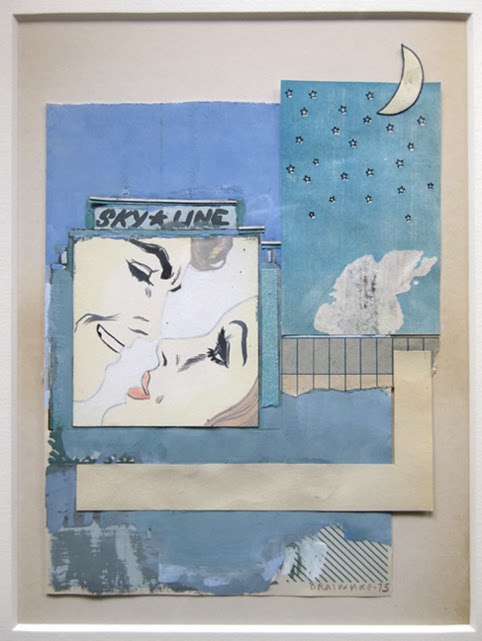
Would be a surprise to learn that I am alone in struggling with the work of artist-writer Joe Brainard, a man of prolific production during the first 45 years of his short life. Brainard died in 1994 at the age of 52, having stopped exhibiting in the early 1980s. Despite the decision to distance himself from the art world, he enjoyed admirable success as both artist and writer, his first solo exhibition in New York coming at the age of 22. With a few infrequent exceptions, he had stopped producing art by the mid-1980s. Work by Brainard is currently included in collections at the Museum of Modern Art, the Metropolitan Museum and the Whitney Museum. His medium stretched from drawing to collage, assemblage and painting, as well as half a dozen book and magazine covers. It could be argued that some small part of his success came from the advantage of being part of a group that included many talented New York artists, poets and writers, not to mention a few wealthy supporters. Many remember Joe Brainard more for his unusual but wonderful memoir, I Remember, published in 1970.


“Garden XV” 1971; watercolor and cut paper

The struggle with Brainard’s work mentioned above comes with the landslide of images that make up his output. Many of his collages are immediately stunning, several of his paintings hold the eye without letting go, some of the assemblages provoke a study of the almost uncountable and minute parts. Pages of drawings prove that the artist was a skilled draftsman. In spite of all the good, I suspect that some viewers of a Joe Brainard retrospective might wonder what all the hoopla was about, might ask, “What’s so special about this stuff?” Joe Brainard produced a large catalogue of work and in my opinion not all of it is up to par. The first question could easily be, “Where in all of this is the Joe Brainard style?” In fact, there is no distinct quality in his work that gives the viewer a sense of connection or continuance, nothing to identify the art as the work or style of one man. It is a question not unfamiliar to people who know his work, and Brainard himself was quick to admit that the work had no distinct style that could be defined as his alone.


“Skyline” 1974; gouache and collage on paper

Thanks to lifelong friend, poet and editor Ron Padgett, we now have The Collected Writings of Joe Brainard to give us an inside look at the mind of this singular man. It makes a very helpful companion to his art and life while also showing that Brainard could on occasion be carried away by his own words, fall prey to the overly confessional and at times be plain old mundane and trivial. I expect that only close friends of the writer could manage each of the 517 pages in this collection. Honesty is to be admired on the page, but there is a time when it all seems too much like someone shouting out, “Look at me!”


Untitled (Whippoorwill), 1973; oil on canvas

The exception is his marvelous and even extraordinary book, I Remember. The format is simple: The writer recalls in two or three lines a list of things he remembers from growing up in Tulsa in the 40s and 50s, and on into the moments of his life in New York, Boston and Vermont during the 60s and early 70s. Paul Auster called the book, ‘A masterpiece. One of the few totally original books I’ve ever read.’ Since its publication and several re-printings, teachers everywhere have used the book in classrooms to teach the writing of both poetry and prose. A few samples hint at the writer’s gift for poignant recollection…

I remember the small diamond heart necklace that Arlene Francis always wore on What’s My Line.

I remember the “swoosh” of Loretta Young’s skirt as she entered the room each week.

I remember that Rock Hudson “is still waiting for the right girl to come along.”    

I remember on newsstands, Jet magazine. But never getting up the courage to thumb through a copy.

I remember reading the big sex scene on the beach in Peyton Place.

I remember having a crush on a boy in my Spanish class who had a pair of olive green suede shoes with brass buckles just like a pair I had. (“Flagg Brothers.”) I never said one word to him the entire year.

I remember the first time I got a letter that said “After Five Days Return To” on the envelope, and I thought that after I had kept the letter for five days I was supposed to return it to the sender.

I remember the kick I used to get going through my parents’ drawers looking for rubbers. (Peacock.)

I remember when polio was the worst thing in the world.

I remember my first erections. I thought I had some terrible disease or something.


Untitled (sardines), 1975; gouache on paper


Untitled (sweets), 1972; mixed media collage

Thursday, October 24, 2013

“I Do” in Lime Green


In the city of Tokyo forty million passengers use the metropolitan rail system every day. By comparison, the highest daily train usage in Europe is in Germany where the number is only ten million daily. Of Tokyo’s many different train lines, the most notable is the Yamanote Line, a loop line of twenty-nine stations connecting three million passengers a day to the city’s multiple centers. This train line was always a favorite with me not only for its convenience, but also for the appealing lime green of the passenger cars. In my early years in the city the cars were a solid green but in 1985 they became silver and green. The particular green used on the cars, signs and diagrams is a shade of lime green with the poetic name of Bush Warbler green, or uguisu-iro in Japanese.


Stories abound of the jam-packed rush hour trains in Tokyo, and the platform attendants whose job is to push passengers more tightly into the cars before the doors close. Those stories are likely accurate in the telling but fall short of imparting the tactile crush of a Yamanote train ride at 8:00 a.m. on Monday morning. For many years my early mornings in Tokyo included a 7.5 mile crunch on the Yamanote from Shibuya Station to Sugamo, a ride that left me rumpled, poked, twisted, stepped on and rubbed with a mystery mix of hair oil and cologne. You get used to it, and despite the negative aspects, there does not exist a more efficient transportation system anywhere in the world.  

Now imagine getting married on such a train. On October 14 that is exactly what one Japanese couple did. The day happened to be the 141st anniversary of the train’s start of operations and as part of the celebration Japan Railway East offered one couple the chance to hold their marriage ceremony on the Yamanote Line on that particular day. Guests were limited to 120, with exclusive use of the 11-car train as it traveled around the twenty-one mile Yamanote Line loop. For the one-hour wedding run, passengers were limited to the couple and their guests, and though the train stopped at all twenty-nine stations, the doors did not open. For one or two in the wedding party there might have been the small problem of no restrooms, meaning holding it in for the duration of the ride and ceremony. The wedding couple and their guests had to agree to having the media present to film the event, surely an advantage since it guaranteed a well-recorded commemoration of the day. 

Photos of the newlyweds were hung throughout the train and a video re-enactment of the marriage proposal played repeatedly on screens above the doors during the ceremony. The seated guests applauded the pair as they walked through the cars to No. 6. Other passengers waiting on the platform at Ikebukuro Station greeted the newlyweds with cheers as the train began its circular journey. “We want to cherish the bonds with family and friends that we have confirmed during our wedding preparations,” Suzuki told their guests.

The couple who won the Yamanote wedding lottery are Nobuhiko Suzuki, 27 and Sayaka Tsuchiya, 28, who East Japan Railway found most interesting among the applicants because their courtship took place daily on the No. 6 train during their commute to Shimbashi Station for work.


There was no charge for the train wedding but it was the rail line’s belief that they got publicity enough to justify a few bottles of free champagne. The reception held later at the Hotel Metropolitan Ikebukuro (operated by the train line) was paid for by the wedding couple. Considered by many Japanese to be the most beautiful season, the “Railway Day” wedding fit perfectly with the custom of marrying in autumn.


Oct. 14 is designated Railway Day to commemorate the beginning of the first railway service between Shimbashi and Yokohama stations in 1872. The Yamanote Line went into service in 1903 but the full loop was not completed until 1925. The company launched its lime green cars in 1963, with the stainless steel body coming in 1988. The special train used for the wedding is currently in service to commemorate the 50th anniversary of the lime green cars.

Wednesday, October 9, 2013

Something Old, Something New


There was a time when book talk was a regular feature of this blog. For one reason or another the last book post was nine months ago when the view out my windows was still pelicans and blue ocean and not yet a forest of twisted live oaks with dangling beards of Spanish moss. The drift away from book talk has been too long and some readers might have wondered what happened to dislodge the periodic “book reports.” Easy answer for that; nothing more than a change of scene, adjustments to that change and preoccupation with thoughts curving in a different direction. High time for a return to earlier topics.

The “new” remote country setting far from the tumult of traffic, tourists and malls has if anything boosted the time allowed for reading. A tiny local library, a multitude of online booksellers and minimal interruption provide the opportunity to explore or reconsider heaps of books, writers both new and old. The words ‘new and old’ should suggest that reading is a hand-off between new writers, new books and older, established or deceased writers and their work. Am I alone in thinking that reading pleasure includes not only books newly published, but on occasion an old book gone back to a second time, and other times a dusty and battered paperback picked up for 25¢ at a yard sale?

Here are a few of the books in my reading stack the past few weeks, three of them new and two going back a few years. Nothing like a comprehensive review for any of the five, only a few brief remarks which depending on taste, might encourage or discourage.


Light of the World (July 2013) by James Lee Burke
Long a fan of James Lee Burke and rarely disappointed, this one failed to make the grade. Few would argue that Burke is a writer of great talent, often touching on the sublime. His descriptions of south Louisiana are without compare and bring to life a setting that ripples across the skin with tactile expression. Burke is best known for his ongoing series of novels featuring police detective, Dave Robicheaux as the major character, most of them set in and around New Iberia, Louisiana. Not for the first time, Burke has moved Dave Robicheaux northwest to Missoula, Montana for a clash with bad folks in that neck of the woods. While the setting is Montana, the story still adheres to the established parameters of a Dave Robicheaux story but this time the writer has fallen overboard into a deep trough of moralizing, pondering too long the nature of evil and it’s origins. A heavy-handed  bee-in-the-bonnet about the overall hopelessness of us regular folks against the barons of industry and their environmental scourge is another weight to the novel. With Light of the World, I found myself murmuring for the first time, “Get on with your story and stop with all the preaching.” A highly recommended writer stumbling a little off track. 

Dissident Gardens (September 2013) by Jonathan Lethem
If you’ve never read Jonathan Lethem, run to the bookstore or dial up Amazon now. This guy is one of America’s best young writers and it will be no surprise if this latest book wins either a Pulitzer or the National Book Award. Lethem writes of Brooklyn like nobody else and Dissident Gardens is right in his backyard. The story covers a stretch of years in the lives of 1950s communist, Rose Zimmer, her black policeman lover, Rose’s radical daughter and son living in a 60s East Village commune, and Professor Cicero Lookins, son of the black policeman. Always top notch, Lethem has outdone himself with this one.

Lookaway, Lookaway (August 2013) by Wilton Barnhardt
A novel of the American south, Lookaway, Lookaway centers around the dissolution of a once wealthy aristocratic family in Charlotte, North Carolina. Scandal and mishap work their ruin in the family of Jerene Jarvis Johnston and her husband Duke and their four children. The novel includes a moderate dose of Civil War history but don't misunderstand that to mean it bogs down in long passages of dull history. On the contrary, Barnhardt’s tale is a laugh out loud romp, alternately funny, poignant and disturbing. Despite their foibles and weaknesses, the characters are people we can’t help empathizing with.

One Hundred Years of Solitude (1970) Gabriel García Márquez
Since it’s publication, this Márquez classic has been put by many readers, critics and scholars among the best books of the twentieth century. No argument from this reader on that claim. It came to me last week that it was time to give this book a second read and no surprise that a second reading is every bit as rich and telling as the first. A book of this depth offers the assurance that a second or third reading will uncover nuances and insights that slipped past the first time. Not quite finished with my second reading, I’m starting to regret there aren’t more pages to the story. One Hundred Years of Solitude should be on your ‘have to read’ list. Hard to imagine how anyone could be disappointed or bored by this book, one that is even more enchanting than the later Márquez diamond, Love in the Time of Cholera.

Rivalry (1916) by Nagai Kafû
I will be honest and say from the start that this is not a book that will attract a great many American or Western readers, unless they have an interest in the details of life in the early twentieth century Tokyo demimonde. It is a tale of geishas and their patrons and the intrigues that colored the lives of a small segment of Japanese society in that age. Beautifully written, with lyrical passages describing the city and its people, Rivalry (Udekurabe in the original) is only one of Nagai Kafû’s (1879-1959) several paeans to a vanishing culture. The writer is best remembered for his short novel The River Sumida (1911).

Monday, September 2, 2013

Life Among Frogs & Bookmarks


My neighbor Manny was over late yesterday afternoon doing some touch up work on the grass outside the gate and during a pause over the idling lawnmower he pointed to the gap in his front teeth and said he found a guy that’s going to put a new tooth in next week or the week after, a guy—I didn’t hear the word dentist—that works out of the trunk of his Pontiac Le Grand and uses laughing gas as an anesthesia. Didn’t know what to say to that, my mind running with images of dentistry by way of a tire iron and Krazy Glue. 

Finding mouse droppings on the floor of the back porch recently, I set out a mousetrap, baiting it with a small piece of Boar’s Head herb chicken neatly wrapped around a dab of lo-cal peanut butter. Next morning the mouse trap was gone, disappeared, snatched up in a poof of nighttime magic. It occurred to me that the mouse might have been too big for the trap and undeterred by the snap of steel, but held by leg or tail dragged the trap and itself off to an emergency exit. I looked around the porch and soon spied the mousetrap upside down in a corner by the screen door. I flipped the trap over with a broom and couldn’t believe my eyes—a frog caught by the toes of one leg and still trying to hop away. I rescued the poor creature, figuring it must have brain damage after a night of that, and it quickly hopped out the open door, apparently uninjured.

Later, I stood for thirty minutes watching a lengthy black snake nosing around outside the back porch. I decided finally, judging by the way the snake pushed its nose into the leaf litter and small holes, that it was looking for a meal of insects or lizards. It paid me no mind as I stood back at least ten feet hoping not to alarm it. Best not to bother or kill these non-venomous snakes since they help keep rats, mice and bad snakes away. I haven’t seen any of the small rattlers around, even though the climate and geography are magnets for their breed. 

Days pass in my country jungle jumping with every kind of life save elephants and giraffe, a place that brings back to a transplanted city boy some of the small wisdoms that concrete, swimming pools and shopping malls forced us to either discard or forget. Live with them long enough and even the dullard will find a way to cope with mosquitos, diminish the ant bites, avoid the hairy caterpillars and manage the summer heat. I’m learning how to blend. 

I transplanted a big tub of mint to a spot just off the back porch three days ago. For a long time it was a beautiful, lush and bountiful plant happy and snug under the table situated on a beach patio. Starting out as a small $1.99 pot of mint from Publix, for some reason only science can explain, it went wild on that salty windblown spot just off the ocean. When I brought it here to the country it fell straight into a decline, turning scragglier by the week. Thinking it might be root bound I dug it out of the large tub and planted it beside a clump of purple lantana behind the camphor tree, then brought home another small pot of supermarket mint to plant as a bolster beside the ailing cousin. 

Squirrels are doing their best now to munch through the seed-packed magnolia fruit-cones that succeed the fall of the tree’s large white blooms. I try to dissuade the pesky varmints but they are tenacious devils. Put together in a bowl the fruit-cones have a certain beauty.


……………….

Bookmarks are something I’ve always thought you can never have too many of. Kindle and its electronic brothers have naturally gone a step toward making the old-fashioned paper bookmarks obsolete, but there must be more than a few of us who hope that never happens. There was a time before they went out of business that Borders offered its customers a series of very stylish bookmarks that I continue to use. Simple but bold, black and white lithographic designs characterize the bookmarks offered by Borders in its last two years of business. Only wish I had the full set of designs they produced. Below are three examples.


Saturday, August 17, 2013

Pull out, Betty!


Since moving to the country three months ago mosquitos have taken on a new meaning in life. Never thought much about the little devils during the time I lived at the beach, the almost constant ocean breeze keeping them off and away. But that was then. In my new home among the tall moss draped oaks, palmetto scrub and marshland, along with a host of less bothersome creatures, mosquitos are a force to be reckoned with. Stepping into the outdoors is no longer a casual action, but one measured by the preventatives necessary to hold off the ever present swarms of hungry blood suckers. The five minutes it takes to walk out and lock the gate at night require either a beekeeper’s costume or a nasty head-to-toe lather of chemical sprays. Ever in the market for a working solution, I’ve gathered an almost cumbersome collection of products that promise to keep mosquitos at bay. So far, none have truly solved the problem.

Blood gorged, the mosquito passes blood to make room for more solid nutrients in her gut.

The first trick I tried was the heavily scented Bounce fabric softener sheets, but they turned out to be like most remedies, working partially or with some atomic mosquitos, not at all. “Tuck one in your pocket when you go outside,” advised my sister. At one point I had them pinned all over my T-shirt and jeans with one in each pocket, and was still slapping at the dozen or so who enjoyed a hint of Fabreze with their blood. Next came the much stronger chemical spray, Off. This one worked well, but left me feeling uncomfortable with the chemical residue on my arms, neck and legs. And the monsters still went for my face because I refused to put the spray there. Next came the pleasantly scented cream, Skin-So-Soft Bug Guard made by Avon. I continue to use this one, convinced I’m not rubbing agricultural pesticides on my body and pleased that it keeps the mosquitos away for the most part. In the hardware store one day, I came across a large spray bottle of Cutter Backyard Bug Control. This one promised to keep mosquitos away for six to eight weeks. Problem is, I have to take it back to the store and ask someone to explain how the baby-safe top works to get any spray out. I can’t even pry it open to pour the contents into a Flit can.


Remembering how well the old Pic mosquito coils worked at the drive-in movies way back when, I looked on Amazon and found Off mosquito coils, but while serving well enough on the screened back porch where a few pests can always find a way in, they work not as well when friends sit around the backyard. I doubt that the company ever considered mosquitos in the numbers that plague my backyard. Next came sonic mosquito repellers made by the PIC Corporation. I bought three and discovered they work to repel mosquitos about as well as macaroni and cheese. I later read that a professor of entomology at Rutgers University does not believe electronic devices that transmit sounds to mimic male mosquitoes or dragonflies work, and even suggests that claims made by distributors are next door to fraud. Hearing that the Bounce sheets didn’t suffice, my sister advised last week that I try eucalyptus oil. So now I apply several drops of the oil to ears, neck and other exposed areas before going outside. The result? The tiny vampires buzz around until they sense an oil-free spot of skin and then dive bomb for lunch.


With my ongoing battles I’ve managed to collect some interesting info about our favorite pest. Some of it might be useful on Jeopardy! or in a trivia contest, the kind of facts few of us ever encounter. Did you know that…

Mosquitos are the deadliest animals on Earth.
More deaths are associated with mosquitos than any other animal on the planet. Mosquitos can carry malaria, dengue fever, yellow fever, and encephalitis. They also carry heartworm, which can be lethal to your dog.

Only female mosquitos bite humans and animals; males feed on flower nectar.
Female mosquitos need protein for their eggs and must dine on blood in order to produce another few hundred pests. Since males don’t produce young they avoid humans completely and look for flowers instead. When not trying to produce eggs, the females too are satisfied with only nectar. 

Mosquitos fly at speeds between 1 and 1.5 miles per hour.
Mosquitoes are the slow pokes of the insect world. If a race were held between all the flying insects, nearly every other contestant would beat the mosquito. Butterflies, locusts, and honey bees are much faster on the wing.

Early twentieth-century Japanese poster ad for mosquito coils

A mosquito’s wings beat 300-600 times per second.
Rapid wingbeats produce the warning buzz you hear just before a mosquito drives her snoot into your ear.

Mates synchronize their wing beats to perform a lover’s duet.
At one time scientists thought that only male mosquitos could hear the wing beats of a potential mate but recent research has proven that females also listen for males. Wing beats are synchronized in mating pairs.

Adult mosquitos sometimes live from 5 to 6 months.
Few probably make it that long, given our tendency to slap them when they land on us. Under the right circumstances, an adult mosquito has a long life expectancy, in the insect world.

About Me

My photo
Oak Hill, Florida, United States
A longtime expat relearning the footwork of life in America