Friday, December 24, 2010

Seidensticker

Between books and in those times when a wistfulness for Japan wells up turning my thoughts sentimental, more often than not I feed the nostalgia with a few pages from one of the several old ‘living and working in Japan’ books tucked into my shelves. This time it was the late Edward Seidensticker’s journal of his time working on the translation of the tenth century Japanese classic, The Tale of Genji.


For specialists, Seidensticker’s commentary on the translation process is of some interest, but his journal of this time, Genji Days, published in 1977 is much, much more than a record of his putting the classical Japanese of a long and complex novel into English. For most of us the tidbits and items of daily life sandwiched between his record of translation is the delicious nugget at the journal’s heart.


For those unfamiliar with the preeminent scholar of Japanese studies, Edward Seidensticker translated most of the great names in modern Japanese literature, including Mishima, Kawabata and Tanizaki. He has been called the best translator of Japanese that has ever lived. Apart from that, he was also an extremely witty man with a sharp eye for all around him, and a remarkable fluency in describing it. Mr Seidensticker died in 2007 following a fall near his Tokyo home.


Genji Days is full of interesting (fascinating, unusual, racy) observations or commentary on personal experience. Seidensticker first went to Japan in 1948 as a diplomat. He lived there on and off for the next fifty-nine years, dividing his time between Tokyo, Honolulu and mainland US. During his years in Tokyo he moved fluidly between levels of society, having drinks with the rich and famous one night, and trading jokes with laborers in a lower class dive the next. His writing is full of that color and range.


TUESDAY, JULY 7, 1970: In the late afternoon I ventured timidly into a barbershop and my!—such treatment as I did get, such an assortment of wetters and driers and steamers and perfumers, all for a thousand yen. I felt alternately as if I were enthroned and as if I were being guillotined. With such attention to look forward to, how could one possibly become a long-hair?


WEDNESDAY, JULY 26: Kaoru took me to a most extraordinary place, a “host club.” The clientele is female, and its needs are seen to by boys. The clientele, this particular evening, consisted of rather frowsy ladies of a certain age. The boys were all excessively pretty, and their masochism seemed quite open—and I suspected many of them of being boys from the band. I was fascinated, and at the same time repelled, and I suppose the most curious thing is that I felt nothing in the least erotic about the scene before me.


MONDAY, JUNE 26, 1971: Speaking of scents, in the new instructions on how we should comport ourselves in this our Shûwa Residence is an admonition that we refrain from farting in the elevator.

Down to the spicy lotus breezes to await Bill Sibley. He arrived just as I was about to be propositioned by a tart. We (Bill and I, not the tart) went and had a beer nearby.


THURSDAY, JULY 5: Having an evening to myself, I spent it wandering around Ueno. The lotuses, most powerful symbol of high summer, are coming into bloom. In a month I will be gone. I sometimes seem to tire of Tokyo and its frantic stir; but I regret the passing of each Tokyo day, the dwindling supply of Tokyo days, all the same.

Thursday, December 23, 2010

Tangerines & Cake

As far as Christmas spirit goes, this little town in Florida has nothing whatsoever over Japan, where the late December air is everywhere palpable in music, decoration and the holiday demeanor of people. Hard to tell it’s even Christmas in this sand blown beachtown with few decorations.


Though people do go to work as usual on Christmas Day, like most December days people are caught up in a holiday swing. It is a time of year in Japan when tangerines and strawberries are everywhere, boxes, bowls and dishes of the bright orange and red fruit coloring stores and living rooms, a time when people are thinking about Christmas cakes and what kind to get this year. Boys making plans to take their girlfriend for a Christmas Eve dinner, while the restaurants are gearing up for their prix fixe specials. Lampposts and storefronts are wearing garlands that twinkle with lights, and in the busier parts of town carols from overhead compete, “Jingle Bells” from the camera shop, “Frosty the Snowman” from a tinsel-wrapped bakery crowded with strawberry topped cakes. Even the big Colonel Sanders figure out front at Kentucky Fried Chicken wears a Santa suit.


One thing absent from a Japanese Christmas is our own tradition of gift giving. Oh, sure there are those parents who give their child a Christmas present, but without the stockings and bedtime stories of Santa, and nothing like the American Christmas tree surrounded by colorfully wrapped presents. Apart from the many decorated trees in stores, parks and on select corners, Christmas trees are not a custom in the average home.


There is no Christian tradition underlying the thoughts and celebrations of the average Japanese, as less than two percent of the population is Christian. I suppose there are those strict Western-taught Christians who on occasion discount the Japanese celebration as hollow, but it is also true that Christmas in America is as much an economy driven bonanza as it is a holiday commemorating the birth of Christ. The idea of ‘Jesus is the reason for the season’ has a competing flip side where Wall Street and Madison Avenue declare that spending is the reason for the season. But in that aspect Japan is no different. Christmas was created by retailers who saw a phenomenon they could re-create in Japan with a few Christmas carols and some yards of tinsel and was from the beginning a marketing concept. Still it would be unfair to criticize those beginnings, because the years have brought at least some understanding of the Christian concept, the joy, happiness and celebration.


This will be my first Christmas in the US since Ronald Reagan was President and I haven’t yet gotten a hold on the differences. I keep thinking I’ll be going to Christmas dinner in Yokohama at Kumiko’s house, but then remember it will be my sister’s house in Maitland instead. Will she have a Christmas cake, I wonder.

Wednesday, December 22, 2010

Handful from Levenger

During the two weeks spent in Louisiana last month, I enjoyed some time visiting with my favorite cousin and her family. Carolyne, or as I’ve long called her, the Cajun Queen, is one of us who takes pleasure in stationery goods, and stays on top of what’s available in the pen, pencil, ink and paper market through blogs and other websites. Carolyne has kept up with my frequent fountain pen hurrahs over the past year, but apart from a Pelikano Junior, remains loyal to her rollerball pens. She is a big fan of Levenger products and has on at least three occasions given me wonderful gifts from their online catalogue. What I’ve come to discover however, is that Levenger is quick to ‘retire’ items from their online menu. I have a pen case, an eyeglass-pen case and a mechanical pencil from Levenger-via-Carolyne, and none of the three are currently available on the Levenger website. Hard to understand when each of the three is an excellent, high quality product, as well as practical. Mmm…wait a second there; let me amend that to say that two of Carolyne’s gifts are practical, with the case for ten fountain pens more in line with the needs of pen nuts like myself. I have to doubt that a case for multiple fountain pens would be very useful for someone like my sister or best friend.


The last time in Baton Rouge Carolyne gave me what Levenger calls the 2mm Clutch Pencil. Lead with a 2mm diameter is huge, practically verging on the size of a carpenter’s pencil. I am no stranger to thick lead, since I regularly use a 0.9 Montblanc 167 mechanical pencil, but the difference in 0.9 and 2mm is considerable. Still, I like thick lead because it guarantees stability in writing; thick lead doesn’t suddenly snap in mid-sentence.


The Levenger Clutch Pencil is short, measuring only 4.5 inches, with a weighty 0.5 inch diameter. After writing with it for three pages, I switched to my regular 0.9 Montblanc and was surprised at the Montblanc’s lightness in comparison. The Levenger has a barrel of half brushed aluminum at the top, and natural wood at the bottom. I wish they had added a rubber grip above the point because the smooth wood does not allow for a secure hold, making the grip almost slippery. I also would ask that they lengthen the pencil at least an inch, but perhaps that’s my big, large-grip hand talking.


Unfortunately, as stated above, the 2mm Clutch Pencil—like the eyeglass-pen case and the fountain pen case—is no longer listed on Levenger’s website. Don’t quite know why this is so, but they know more than I do of sales and marketing.


Finally, a bayou-sized thanks to the Cajun Queen.

Tuesday, December 21, 2010

The Composure of Trees

My thoughts seem to be stuck on Japan, this being the third post in a week related to Japan or things Japanese. Must be the season that’s sending my ruminations eastward to my longtime home. Whatever the reason, during a walk today I began thinking about a Japanese poet I’ve long liked, and one of his poems in particular.


There may be some who would argue my description, but Kinoshita Yûji (1903-1965) is a poet I would call obscure, or at least obscure to all but those with a particular interest in modern Japanese poetry. I have mentioned his name to a great many Japanese people and most are unfamiliar with both his name and his writing. So, I use the word obscure.


The defining characteristic of Kinoshita’s life was the tension created by unhappiness in his work as a rural pharmacist, and his yearning to be a sophisticated urban poet living in Tokyo. As a young man studying French literature at university in Tokyo, fate dealt him a cruel blow when his stepfather died forcing him to return home and take over the family pharmacy. Thus, he spent his life in the remote countryside mixing medicine by day and writing poetry at night.


Kinoshita had a special affinity for trees and saw in them the characteristics and ideals he hoped to emulate. He wrote many poems with trees as his subject, one of them the poem, “A Felled Tree” included in his collection, Flute Player published in 1958. The translation below is by Robert Epp and comes from his book, Treelike, The Poetry of Kinoshita Yûji. In his poem Kinoshita observes the fall of a tall tree by the roadside and expresses the hope that his own death can be met with the same composure and sense of fulfillment that he sees in the tree.


A FELLED TREE


Today I stood by the roadside and watched

a tall tree sawed down

Aware of its maturity

the tree seemed to take the saw calmly

with a sense of satisfaction and confidence

I noted a composure born of fulfillment

even in twigs and leaves quivering on the ground


Night now I suppose

that a huge black cloth covers those scars

that stars sparkle beautifully around them

that birds plying the night sky

feel a chilly emptiness on their wings

at the height at the spot where the tree spread out


You who will one day saw me down

at life’s end

do you suppose I too might know that repose that hush?

Do you suppose I’ll be capable of feeling then

what I felt today as I watched by the roadside?


We see in Kinoshita’s words a hope that his own death can be met with a similar composure and sense of fulfillment with life that he observes in the fallen tree.

Monday, December 20, 2010

The Cat’s Meow

A common sight in Japan is the coffee shop. Unlike the shared and almost predictable commonality of coffee shops in many American cities, those in Japan come in a funhouse of types and themes. If you’re looking for a simple cup of coffee the choices are myriad and if you’re in a Starbucks mood walk twenty yards and look around—you’ll probably see two of them. Want to be waited on by a young girl in a French maid’s costume? Easy to find. How about boys in French maid’s costumes pouring tea and coffee? Yep, that too. Coffee shops in Tokyo come in all guises.


One increasingly popular type of coffee shop is the cat café. There are anywhere from fifty to sixty coffee shops in Tokyo catering to cat lovers, cozy shops where you can sip your coffee with a cat on your lap. The Calico Café in Shinjuku has about twenty cats in a wide variety of breeds.


What kind of customer goes to these cafés? First thought is probably of odd old ladies who live alone and moderate lonely afternoons petting and nuzzling cats. But in fact, the cat cafés attract all kinds of people. You’ll find singles, couples in their 20s and 30s, and lots of people who simply like cats and for one reason or another can’t keep one at home.


In most of the cat cafés, walking in, finding a table and ordering a cup of coffee is not the way it’s done. Rates vary, but the average is $9.00 or $10.00 for an hour of cat company, with coffee extra. There are also rules and picking up just any nearby cat may not be the thing. At the Calico Cat Café there are six rules: (1) Customers must wear a ‘cat-access’ pass around their neck. (2) Cats wearing a scarf are too young to be handled or picked up. (3) Customers must not force themselves on any cat that resists. (4) Napping cats must not be disturbed. (5) No catnip or cat treats allowed, and (6) children under eleven are not allowed in the café.


I probably know at least ten Japanese people who would consider relaxing in a comfy chair, sipping a cup of cappuccino, flipping through a comic book while scratching the ears of a purring cat the ultimate in relaxation. On the other hand, I probably know a good many who view the whole thing as just a little screwy. Think I might be more comfortable if there were just one cat instead of several, and him or her dozing on the sill of a sun-splashed window across the room.


Note on the bottom photo: A cat I used to have, a red point Siamese dozing on the veranda. Her name was Husselbud.

Sunday, December 19, 2010

Elegy for Catfish

A walk on the beach in Florida can take on a multitude of shapes. Depending upon such influences as sun, wind, rain, tides and season, the fundamental trio of ocean, beach and sky shifts daily through a cycle of patterns ongoing in their variety. Just when you think you’ve recognized something predictable in the daily scene, a twist in the weather brings on a sudden surprise in the tenor of that walk on the beach.


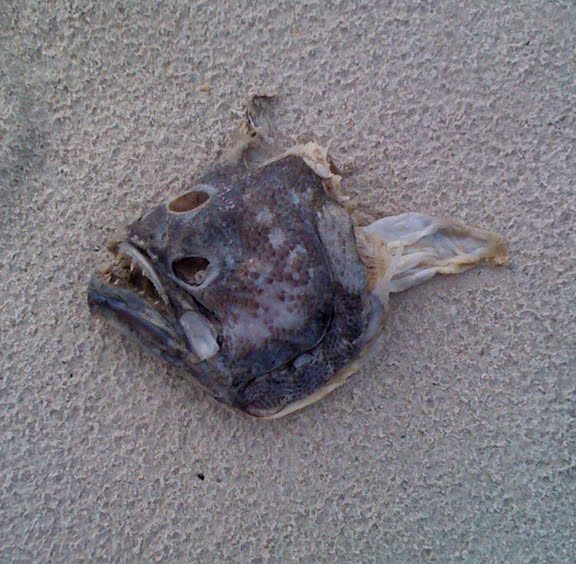
This week the twist is cold ocean water and its effect upon catfish and snook. In daily walks the past few days I have seen an increasing number of catfish washed up on the beach, some newly dead, others half picked over by scavenging birds. Not nearly as many, but the same is true of snook. My initial thought was that the phenomenon is related to the temperature of the ocean. A call to the New Smyrna Beach Wildlife Services confirmed that guess. According to the person I spoke to, from Flagler Beach south to Vero Beach, a stretch of about 100 miles, the ocean temperature this week is low enough to cause shock among catfish and snook. The shock disables the fish as far as swimming goes, leaving them helpless against tide and surf. Thrown onto the beach they are stranded at the surf line, quickly becoming a fresh dish at the grand and sandy beach buffet for birds. Onshore temperatures have been higher the past three days and birds are more numerous now. Their numbers though are still too few to handle the large influx of beached fish. For the time being, what you see are many fish only half-eaten. But this environment, whatever the season is supremely efficient in processing the non-living, and the passage of several days will find a beach cleansed of these partially eaten carcasses.


As for us two-legged creatures who frequent the beach, temperatures are back in the 60s and 70s, and the walking is optimum, if a little ghoulish with the sight of so many eyeless fish heads.

Saturday, December 18, 2010

Dark Streets

A friend recently passed on to me a big thick paperback, a trilogy of novels called collectively Berlin Noir. The book is a 1993 Penguin paperback that includes March Violets (1989), The Pale Criminal (1990) and A German Requiem (1991). Long a fan of hard-edged mystery stories in the noir style, this collection was quick to grab my interest. Not my usual practice to write about a book before I’ve finished reading it through to the end, but I am making an exception this time because my comments will stay pretty much with the book’s setting.


What exactly is noir fiction? It describes a style that is lean and direct with a fair serving of gritty realism, a further development of the hardboiled crime story made popular by Dashiel Hammett and refined by Raymond Chandler. Noir fiction took its name from “film noir,” dark dramas of hardboiled stories. Jim Thompson is a paramount name in noir, but what many have failed to notice is that Patricia Highsmith was the ultimate of noir writers. Though Raymond Chandler may be more accurately described as a writer of hardboiled fiction, the darkness of his Los Angeles streets and the characters who inhabit them is very definitely a noir characteristic.


The Chandler descriptions of Los Angeles make up the element that many of his readers look for in each of his books. The city becomes a character as much alive as any of his human characters. And it is that point that connects him to Philip Kerr and his trilogy, Berlin Noir. In March Violets, the Kerr book I am now reading, the city of Berlin, circa 1936 is recreated so finely, and with such completeness that it makes me believe the writer must have had photographs and maps tacked up all around his writing desk. He writes of dark, wet streets and you feel that darkness and wetness as though you were standing there on Alexanderplatz in east Berlin looking up through lamplit drizzle at Berolina Haus and Alexander Haus. Kerr does for Berlin what Chandler does for Los Angeles. Here is Kerr in an interview:

‘Yes, I tried to make Berlin a character in the same way that Los Angeles is a character in Chandler, which is probably where people get the idea that I copied Chandler. I do admire his descriptions of places and have always used them as an example of excellence that I set myself. It seems to me that a sense of place is essential in all good fiction. I like to think of myself as being rather similar to a painter in that I describe pictures of places.’


Kerr is so successful in his descriptions of Berlin 1936 that holding the book open in my hands I almost feel as though I’m wearing a trench coat, a wide brimmed hat, cheap leather shoes, with a Luger stuffed in my pocket. Only halfway through March Violets, I am reluctant to say more about the book. But for those readers with a special penchant for noir, and especially pre-World War II Berlin, Philip Kerr and Berlin Noir is the ticket.

About Me

My photo
Oak Hill, Florida, United States
A longtime expat relearning the footwork of life in America