A scrambled scribble of hodgepodge scraps, ragbag thoughts, an all-around mishmash about pens, inks, books and…well, whatever
Thursday, December 6, 2012
On Familiar Terms
Sunday, August 26, 2012
Defining Chocolate
Wednesday, April 18, 2012
Trees

“I never before knew the full value of trees. Under them I breakfast, dine, write and receive my company.” —Thomas Jefferson
He never lived in Louisiana but the words above suggest that Jefferson had great appreciation for the comfort that trees bring to our lives everywhere. Many of my earliest memories of the deep south are clothed in the grandeur of sweeping oaks gnarled with age and hung with Spanish moss. I doubt it would be far off to imagine that most of the people living in Baton Rouge have similar feelings for the trees they have grown up with, or come to love in their time here. Seeing the city for the first time, a visitor would never guess that twenty percent of the tree canopy was lost when Hurricane Gustav hit the city on September 1, 2008.
The most familiar trees are the majestic oaks and cypress that grow so well in the climate of south Louisiana. Who hasn’t seen a photograph of a plantation drive lined with overhanging oak trees? A variety of oaks are found in and around Baton Rouge, including live oak, southern red oak, cherry bark oak, and shumard oak, along with southern magnolias, yellow poplar and bald cypress.
Some of the photos taken over the past three weeks are below. I’ve made no attempt to attach names or exact locations. All were taken within the city proper.


Friday, April 6, 2012
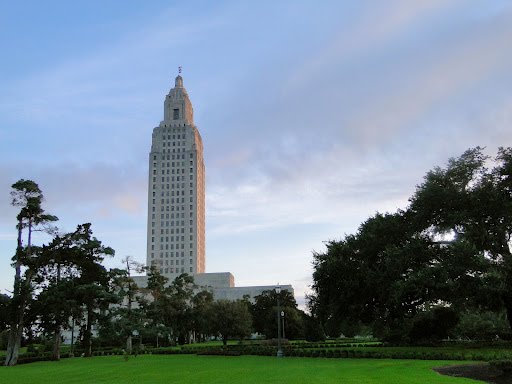
Huey’s Dream
Few who grow up in Baton Rouge can ever forget the majesty of the State Capitol Building, located just north of the old downtown area. At the time of its construction the area immediately to the south was a bustling center of commerce where most came to shop, work, see a movie or attend a function at the old Heidelberg Hotel. From anywhere downtown the Capitol is in clear view, rising tall above all else. It was also a place where teachers from around the state brought their students on day-trips to study and experience a big piece of the state’s history. And for some of us, it provided a huge and rambling playground full of trails, hills, old cannon and a nineteenth century Arsenal overlooking a lake.

Each time I return to Baton Rouge a part of one day at least is spent driving downtown to visit once more (for perhaps the thousandth time) the State Capitol Building, a National Historic Landmark. If nothing else, it’s always eye-opening to have a look at the city from the observation deck of the 27th floor, with its panoramic views of the Mississippi River to the west, and in the south the gardens and downtown below, in the distance Louisiana State University. And after so many years I still take joy in sitting on the big cannon and looking out over the lake.

The Capitol Building began as the dream of Senator and future Governor, Huey P. Long in 1928. As part of his gubernatorial campaign, Huey Long advocated the construction of a new, modern capitol building to replace the Old Louisiana State Capitol, built in 1847. A tremendous and ill-timed project, it became a symbol of the pride, history and spirit of Louisiana’s people. Only a powerful politician could have made this dream a reality. Constructing a large and expensive state capitol building during the Great Depression was testimony to the will and influence of a fierce politician. Call it irony that in 1935 Governor Huey P. Long was gunned down in a hallway of the Capitol Building.

Huey Long hired architects Dreyfous and Seiferth Weiss to design his dream capitol. The architects took as their model another architect’s design for the Nebraska State Capitol Building. The work was done during the depression and completed in March of 1932. Remarkably, it took only fourteen months to put up a magnificent building in the art deco style reaching a height of 450 feet (137 meters) with thirty-four stories. It cost the state five million dollars and included an apartment on the 24th floor for Huey Long.
Twenty-five hundred rail cars were needed to bring in the limestone used on the exterior and the interior marbles from places as far away as Vermont and Italy. Architects used symbolism throughout the design of the building, and as the square tower rises it cuts away to an octagon at the 22nd floor. At this point four allegorical winged figures representing Law, Science, Philosophy and Art guard the four corners. The building is approached by grand steps leading up to the fifty foot high main entrance. The steps are carved with the names of all US states in the order of admittance to the union. The forty-ninth step carries the names of both Alaska and Hawaii. The top step is carved with E Pluribus Unum (‘One from Many’) from the Great Seal of the United States.

Trees native to Louisiana, such as magnolia, live oak, and palm are prominent around the capitol grounds. The gravesite and memorial of Huey Long is a focal point of the park grounds, with a statue of Long standing before a model of the capitol. After being shot in the Capitol Building on September 8, 1935, Long was rushed to the hospital where he died two days later. His last words were, “God, don’t let me die. I have so much to do.”
Thursday, March 29, 2012
Old Roots
On most mornings the thump and crash of waves hitting land, the moan of wind and the whir of a sprinkler head are the sounds that come first through walls and windows shaking me from sleep. By now these sounds are ingrained and perceived almost as a soundtrack, and on those occasions of waking in a different setting I open my eyes confused by the silence. That happened this morning in a Louisiana bed that for some time at least I can call my own.

Out of bed, I wander out to the back patio of Raymond and Dee’s house to sit for a few minutes and absorb the notes and chords of a different soundtrack, this one composed of the chinwagging of unfamiliar birds, the whoosh of tires on pavement and the splash of frisky koi in their tree shaded pond. A cardinal sits on the nearest bird feeder and in his eagerness rattles the seed from its spout. He stuffs himself with safflower, thistle and cracked corn for one guarded minute, until a fat and also hungry squirrel approaches from the limbs above. Three cats twine between the chair legs, occasionally coming by to polish my feet and beg for a scratch under the chin.

Sitting in this arbor of green among Eden-like lushness, it takes a moment or two for my ocean-shaped vision to adjust, to bring into focus a palette not dominated by blue and white. Here it’s all brick and stone against the spreading green of fox tail fern and Louisiana iris. The shrimp plant and angel wing begonias splash their red and green at the foot of a loquat tree and nearby stand their neighbors, the lemon, fig and satsuma trees. It is a setting very unlike the spare and distant perspective of Florida’s ocean shore and a welcome change from the salt and glare that mediate everything there.

Each time I return to this place that colored my childhood, the sense of connection is strong in spite of now unfamiliar streets and development. There is something about it that arouses a feeling of being lost at home. The names on street signs trigger a flash of memory, a teenage face, a 1957 Chevrolet. The missing oak trees on Steele Boulevard, a onetime alley of ancient drooping limbs and extruded roots remind me of Robert R, a schoolmate of those days. The oaks were all cut down after residents along the street complained of giant roots pushing up through the asphalt surface, their road constantly broken by those grandfatherly roots. The house here on Lobdell is several miles east of those absent oaks, in a neighborhood also rich with the remembered tokens of childhood and youth. Goodwood Elementary was the site of many after school basketball games, few of which we won against those red and white clad Cardinals. And at the northern edge of Goodwood only a short walk from this patio is the old municipal airport (now a park) where piper cubs took off and landed.

And so the feeling is like coming home, but to one where I can’t remember well what’s in that old hall closet or where the back bedroom is. A place familiar in so many ways, but brimming with hidden facets that promise to reveal themselves in the coming weeks, a delicious scavenger hunt with old friends among old haunts. Raymond and Dee asked how long I wanted to stay and I suggested a time frame from two weeks to two years.
Friday, July 15, 2011
House of Sorrows
Sitting on a spit of land six miles south of Baton Rouge on the Mississippi River, the crumbling ruins of an old plantation house lie in a picturesque field of pecan and oak trees. Because the river wraps around the land and the former plantation, the setting offers one of the better views found along the River Road. Although destroyed fifty-one years ago, memories of the Cottage Plantation still linger in the minds of some living in Baton Rouge—remembered for what it used to be, what it became and for the ghosts who are rumored to still walk there.

Not many years before fire destroyed the plantation, it was a playground of sorts for several of us, and we went there on many nights to ‘walk with the ghosts’ and to sit under its crumbling columns telling scary tales of blood, murder and vengeance. In those days the grounds were accessible, or at least it seemed that way to a car full of teenagers willing to climb fences. We plotted elaborate dramas and scare tactics to spring on friends, the more elaborate stunts requiring some of us to arrive early, set the scene and then hide among the shadows. We laughed as the terrified girls ran screeching from a ‘ghost’ in flour whiteface, arms pinwheeling with glittering butcher knives but in the long run we all once or twice got scared out of our wits.
At the time not many among my ghost story partners knew much about the old house, apart from it being some old place from the time of the Civil War, and that it was sometimes in the movies. I don’t remember it ever being a subject in our Louisiana history classes. But it does have a story, a colorful one that includes fiery steamboats, yellow fever, occupation by Union soldiers, wandering ghosts and finally crumbling in flames.

The Cottage was built in 1824 as a wedding gift to a daughter and her husband. Considered one of the finest houses in the area, it had 22 rooms filled with imported furniture. Operating as a sugar plantation with 250 slaves, the owners were able to accumulate considerable wealth, and in the years before the Civil War, life was good at the Cottage.
On February 27, 1859 a steamboat bound for New Orleans caught fire on the river near the Cottage, burning to the water, with bales of burning cotton floating on the Mississippi, passengers clinging to them as best they could. Plantation slaves helped pull passengers from the water, while the owner of the Cottage had bed sheets laid out with flour on top of them, a palliative for burn victims to be rolled in. One witness later wrote in his journal: ‘One man approached me wrapped in a sheet with flour covering his face and looking like a ghost. Before I could run away from the hideous object it extended its arms toward me and quietly said, “Don't be afraid, Jimmie. It is me, Mr. Cheatham. I am dying—hold my hand!” then sinking upon the turf beside me. The ghost-like man gave a cry which seemed to wrench the soul from his body. He shivered for an instant, and then lay still. A slave passing by pointed to the body and casually remarked, “He done dead.”’

After the start of the Civil War, life on the plantation changed forever. The Union Army took over the property and removed everything of value, including horses, furniture, jewelry and even the children’s clothing. Troops occupied the plantation holding the family prisoner. When the soldiers finally left, the family abandoned the house and it was taken over as a hospital for Union soldiers with yellow fever. Many died from the disease and were buried on the grounds. In the years that followed, the fact that it was a hospital probably saved it from being destroyed by vandals.
Following the war’s end the family tutor returned to the abandoned Cottage, becoming a recluse and spending his time repairing the old house. He was sometimes seen wandering the grounds of the Cottage with a long, white beard. Years passed and the Cottage stood empty, people living nearby calling it haunted. There were reports of doors opening and slamming by themselves and sightings of ghosts wandering the grounds. In the 1920s, the family began a restoration of the house and in the 1950s it was opened to the public, a museum of the Old South. In 1957 it served as a movie set for the Clark Gable and Yvonne De Carlo picture, Band of Angels.

One early morning in 1960, the Cottage burned to the ground. Firemen later reported that while pumping water onto the flames from the side garden, a man ‘appeared’ in an upper window. Firefighters shouted for him to jump, but he stood not noticing them or the fire around him. The roof collapsed and the man was gone. Searching for the his remains, firemen found nothing. Some say a ghostly figure still haunts the Cottage, passing on dark nights among the ruined columns of a former life.
Monday, November 29, 2010
Starbucks Days


During these Baton Rouge days over the past two weeks Starbucks has been an almost regular stop on my travels around town and country. Not really a signal that the ubiquitous green, black and white logo is a special sort of magnet pulling me daily toward its caffeinated charms, but more a mark of dependance on the available WI-FI Internet connection. In spite of living most of the time surrounded by and embracing the tools and objects of time past, the vintage fountain pens, old spoons and dishes, the preference for books instead of Kindle or iPad, in spite of these and other ‘old-timey’ interests, I have to admit my addiction to being wired up for a little time each day. To get that online fix during these days of vacation at 1051, the nearby Starbucks has provided a solution to connection problems in the house.
Figured if I was going to write something about sitting around Starbucks I could at least find an interesting factoid or two about the company. It was founded in 1971 by three fellows in Seattle, an English teacher, a history teacher and a writer. No one involved is named Starbuck, and the name comes from a character in Moby Dick. The first mate on Captain Ahab’s ship, the Pequod is named Starbuck. The number could be a few more or less, but you will find Starbucks in about fifty-five countries worldwide. The first branch outside North America opened in Tokyo in 1996. By the end of March 2010 there were 877 stores in Japan. If you're planning a trip to Tokyo, guaranteed you will find the Starbucks urge easily satisfied. In more than one part of the city there are even Starbucks on opposite corners of an intersection. One of the best, at least in warmer months, is the larger of three stores in western Tokyo’s Kichijôji area, the one located at the back of Tokyu Department Store with it’s wide and spacious deck opposite The Gap. Comfortable spot to pass an hour or two on a spring afternoon. The photo here was taken at night and doesn’t really do justice to the terrace atmosphere. The Japanese are no different from many in other countries who frequent Starbucks, and hang out there with their laptops and schoolbooks, or a group of friends. They love their coffee just as we do, and I would bet that business is booming there.
These past days have given me a chance to 'eavesdrop’ on conversations and attitudes in a not-very-Cajun Starbucks located at the Towne Centre mall in the Goodwood area of Baton Rouge. It’s an upscale kind of place, and the people flowing in and out are well-dressed and well-spoken. One man I’ve noticed on several occasions always has a thick book from the more difficult shelves; yesterday was The Decameron by Boccaccio. Three girls from LSU like to study here, but you have wonder how much of that gets done between the cell phone texting and the peals of laughter. Business meetings are happening at every other table, and Bluetooth phone calls from every direction make you wonder if you’ve stumbled into a rest stop for schizophrenics. Is it just me or is it hard to get used to people sitting in a chair talking and gesturing to an invisible presence? A note about the Starbucks employees here and elsewhere—No question there are exceptions, but my experiences have always been good whether in Louisiana, Florida or Japan, the service friendly and efficient. Just don’t ask me about the low fat pumpkin brulee holiday frappaccino. I’m a straight coffee kind of guy.
Sunday, November 28, 2010
Breakfast at Parrain’s
Food has lately been at the forefront of conversations and gatherings, probably a characteristic true of many people celebrating Thanksgiving around the country this week. For the more fortunate it’s been a blitzkrieg of eating that has us still groaning with the abundance of it all. Lots of remembered favorites, new recipes and flavors that linger on the palate for a day or two, and a refrigerator half full of leftovers. “Do you want a turkey sandwich?…Hey, how about a piece of mince pie?” Had to answer no this time and confess that I’m full of turkey and dressing. “But hey, let’s jump in the car, take a drive and find a place to have a bite to eat.”
At the risk of overkill, today’s post again features Louisiana food, or the type served at Parrain’s seafood restaurant on Perkins Road in Baton Rouge. Not that old, Parrain’s opened in September of 2001. The waiter offered an interesting tidbit of information about that: The opening was originally planned for September 11, but a slight complication in New York City that morning put a stop to most things, including restaurant openings. In the nine years since then, Parrain’s has become a Baton Rouge favorite for Cajun seafood dishes. The name of the restaurant comes from the Creole-French word parrain for ‘father.’
Sunday brunch at Parrain’s is a popular time, but we got there early enough to get a comfortable table beside a window half full of banana leaves. The restaurant isn’t small, but some sections give the impression of being busier than others, with a loud clatter of dishes and voices. Our table was in a quieter corner. The brunch menu for today offered five special dishes, with the alternative of ordering from the regular menu. The five specials looked pretty good, and we ordered the first choice, something called Eggs Grace. Here is a description straight from the menu: French bread toasted and topped with grilled tomatoes, fried catfish filets and poached eggs smothered with crawfish etouffée and served with grits. It’s a tempting plateful, but maybe more the thing for someone with an appetite. First look makes one wonder if all those flavors are going to work together, and for the purist they might not. Eggs smothered in crawfish etouffée is a combination I first had last Monday in Breaux Bridge, Louisiana, one that I was eager to try again. As for the catfish, it fits right in as long as you eat it still crisp and not drenched in etouffée. The way it is served at Parrain’s makes that easy, with most of the etouffée soaking into the French bread.
But others may opt for the Boudin omelette—a three egg omelette with boudin sausage and pepper jack cheese topped with white gravy and served with grits and a biscuit. Or the soft shell poach—a bed of spicy hash browns topped with a fried soft-shell crab and poached eggs, finished with hollandaise sauce and served with a biscuit.
It might be hard for anyone to eat like this every day, and I can’t imagine many do and still keep a healthy heart, but for a different kind of brunch or breakfast, these Creole recipes are a delicious alternative. I will miss them when I return to Florida in a few days.
Sunday, November 21, 2010
Flowers from Japan
A big part of Saturday echoed with the roar of football crowds cheering hometown teams. Around here the roars were for the guys in purple and gold. Not an easy victory, but LSU managed to somehow squeak by with a winning touchdown. A good win, no doubt, but a performance that left many fans wondering how the team they watched today will fare next Saturday against an Arkansas team that looks mighty strong, at least on color TV.
Today I am trading in football for drama. Once upon a time I played football, and like many of my young teammates dreamt of later glory on the scrimmage line in LSU’s Tiger Stadium. But that all got bumped aside when I discovered the fun of playacting in school plays. Suddenly the interest turned from floodlights on the playing field to spotlights stage right. After the school plays came community theatre and involvement with the Baton Rouge Little Theatre. There has always been a warm spot in my memories of the time spent doing plays and musicals there. The last production I saw there was West Side Story, directed by my lifelong friend (and current host), Dee. That was about ten years ago. On the boards now is that old Frederick Knott chestnut, Dial M for Murder. I will be in the audience for a performance later today.
Raymond’s lagniappe…
‘Forty or forty-five years ago, the Beatles at City Park in New Orleans.
Sitting high in the small stadium makes everything small in the photographs taken. Small people dashing toward the stage in the end zone, some avoiding tackles by the police, one policeman’s hand high on the thigh of a young girl he tackles, her dress gathering in folds at her waist.
Later, after the concert, walking French Quarter streets, watching couples, avoiding bums on dark corners with their hands extended, glancing in store windows at the reflection, exhilaration now a sense of loss, old buildings and smelly streets of uneven brick better than the drive back to nighttime marsh.’ —excerpt from Southern Snapshots
Note on the top photograph: An autumn flower arrangement by a good friend in Japan. The three components are kaki (persimmon), kiku (chrysanthemum) and the tiny purple umonodoki flowers, a name I do not know in English.
Saturday, November 20, 2010
Acorns & Earphones
Still surprised by the winter-like chill of these Baton Rouge mornings. Outside now on the patio but suitably layered in enough cotton and denim to buffer the cold. Helps too to have a steaming cup of Community coffee and a warmed up leftover sweet potato hushpuppy from last night’s dinner. The light is good here beside the small pond dancing with bright orange carp. It filters through the leaves and falls to the brick in restless patches that jitter in concert with the breeze nudged leaves overhead.
Light, breeze and chill aside, this hour on the patio is bound up in Florida responsibilities and the necessity of making a telephone contribution to HOA affairs, attending by phone. In all truth, if one has to attend a meeting, a sun-glazed patio sounds a better spot than a clubhouse meeting room. But the fact that I’m on holiday and eager to spend the time with friends usually absent makes sitting still with cellphone earplugs tedious and antsy.
The birds have returned. Dee was elbow deep in her seed mixing pots earlier and the garden feeders have been filled. Redbirds are still holding their distance, waiting perhaps for the first rush of hungry birds to thin out. A mockingbird overhead is now singing out the news of fresh seed.
LSU football is on the agenda today, the long well-worn rivalry between our hometown Tigers and the boys from Ole Miss University in Oxford, Mississippi. The pre and post game traditions of Saturday football are elaborate in this part of the south, and we have something of a party planned here at 1051, with friends coming over to watch the big gridiron clash between the Tigers and Rebel Bears. I have for years been removed from these celebrations and now find that somehow the excitement is coming back with the anticipation.
Raymond’s lagniappe…
‘In a Jamboree game at Memorial Stadium we run the reverse five times and then Bill fakes the handoff and half the other team comes charging through the line to smear me for a loss; just before they do I show empty hands and we all turn and watch as Bill weaves his way downfield. I run for a long touchdown but it is called back and the shortened game ends scoreless. The rest of the games we win, many of the players going on to play junior high and high school ball. Although we go out for practice in the seventh grade a few times, Bill and I discover DRAMA, realizing football practice takes places at the same time as rehearsals, girls without pom-poms more plentiful around the stage, recognition coming without battering heads and bruising bodies.’ — excerpt from Swimming Underwater
Friday, November 19, 2010
Catfish


Went wandering yesterday around southeast Baton Rouge and somewhere along the way bumped into a Barnes & Noble bookstore. Very probably my car sniffed it out all by itself, a skill picked up from other wanderings. The Toyota has reminded me on more than one occasion that its favorite place for resting is the parking lot in front of a bookstore. Who am I to argue?
For a list of reasons, the Barnes & Noble I browsed yesterday was more inviting than my usual B&N in Daytona. The arrangement of books is easier to follow, there are more armchairs for reading in a mush of comfortable cushions and the shelves holding new fiction are fuller with more titles. Not sure I understand why that would be, but it could be because this store is designated as a superstore. Whatever the reason, there were three or four titles I wanted to buy, but managed some often absent control and in the end bought only one.
Dog Stories, from Everyman’s Pocket Classics is a handsome little volume of stories from an impressive list of writers who include Anton Chekhov, G.K. Chesterton, Rudyard Kipling, Jonathan Lethem, Doris Lessing and fifteen others. As the title implies, the stories all revolve around dogs. After reading Lethem’s story of Ava, the three-legged and full of love pit bull, I knew the book had been a good buy. “Garm—A Hostage” by Rudyard Kipling is a gem of a tale set in colonial India and about a bull terrier of extraordinary intelligence. Some will call Kipling an acquired taste, but this story is fueled by a bond of love and trust that would affect the most dour of readers. In another story by Patricia Highsmith, we meet an aged dog living with a cruel and uncaring master in a New York penthouse. Highsmith is famous for her fiendish characters, but this time the ending is happy.
Good collection. Give it a look next time at the bookstore. Dog Stories, edited by Diana Secker Tesdell; Everyman’s Pocket Classics 2010.
For dinner last night we went to the Acme Oyster Bar for a grand feast of grilled oysters, fried catfish stuffed with crabmeat, crawfish etouffee, red beans and rice and gumbo. Let no one tell you that Louisiana is without a classic cuisine. This Creole-Cajun style of cooking has its origins in the old dirt floor kitchens of poor people from south Louisiana, but its rich and earthy flavors have tamed giants. If ever the question arises, ‘Why should I go to Louisiana?’ the answer is simple: Go for the food.
Raymond’s lagniappe…
‘That first real 35mm camera, a Topcon D-1, black, about the size of an open hand, carried everywhere when young, plenty of film to shoot the dark water of the Mississippi reflecting blue sky and green trees along willow-choked banks. Those black and white negatives from the Topcon show river traffic from the levee in Baton Rouge, crowded Third Street, the Sears store, Walgreen’s Drug Store, the Paramount Theatre, Piccadilly Cafeteria where black men in white shirts carried food trays to the tables for tips, the Istrouma Hotel, Liggett’s Drug Store, H.J. Kress with toy-filled windows, the City Pawn Shop, and Claitor’s Bookstore in the hot summer stillness, the sagging shelves crammed with adventures, the memory of them like a photograph.’ —excerpt from Southern Snapshots
Wednesday, November 17, 2010
Walking Under Oaks

The long drive yesterday from Florida’s east coast to Baton Rouge, ark of my childhood, took a lot out of me. But eleven hours behind the wheel will do that, and arriving car-tired was little surprise. A hot shower washed a good bit of the tiredness away, and seeing again my two oldest friends, sitting together, talking, laughing, remembering—It was like an adrenaline shot straight to the heart. How much better can the hours and days ahead get?
Things are different here in the land of Tabasco, oyster po-boys and pecan pralines. Sort of figured I would sit in Raymond’s house and be granted instant Internet access on this MacBook Pro, with WI-FI snaking invisible from inside the house walls and embracing the laptop. As it turns out the Bluetooth and WI-FI are dead in the water at 1051. Looking into the why of that today, but for now the nearby Starbucks offers an easy solution.
Walked early this morning for a long distance on Sevenoaks Avenue. Of course, I remember it all from the years of growing up here, but once again the droop and swag of huge old oak trees captured my heart and gave a lightness to my step. This area is one called Old Goodwood, and is a place where building was conceived as non-invasive residential architecture, and where ground plans were laid out around and between tall moss-draped oak sentinels. There is a feeling almost of breathing green. Walked past Goodwood Elementary and recalled the afternoon basketball games, halcyon days when twelve year-old boys in blue and red challenged the boys in maroon and gold, and pert, red-haired Nannette cheered us from the bleachers.
Been my hope for awhile that friend Raymond might be willing to add some native thoughts to my Louisiana impressions, a perspective of his own. Let’s call it lagniappe—a Cajun word for a little something extra.
‘Nights with a breeze blowing in from across the Amite River, no glow from Baton Rouge in the distance, pull a mattress out on the porch of the camp and sleep with sounds of crickets and frogs near, and when waking during the night to turn over, opening eyes like a camera lens and seeing the lightning bugs flickering among the dark trees. Wishing it could be but knowing the impossibility of truly capturing for memory this fresh everydayness.’ — excerpt from Southern Snapshots
Wednesday, September 1, 2010
The Smell of Childhood
Ed Cullen has been writing for the Baton Rouge newspaper, The Advocate for more than thirty years. He has been featured on NPR’s All Things Considered frequently since 2001, and from that came the idea to put together a collection of essays in book form. The result was the 2006 collection called Letter in a Woodpile, published by Cool Springs Press. The book offers in slightly different form forty-nine of Cullen’s essays that first appeared in The Advocate, and in some cases those heard on NPR.
A Louisiana native, Cullen’s writing brims with the mannerisms and idiosyncrasies that so richly describe his hometown and surrounding parishes. His subjects are centered in neighborhoods, backyards and side streets, all enhanced by particular sounds and smells that throb with southern Louisiana authenticity.
The forty-nine essays are a spicy gumbo of observations, strolls, car rides and simple encounters over the years of growing up and living in Louisiana. In a similar manner Alfred Kazin did the same thing with New York in A Walker in the City, and Studs Terkel with Chicago in Talking to Myself. What each of these writers offer their readers is an almost tangible flavor distinct to its locale.
My introduction to the work of Ed Cullen came long, long after I’d left my Baton Rouge hometown. Four or five years ago I was listening to NPR in Tokyo and heard an essay that identified Louisiana in the first sentence. It was Ed Cullen reading his short essay, “Aroma Inventory.” It had been some time since I’d been thrust so wholly back into the sights and smells of my childhood, and I quickly made a note of the writer’s name. Some time later I discovered Letter in a Woodpile and quickly ordered a copy. Without plan or expectation I received a signed first edition shortly afterward.
Here is an excerpt from the essay, “Aroma Inventory” that caught my attention on NPR…
‘One afternoon, dripping from mowing the yard, I sat in the shade drinking ice water, and the smell of Tanker, the yardman of my childhood, ambled up.
Tanker worked hard in the summer and didn’t bathe unnecessarily. His smell was more than human. He smelled like a rotting tree in the woods, the edge of a bayou, a pile of leaves. He smelled like the oil on the blades of his push lawnmower. He smelled of sweat stained khakis, ruined felt hat, and big leather shoes his feet had pushed over to look like speedboats making tight turns.
I imagined that Tanker smelled like the pioneers in my school books.
I think of Tanker and I think of the summer smells of long ago—heat rising through the crape myrtle blossoms at street’s edge, storm drains, the exhaust of passing cars, wet dogs. When the air was still and hot, you could smell a woman’s perfume above the sidewalk three minutes after she’d walked by.’
Monday, July 26, 2010
340 (3)

FINAL PART OF A SHORT STORY BEGUN ON SATURDAY, JULY 24.
•
I slipped the key in the front door, not sure what to expect. The last family renting the place had left three months earlier without giving any word of their move. Polite but vague over the long distance of telephone calls, the middle-aged housewife, used to say, “You gon’ get that rent check ’fore you know it, Miz Lillian. Don’t you worry none.” Her husband was a carpenter and was happy to fix things around the house whenever we paid for the materials.
Behind the front door was a still and lonely diorama of household deterioration. A living room smelling of dust, a room where countless Christmas presents once spilled their bounty, where I wrestled with dogs, and where on late nights my sisters made out with boyfriends in the dark. A floor that used to creak when a delinquent son came sneaking in after too much rum and Coca Cola at Sammy’s Lounge. But those presents, that dog, the creaking floor happened in another room. Couldn’t be this room that now stung my eyes with its show of dirt and neglect. A rancid hole of four walls scattered with the scrap, the trash of nameless temporary lives. Several bent and tarnished forks and spoons, a tilted chair without legs enough to stand, a half-melted toy robot, an old plate grubby brown with petrified spaghetti, the metal grit of old screws and rusted nails. Over the scarred mantelpiece an empty frame hung lopsided.
Slowly from room to room, finding hardly more than garbage and shattered toilets. I lingered for ten minutes in my old room, running my finger over still legible pencil scratches on the wall. On some sweet with memory night long ago I lay on the cowboy patterned bedspread keeping count on the wall the number of times WLXK played an Elvis or Fats Domino record. The bedspread was brown and red and smelled like my Sabre, a dog I adored and who spent most nights on that bed.
“Wilmore, did you know that Mama threatened one time to burn this old house down?” Lillian stood in the door behind me.
“Didn’t know that. She should of.”
“Lemme show you something.” Lillian pulled on my sleeve turning me back to what had once been a bedroom, then later a dining room of sorts.
Faint, but still visible under several coats of dull paint, were six or seven scratches in the doorframe between kitchen and dining room. The lowest was at about knee level, and above that other scratches an inch or two higher, rising to something like three and a half feet. Lillian rubbed a finger over the marks.
“That first mark there low down is thirty-three inches off the floor. You were three years old. I remember mama standing right there at the stove frying okra, saying to me, ‘How tall is that baby brother now?’ This one at the top was the year you started school…can’t remember how tall you were then…What does that look like, about three and a half feet?”
“I don’t remember much of this here, but I’ll tell what I do remember from around that time. Can’t recall the details, but I do remember me running after you with a worm I found in Daddy’s garden. You were screaming and running, trying to keep a row of tomatoes between you and that long ol’ worm.”
“Oh, Wilmore! You did that to me so many times I got to where I was afraid to go out in the garden when you were in the back yard. I get the shudders just thinking about those nasty worms. Don’t you remember how L.T. from over at the shop used to come and ask Daddy for some worms outta his garden? Wanted to go fishing?”
“Yeah, I remember that,” I said, rubbing my own finger over those doorframe scratches. It was a small light in my memory, one that flared like a falling star, then disappeared. Lillian on the other hand had all the stories of my young childhood. It was she who spent part of each day looking after me, pulling me away from the shop trucks, picking me up when I fell off the bouncing red rocking horse. It was she who spanked me for licking all the glue off a roll of stamps, who cooked half the suppers I ate.
Most afternoons, when Mama and Daddy went off to the golf course I was left in Lillian’s care, an arrangement that continued for four or five years, until I was old enough to play in the shallow end of the golf course pool, and Lillian was old enough to have eyes for Glen Earl, the boy she eventually married.
Stepping over a rusted toaster at her feet, Lillian shook her head, saying, “Come on. Let’s get out of here. This place is depressin’ me.”
“Give me a couple of minutes to crawl up in the attic and see if there’s anything up there Annice Loyd left behind.” Something about the place was making Lillian nervous. Maybe it was her impatience with being in a house she had once said good-bye to years ago, never counting on being an eye witness to its uncomfortable demise. I would have stayed there for hours pouring over every surface and pawing through every corner, but I too knew that ultimately it would bring pain.
The attic was an ocean of brittle old cardboard boxes. The unstirred air was fetid and heavy and caught in my nose. A weak ribbon of yellow-gray light shone through a window at the other end of the attic, illuminating the only once-living thing still in this neglected loft, a silver Christmas bulb, still shiny and caught in a swirl of dusty angel’s hair. How long, I wondered, since this forgotten ornament in its dusty corner had been on a tree.
I locked the front door and moved down the front steps but then stopped, went back to the door and with a pocketknife pried loose from the gypsum siding the house numbers 340.
About Me
- Bleet
- Oak Hill, Florida, United States
- A longtime expat relearning the footwork of life in America