Showing posts with label Beach sights. Show all posts

Thursday, February 17, 2011

Not Exactly Bubble Bath

Back in the old neighborhood Ward’s Creek had a bad rep. It was one of those nasty slivers of questionable water and other nebulous ‘ingredients’ that made even an eleven year-old boy’s lip curl with creepy uncertainty. We were ‘careful’ about playing near the creek, but probably not anywhere near as careful as mothers could wish. It really didn’t take a scientist to look into the slimy swirls of Ward’s Creek and see that some of the stuff bobbing around in the water didn’t belong there. Bootsie once told me that he knew a boy who fell in, and two days later caught the polio and was living in an iron lung. That story should have put the brakes on anyone with an eye to playing on the banks of Ward’s Creek, but it never did. The point of this recollection about a dirty stream in my childhood is connected to the nasty yellowish foam that was always in the water of that creek, or lodged against the rocks and clumps of garbage. Of all the possibly dangerous gunk that floated in and on that water, the one that scared us most was that godawful foam that hung on like poisonous meringue. That we steered clear of.


It took awhile but today I finally made an effort to find out just what that dirty old foam is. Ward’s Creek is now 750 miles away but the name and memories of it were called back this morning by the excess of sea foam that decorated the Florida beach outside my door. In any season a long walk along the Atlantic will provide something new to see as long as the walker isn’t too wrapped up in either iPod or cellphone. Birds one day, shells the next and who knows what the next. Today is was heaps and puffs of sea foam piled liked fallen clouds bobbing and jittering on the sand. Why today? Why never before in my months of daily walking? I spent a little time looking it up.


Sea foam or spume is created by the natural agitation of seawater and on most days is seen as nothing more than the usual curly white foam that rides on the back of incoming surf. There are times when the usual becomes multiplied by higher concentrations of dissolved organic matter from a breakdown of algae blooms offshore. Chemical compounds in this breakdown work as a super foaming agent. There are several things like fat and protein involved, but in layman’s terms the seawater is churned by breaking waves in the surf zone, foaming agents (chemicals) in the turbulence trap air and form continuous bubbles that stick to each other because of surface tension created by the chemicals from the algae. The low density of these foam heaps makes them shiver and sometimes blow along the sand.


Comforting to think that on this pristine beach where water and meager amounts of sea foam frequently splash against my feet and legs the foam is harmless. That isn’t always the case. There is a Ward’s Creek version of sea foam that appears on some beaches around the world. In areas where polluted stormwater from rivers or drains empties into the ocean beaches can be polluted with foam containing viruses and other contaminants. There is a type of harmful algae bloom along some coastal areas that creates foam causing skin irritation and breathing difficulty.


Two of the photos on the right give a good picture of how the chemicals from the algae appear under close view. In one it looks as though a handful of jewels have been scattered in the foam, and in the magnified view at the bottom the colors are richer and it looks very much like two black figures stand framed inside bubbles.

Sunday, December 19, 2010

Elegy for Catfish

A walk on the beach in Florida can take on a multitude of shapes. Depending upon such influences as sun, wind, rain, tides and season, the fundamental trio of ocean, beach and sky shifts daily through a cycle of patterns ongoing in their variety. Just when you think you’ve recognized something predictable in the daily scene, a twist in the weather brings on a sudden surprise in the tenor of that walk on the beach.


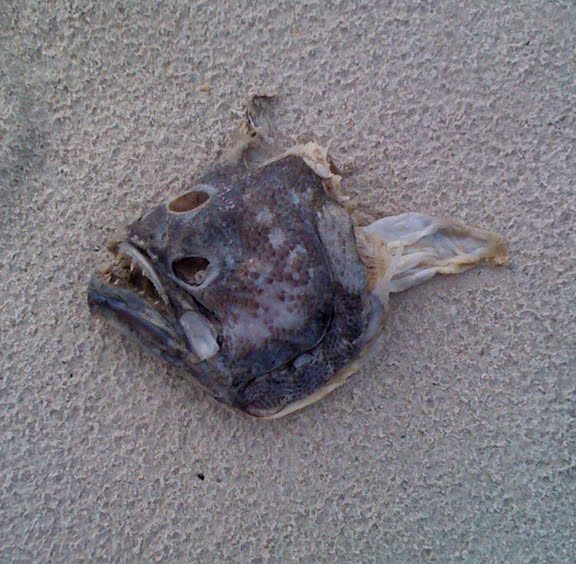
This week the twist is cold ocean water and its effect upon catfish and snook. In daily walks the past few days I have seen an increasing number of catfish washed up on the beach, some newly dead, others half picked over by scavenging birds. Not nearly as many, but the same is true of snook. My initial thought was that the phenomenon is related to the temperature of the ocean. A call to the New Smyrna Beach Wildlife Services confirmed that guess. According to the person I spoke to, from Flagler Beach south to Vero Beach, a stretch of about 100 miles, the ocean temperature this week is low enough to cause shock among catfish and snook. The shock disables the fish as far as swimming goes, leaving them helpless against tide and surf. Thrown onto the beach they are stranded at the surf line, quickly becoming a fresh dish at the grand and sandy beach buffet for birds. Onshore temperatures have been higher the past three days and birds are more numerous now. Their numbers though are still too few to handle the large influx of beached fish. For the time being, what you see are many fish only half-eaten. But this environment, whatever the season is supremely efficient in processing the non-living, and the passage of several days will find a beach cleansed of these partially eaten carcasses.


As for us two-legged creatures who frequent the beach, temperatures are back in the 60s and 70s, and the walking is optimum, if a little ghoulish with the sight of so many eyeless fish heads.

Saturday, December 11, 2010

The Democracy of Nature

Not every walk on the beach holds promise of sights that inspire or elicit praise of nature’s beauty. It is at times a cruel environment that on occasion exhibits a reminder of the axiom, ‘survival of the fittest.’ In these human eyes life at the water’s edge is often viewed through a perspective perhaps a shade romantic and far from the up close reality of the life forms that call it home. In another world our textbooks and politicians talk about democracy, but those words and descriptions bear little resemblance to the true democracy of nature. For here, in the natural world beyond human intervention is real democracy, one that recognizes no distinctions in the turning of its coils, that cares little for weakness, kindness or empathy, and goes about its business as casually as we would swat a fly.


More than once I have written of my enchantment with the pelicans that soar up and down this beach day after day unending. To my eye and my understanding of the concept, their flight exemplifies perfect grace, and there is never a time when I might ignore their overhead passage, or their long low glides over the ocean’s surface.


I have heard that for pelicans aging is especially unkind, that blindness followed by starvation is too often their fate. The daily and countless dives into salt water eventually destroy their vision, leaving them helpless to find fish and feed themselves. But here again is the survival of the fittest.


Today I came upon a recently dead young pelican. From the appearance of the bird, a male, he had died there on the beach no more than four or five hours earlier. The wind was strong and blown sand had layered much of his body, but there was nothing to indicate a frailness or cause of death. As I approached, a vulture, itself sleek and handsome and unlike its ugly cousins elsewhere, was pulling at the pelican. He flew off, but some time later on my return northward, it had come back and called its mate as well, the two of them busy over the pelican’s body.


In his poem “Out, Out—”Robert Frost wrote: ‘No more to build on there. And they since they were not the one dead, turned to their affairs.’ Words that sound unfeeling, but reminding us that in certain things we are helpless.


So I left the pelican to his fate, turning for home.

Thursday, November 4, 2010

The Floating Mouth

Seems like a lot of people see a jellyfish and get the heebie-jeebies. On that account, there are certainly times when walking on the beach or swimming in the ocean are definitely not something those folks want to do. Jellyfish don’t bother me very much, and I’m not particularly concerned I might be stung when swimming in the ocean. Though I’ve been spared, it does happens on occasion; people get tangled up with a jellyfish and come out of the water none too happy. Where I’m situated on Florida’s eastern coast, it isn’t a problem that anyone need worry too much about. Painful encounters with jellyfish are not that frequent. More often than not, the jellyfish one sees on this stretch of beach are washed up onto the sand in a very visible blob, and easily avoidable. The photographs here are what you see a fair amount of on the beach, depending on currents and tides. There must have been a huge colony of them in the drift last night, because I passed a hundred or more of them on my walk this morning.


The common jellyfish in these parts is the Aurelia aurita, more commonly called the moon jelly or jellyfish, sometimes the saucer jelly. It is from five to forty centimeters in diameter, and depending upon the stage or phase of life, either clear jelly throughout, or colored by pink or purplish patterns. Most conspicuous are the four reddish gonads forming a clover-like shape in the center of the body mass.


The jellyfish is capable of only limited movement on its own, and even when swimming gets most of its movement from ocean currents. The animals’s primary aim is to stay near the water’s surface, whether by current or its own swimming. Food is most plentiful near the surface. Jellyfish are carnivorous animals and feed on plankton, which includes mollusks, crustaceans and young worms. They will also feed on other jellyfish. The tentacles, with their stinging cells are sometimes used to catch small fish.


Like anemones and corals, the moon jellyfish is an invertebrate, with a sac-like body, mouth and tentacles. It is made up of more than ninety-five percent water, and basically just a floating mouth and digestive system. They have no brain, no blood and no nervous system; have neither lungs or gills or tracheal system of any kind. They get oxygen by diffusion through their thin membrane. Aurelia jellyfish rarely live more than several months.


Fishermen do not always appreciate the presence of jellyfish, because they eat the larvae of commercially important fish. Jellyfish can also cause an outbreak of algae blooms, which neither fishermen nor tourists like.


Remember that the bell-shaped body of a jellyfish cannot sting, though it may be sticky with mucus. Should you be stung while swimming, aside from the pain, the sting is usually harmless. The best treatment for a jellyfish sting is household vinegar or—of all things—urine.


The movement of these strange creatures is truly beautiful to watch. Take a look at the short YouTube clip below.

About Me

My photo
Oak Hill, Florida, United States
A longtime expat relearning the footwork of life in America