Showing posts with label Donald Richie. Show all posts

Tuesday, February 19, 2013

An Extraordinary Life


DONALD RICHIE
APRIL 17, 1924 — FEBRUARY 19, 2013 

‘Winter 1947… Tokyo lies deep under a bank of clouds which move slowly out to sea as the sun climbs higher. Between the moving clouds are sections of the city: the raw gray of whole burned blocks with the yellow of new cut wood and the shining tile of recent roofs, the reds and browns of sections unburned, the dusty green of barely damaged parks, and the shallow blue of ornamental lakes. In the middle is the palace, moated and rectangular, gray outlined with green, the city stretching to the horizons all around it.
The smoke of early household hearths, of newly renovated factories, of the waiting, charcoal burning taxis, rises and with it the freshness of late winter, the bitter yellow smoke of burning cedar shavings, the smell of breakfast: barley, sweet potato, roasted chestnuts. In the houses the bedding is folded into closets and tatami mats are swept.

18 April 2004… I wander into the future—Roppongi Hills, an enormous complex of high-rise buildings, including a mighty tower near where I used to live. This is the new Japan—gargantuan, expensive, and wasteful. There are, to be sure, concessions to tradition (trad but mod) in the transplantations of zelkova and gingko trees, all of them expensively mature, and in such touches of the Japanesque as a pocket garden here and a teahouse there. But Keyakizaka Street is lined with Louis Vuitton, Hermès, Gucci, Bulgari, and other high-priced merchants. These are matched by the kind of restaurants now called cutting-edge, which are far too expensive to eat in. People who work in the tower complain that they have to leave the Hills and walk far away to find a place to have an affordable lunch.’                                  — Donald Richie, The Japan Journals 1947-2004

During almost thirty years in Japan one of the greatest influences on my understanding of the country and its people came from another American who devoted more than a half-century to living in and writing about the country. Beginning on January 1, 1947 and continuing over the next sixty-six years, Donald Ritchie’s voice and eye penetrated every aspect of the Japanese experience. From the homeless and destitute to the honored and privileged elite, Mr Ritchie’s observations and insights penetrated everything from art to film and literature, on down to back alley porno shops and ten dollar prostitutes. As much as conversation with the celebrated Kurosawa Akira and Mishima Yukio, he was just as happy to sit on a park bench and talk with someone living in a cardboard box who never rose above the drudgery of manual labor.   

Donald Richie was born in Lima, Ohio in 1924. After graduating from high school he traveled to New Orleans where he was working at the time of Japan’s attack on Pearl Harbor. He was spared the Army by entering an officer training program with the US Maritime Service where he served as an ensign-purser and medical officer during the war years. In 1946 he found work with the US Civil Service and on January 1, 1947 arrived in Japan. For the twenty-two year-old neophyte it was love at first sight.

Except for the years spent at Columbia University from 1949-53, and another four years in New York as Curator of Film at the New York Museum of Modern Art from 1969 to 1972, Richie spent the remainder of his life in Japan. His writing on Japan includes books, articles and stories too numerous to count. There would be little exaggeration in calling Mr Richie Japan’s single greatest cultural bridge to the west.

In his 1971 landmark book, The Inland Sea, the writer observes early in his travels…
‘A journey is always something of a flight. You go to reach, but you also go to escape. I am going to see the islands and all that they seem to promise, but, at the same time, I am going to escape the mainland and all that I already know it contains. I find less fault with Japan than with the century that is destroying this country along with all the others. Now, to escape is no sentimental gesture, it is survival.’

Standouts among the more than forty books by Donald Richie

Saturday, January 29, 2011

Big City Flavors

Friday was a town day, beach and surf fading in my rearview mirror not long after ten o’clock, car’s nose pointed west toward the Toyota dealer fifty miles distant. Time for another of those maintenance checks. Sometimes I wonder if there’s anyone more helpful, courteous and efficient than the people at Toyota.


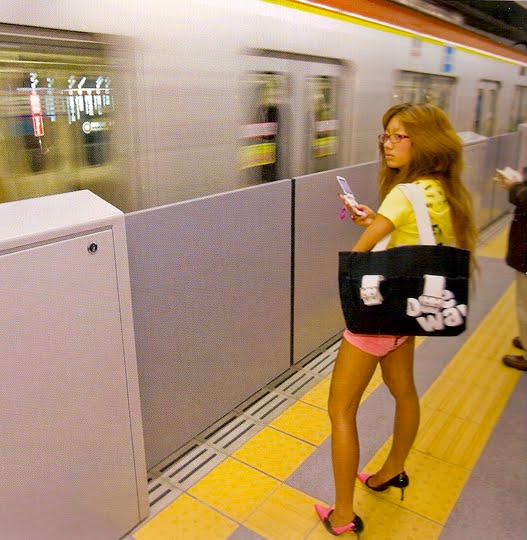
So, I was late getting home and after looking through the empty refrigerator for dinner material and then flopping in a chair with Bacardi and Coke to watch the fading light and darkening ocean, it eventually came to me that I hadn’t given any thought to writing some niblets for Scriblets. Pondering on that while the level in my glass slipped lower and lower, I remembered a recent book with page after page of dazzling photography. Tuttle Publishing put out in 2010 a new collaboration by Donald Richie and photographer Ben Simmons called Tokyo Megacity. It’s another of those large ‘coffee table’ type books that present all the good, beautiful, lyrical, modern, traditional and attractive things about Tokyo, megalopolis supreme. Below are a few favorite photos from that book.


Spring visitors stroll the hillside azalea gardens during a fine mid-April afternoon at Nezu Shrine.


His venerable old family speciality shop offers senbei crackers in Sendagi.


A young woman waits an arriving Fukutoshin Line subway in the Chichusen.


The modern fashion accessory, the cellphone, handy for coordinating a schedule and keeping in touch with friends.


A sarariman (office worker) passes through an old alleyway in Shimbashi.


Masterpiece tattoos revealed during the heat of the Sanja Festival.


The Yurikamome Elevated Railway glides past behind a fluttering Japanese flag.

Saturday, January 15, 2011

A Seated Mountain

My longings continue to revolve around Japan, my reading more and more of a type to feed wistful thoughts. The Donald Richie journals are again coloring the memories, reminding me of that marvelous comment by Pico Iyer that Richie has made his life in Japan and in doing so has made Japan his art. Few observers of the Japanese scene have the eye that sees what Richie does, and when his vision lands upon the rare or non-public setting, the reader feels then the very breath of that moment on the back of the neck.


Turning through his journal pages today with no real direction, looking for this or that passage remembered from an earlier reading, I came upon this entry about a visit to a sumo stable. Unlike the changing generations of Japanese young people celebrating Coming of Age Day, the glimpse offered below is of a solidly traditional and unchanging corner of Japan, the same now as it was in 1700.


5 MAY 1978

With Lynn Levy-Matsuoka to sketch the sumo wrestlers. Met her on the other side of the river in Ryogoku, center of the city in the eighteenth century, now all warehouses. The sumo stadium is still there, however, and so are the stables of the wrestlers.

It is a small world of its own, and a closed one. We are admitted by six-foot apprentices in stiff loincloths, and then sit on the dais and watch the practice. This consists of one young wrestler after another trying to push the head wrestler, an enormous man, from the earthen ring. He does not budge—then slaps them to one side and they roll to the ground. One after another they take their turn. The man stands there like a mountain.

Lynn sketches—her strong line holding the bulging form, suggesting the latent force. When practice is over all the wrestlers go to take a bath, and we are invited upstairs to watch them and then eat with them. A large tatami room, their wash drying at the windows, a long low table, and a big kitchen, since they eat a lot. The younger wrestlers already busy, grating daikon, slicing squid and cabbage, their enormous fingers awkwardly holding knives and chopsticks—all still in their stiff loincloths as they stand, sit or squat. It is like a boys’ school, or like a barracks.

It is also like a stable. The men are so enormous that they are like animals—fat animals, with slabs and rolls of meat and wide, vacant faces. And they behave with the silent deference of beasts, swinging their heads. I am bid to eat with syllables and lowered eyes and an awkward hand. In contrast, the oyabun, a seated mountain, is at ease and it is I who defer to him and use my most polite language, sitting properly all through the meal on my aching calves.

Theirs is a world of order—the old order where differences in station are never questioned. Without a word, he holds out his rice bowl and a young wrestler hurries forward, eyes averted, to take it. The older man leans on an elbow, his strength, his visible power, making him appear arrogant. As he eats, another young wrestler squats and massages his thigh. In the corner of the kitchen, two more young wrestlers whisper, hug each other, and giggle. He pays no attention, shaking his head as though a fly is bothering him—a very intelligent bull. All of this Lynn captures with her pencil, this whole Genroku world she is so in love with, this living remnant of old Edo.


Note: The drawing of the sumo wrestler is one by Lynn Matsuoka.

Wednesday, January 12, 2011

Journals

Last night I finished a book by a writer who could be called, or classified ‘foreigner in Japan.’ The book was Tokyo Central and the writer Edward Seidensticker. It is a memoir in great part, of the years spent in Tokyo and is a good book for one interested in such experiences. What I found surprising was that in the book’s entirety, not once did Mr Seidensticker write of his longtime friend and fellow expatriate, Donald Ritchie, with whom he shared experiences over many years of living near each other in Tokyo’s downtown Bunkyo-ku. To this day Donald Richie continues to live in Tokyo, there since 1947, and in the same apartment for over fifty years. The interesting thing about Richie is that while his friend and fellow American translated an impressive list of Japanese novels and stories, Richie, though certainly fluent in the spoken language, still now does not read or write Japanese. But do not misunderstand; his knowledge and understanding of the country is exemplified by the more than forty books he has written about Japan.


Probably because of the conspicuous absence of Richie’s name in the just read Seidensticker book, I pulled off the shelves one of my favorites of the Richie oeuvre, The Japan Journals: 1947-2004. In many ways Richie’s telling of his experience in Tokyo is much more colorful and human. There is too often the impression with Seidensticker that he is overly careful in concealing that he may once or twice have gotten down and dirty. As far as memoir goes, there’s little earthiness to his well written paean of days and nights in Tokyo. Richie gives us the grime on the bar counter, the prostitute’s sad tale, all rich in the multifaceted textures of life in the world’s largest and at times oddest city.


One of my favorite passages from the Richie journals is from late summer 1947, from his earliest days in Tokyo and long before his settled longterm residency:

‘Wandering in the city after work, smelling camellia hair oil, dusty long unaired kimono, the passing night soil wagon with its patient ox, listening to the incomprehensible murmur of conversation around me, looking into eyes suddenly averted, I try to make sense of what I see.

In a way it already makes sense—Tokyo in ruins still reveals something known from Chicago, New York and during the war, Naples, Marseilles: the look of a big city just anywhere. In another way, however, I begin to apprehend alternatives to things as I already know them…

Another country, I am discovering, is another self. I am regarded as different, and so I become different—two people at once. I am a native of Ohio who really knew only the streets of little Lima, and I am also a foreigner who is coming to know the streets of Tokyo, largest city in the world. Consequently I can compare them, and since comparison is creation, I am able to learn about both.’


For those interested in a more diverse example of Donald Richie’s writing, it is hard to go wrong with the delightful 2001 book, The Donald Richie Reader.

About Me

My photo
Oak Hill, Florida, United States
A longtime expat relearning the footwork of life in America