Showing posts with label Fairy Tales. Show all posts

Friday, October 14, 2011

The Stork Bit Mother

A lot of books around here, and with a good allowance of free time, the hours frequently lead to unexpected places. From a nudge in the direction of birds I wound up Thursday in a book of Hans Christian Andersen fairy tales. Going from large birds to storks to myth, the dots eventually connected with the well-known author of fairy tales, and a story about storks.


“Yes,” their mother agreed…“I know the pond where all the little human babies lie until the storks come to take them to their parents. The pretty little babies lie in that pond, dreaming more sweetly than they ever dream afterwards. All parents want a little baby, and every child wants a little sister or brother. Now, we’ll go to that pond and bring a little baby sister or brother for each of the children who didn’t sing that wicked song or make fun of us. But those that did won’t get any.” —from Andersen’s 1838 tale “The Stork”


Can’t say that the notion of storks delivering babies was ever talked about in my family, and though it was a common enough idea among most in the early years of my own childhood, it’s doubtful that it ever got past the status of pure fairy tale. And though it was Hans Christian Andersen who wrote the story that did most to spread the tale of storks delivering babies, there is much about the large birds that fits very nicely into the legend, and biology as well as behavior fit very well with myth to support the old story.


The large birds build their nests in trees for the most part, but many years ago chimneys were a favorite alternative site for the stork’s nest, and in places like Germany, Poland and Scandinavia they were even encouraged, or lured to build a nest in a family’s chimney. This led to the thought that the stork can easily deliver a baby down the chimney chute, providing a convenient explanation for where babies came from. It also helped that they are migratory birds and therefore able to deliver babies from a faraway land. To explain mother’s bed rest following the baby’s arrival, children were told that before departing the house, the stork bit mother’s leg.


The stork’s great size, serial monogamy and faithfulness to one nesting site have also contributed to the bird’s place in myth and culture. People in earlier times believed the stork is faithful to one mate throughout its thirty-five year life span, but modern science has shown that to be only partially true. They do take more than one mate and they do not always return to the same nest. But they are good parents and care for their young even after the fledglings are able to fly. In biblical Hebrew, the word for stork is the equivalent of “kind mother,” and thus the bird became a symbol of parental care. Believing that the young storks took care of their elderly parents, and taking it as an example, the Romans even passed legislation called ‘Stork’s Law’ obligating children to care for their aged parents.

Friday, September 9, 2011

Once Upon a Time

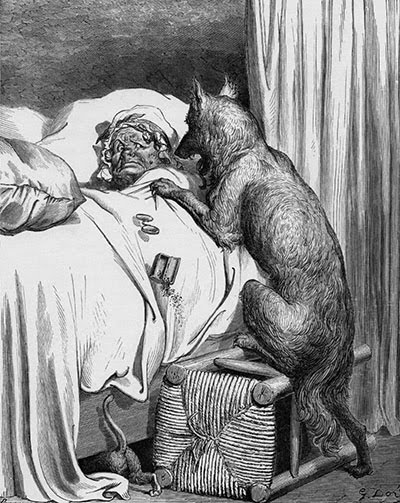
Once there was a little village maiden, the prettiest ever seen. Her mother was foolishly fond of her, and her grandmother likewise. The old woman made for her a little hood, which became the damsel so well, that ever after she went by the name of Little Red-Riding-Hood…


Few are unfamiliar with this classic fairy tale from childhood and have likely either heard or read versions of it on several occasions. The original story is thought to have come down through the Middle Ages as part of the oral tradition, and it wasn’t until 1697 in France that the tale was first put to paper probably intended as entertainment at the court of King Louis XIV. Charles Perrault published what turned out to be a landmark book, Tales of Times Past which contained eight stories the author had often told his children. Among the eight was “Little Red-Riding-Hood.”


The original versions of the old classic fairy tales were more often than not gruesome and shocking in their horror. There was no happy ending in many of these stories: “Sleeping Beauty” did not end with a handsome prince awakening the beautiful young maiden with a kiss. Her troubles were just beginning. In “Little Red-Riding-Hood” the wolf has barely begun digesting the sweet old grandmother when he begins savaging the little girl. These stories were filled with unsavory elements, with lunacy, theft and dishonesty, rape, cannibalism, the maiming of humans, drunkenness and of course racial discrimination. Why such inhumane and immoral themes? One explanation contends that life was harsh, that children saw all or much of what their elders did, never cushioned or sheltered from violence, sex, public floggings or hangings. At the time it seemed natural that children were exposed to such. And then there were the moral lessons always included in fairy tales. Very clear in Charles Perrault’s version of “Little Red-Riding Hood” is the moral lesson warning young ladies of wolf-like men. Going back as far as Aesop 2,500 years ago, storytelling always had a moral nugget at its core. Stories were meant to teach something.


Prior to Perrault’s telling of the story, there is no record of the wolf devouring both the grandmother and the young girl. But the earlier oral versions did include the famous exchange between wolf and girl:

“Grandmother, what great arms you have!”

“That is to hug you the better, my dear.”

“Grandmother, what great ears you have!”

“That is to hear you the better, my dear.”

“Grandmother, what great eyes you have!”

“That is to see you the better, my dear.”

“Grandmother, what a great mouth you have!”

“That is to eat you up,” cried the wicked wolf.


The most frightening of all the early versions of this tale came out of England at the end of the nineteenth century. This telling ends with the wolf collecting the grandmother’s blood in bottles and inducing the unsuspecting girl to drink. Many, perhaps most of the modern versions end with the girl coming through her meeting with the wolf safely, though only the 1817 version by the brothers Grimm spares the grandmother. Sluggish after dining on the grandmother and Little Red, the wolf falls asleep. His loud snores catch the attention of a passing hunter, who enters the house, guesses what has happened and rips open the wolf’s stomach with a pair of scissors. Little Red jumps out and exclaims, “How dark it was inside the wolf!” Then the exhausted and silent grandmother climbs out. The wolf (despite his sliced open stomach) is chased away.


It all sounds fairly fiendish and horrible…kind of like our modern headlines and movies.


The two black and white drawings are by Gustave Doré and the poster is a 1939 work by Kenneth Whitley.

About Me

My photo
Oak Hill, Florida, United States
A longtime expat relearning the footwork of life in America