Showing posts with label Louisiana History. Show all posts

Friday, April 6, 2012

Huey’s Dream

Few who grow up in Baton Rouge can ever forget the majesty of the State Capitol Building, located just north of the old downtown area. At the time of its construction the area immediately to the south was a bustling center of commerce where most came to shop, work, see a movie or attend a function at the old Heidelberg Hotel. From anywhere downtown the Capitol is in clear view, rising tall above all else. It was also a place where teachers from around the state brought their students on day-trips to study and experience a big piece of the state’s history. And for some of us, it provided a huge and rambling playground full of trails, hills, old cannon and a nineteenth century Arsenal overlooking a lake.


Each time I return to Baton Rouge a part of one day at least is spent driving downtown to visit once more (for perhaps the thousandth time) the State Capitol Building, a National Historic Landmark. If nothing else, it’s always eye-opening to have a look at the city from the observation deck of the 27th floor, with its panoramic views of the Mississippi River to the west, and in the south the gardens and downtown below, in the distance Louisiana State University. And after so many years I still take joy in sitting on the big cannon and looking out over the lake.


The Capitol Building began as the dream of Senator and future Governor, Huey P. Long in 1928. As part of his gubernatorial campaign, Huey Long advocated the construction of a new, modern capitol building to replace the Old Louisiana State Capitol, built in 1847. A tremendous and ill-timed project, it became a symbol of the pride, history and spirit of Louisiana’s people. Only a powerful politician could have made this dream a reality. Constructing a large and expensive state capitol building during the Great Depression was testimony to the will and influence of a fierce politician. Call it irony that in 1935 Governor Huey P. Long was gunned down in a hallway of the Capitol Building.
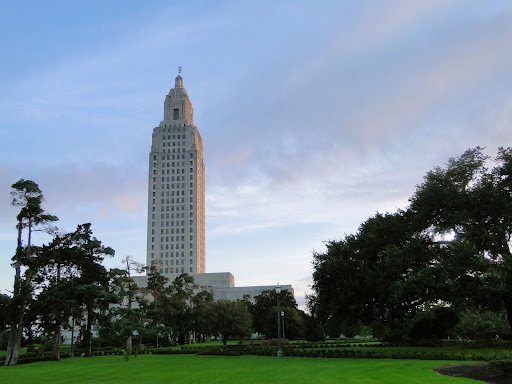

Huey Long hired architects Dreyfous and Seiferth Weiss to design his dream capitol. The architects took as their model another architect’s design for the Nebraska State Capitol Building. The work was done during the depression and completed in March of 1932. Remarkably, it took only fourteen months to put up a magnificent building in the art deco style reaching a height of 450 feet (137 meters) with thirty-four stories. It cost the state five million dollars and included an apartment on the 24th floor for Huey Long.


Twenty-five hundred rail cars were needed to bring in the limestone used on the exterior and the interior marbles from places as far away as Vermont and Italy. Architects used symbolism throughout the design of the building, and as the square tower rises it cuts away to an octagon at the 22nd floor. At this point four allegorical winged figures representing Law, Science, Philosophy and Art guard the four corners. The building is approached by grand steps leading up to the fifty foot high main entrance. The steps are carved with the names of all US states in the order of admittance to the union. The forty-ninth step carries the names of both Alaska and Hawaii. The top step is carved with E Pluribus Unum (‘One from Many’) from the Great Seal of the United States.


Trees native to Louisiana, such as magnolia, live oak, and palm are prominent around the capitol grounds. The gravesite and memorial of Huey Long is a focal point of the park grounds, with a statue of Long standing before a model of the capitol. After being shot in the Capitol Building on September 8, 1935, Long was rushed to the hospital where he died two days later. His last words were, “God, don’t let me die. I have so much to do.”

Friday, July 15, 2011

House of Sorrows

Sitting on a spit of land six miles south of Baton Rouge on the Mississippi River, the crumbling ruins of an old plantation house lie in a picturesque field of pecan and oak trees. Because the river wraps around the land and the former plantation, the setting offers one of the better views found along the River Road. Although destroyed fifty-one years ago, memories of the Cottage Plantation still linger in the minds of some living in Baton Rouge—remembered for what it used to be, what it became and for the ghosts who are rumored to still walk there.


Not many years before fire destroyed the plantation, it was a playground of sorts for several of us, and we went there on many nights to ‘walk with the ghosts’ and to sit under its crumbling columns telling scary tales of blood, murder and vengeance. In those days the grounds were accessible, or at least it seemed that way to a car full of teenagers willing to climb fences. We plotted elaborate dramas and scare tactics to spring on friends, the more elaborate stunts requiring some of us to arrive early, set the scene and then hide among the shadows. We laughed as the terrified girls ran screeching from a ‘ghost’ in flour whiteface, arms pinwheeling with glittering butcher knives but in the long run we all once or twice got scared out of our wits.


At the time not many among my ghost story partners knew much about the old house, apart from it being some old place from the time of the Civil War, and that it was sometimes in the movies. I don’t remember it ever being a subject in our Louisiana history classes. But it does have a story, a colorful one that includes fiery steamboats, yellow fever, occupation by Union soldiers, wandering ghosts and finally crumbling in flames.


The Cottage was built in 1824 as a wedding gift to a daughter and her husband. Considered one of the finest houses in the area, it had 22 rooms filled with imported furniture. Operating as a sugar plantation with 250 slaves, the owners were able to accumulate considerable wealth, and in the years before the Civil War, life was good at the Cottage.


On February 27, 1859 a steamboat bound for New Orleans caught fire on the river near the Cottage, burning to the water, with bales of burning cotton floating on the Mississippi, passengers clinging to them as best they could. Plantation slaves helped pull passengers from the water, while the owner of the Cottage had bed sheets laid out with flour on top of them, a palliative for burn victims to be rolled in. One witness later wrote in his journal: ‘One man approached me wrapped in a sheet with flour covering his face and looking like a ghost. Before I could run away from the hideous object it extended its arms toward me and quietly said, “Don't be afraid, Jimmie. It is me, Mr. Cheatham. I am dying—hold my hand!” then sinking upon the turf beside me. The ghost-like man gave a cry which seemed to wrench the soul from his body. He shivered for an instant, and then lay still. A slave passing by pointed to the body and casually remarked, “He done dead.”’


After the start of the Civil War, life on the plantation changed forever. The Union Army took over the property and removed everything of value, including horses, furniture, jewelry and even the children’s clothing. Troops occupied the plantation holding the family prisoner. When the soldiers finally left, the family abandoned the house and it was taken over as a hospital for Union soldiers with yellow fever. Many died from the disease and were buried on the grounds. In the years that followed, the fact that it was a hospital probably saved it from being destroyed by vandals.


Following the war’s end the family tutor returned to the abandoned Cottage, becoming a recluse and spending his time repairing the old house. He was sometimes seen wandering the grounds of the Cottage with a long, white beard. Years passed and the Cottage stood empty, people living nearby calling it haunted. There were reports of doors opening and slamming by themselves and sightings of ghosts wandering the grounds. In the 1920s, the family began a restoration of the house and in the 1950s it was opened to the public, a museum of the Old South. In 1957 it served as a movie set for the Clark Gable and Yvonne De Carlo picture, Band of Angels.


One early morning in 1960, the Cottage burned to the ground. Firemen later reported that while pumping water onto the flames from the side garden, a man ‘appeared’ in an upper window. Firefighters shouted for him to jump, but he stood not noticing them or the fire around him. The roof collapsed and the man was gone. Searching for the his remains, firemen found nothing. Some say a ghostly figure still haunts the Cottage, passing on dark nights among the ruined columns of a former life.

Thursday, April 7, 2011

Melancholy Song

Most readers looking for a book by James Lee Burke go to library or bookstore with a Dave Robicheaux or Billy Bob Holland story in mind. Robicheaux, the police officer from New Iberia, Louisiana was first introduced in the 1987’s The Neon Rain and readers met Billy Bob Holland for the first time in the 1997 Cimarron Rose. Of Burke’s twenty-nine novels and story collections it might be a difficult task to pick out one that hasn’t excited a legion of fans and a host of critics. Whether set in Louisiana, Texas or Montana, the writer illuminates backgrounds and settings that drip with authenticity, characters of marvelous complexity and stories that enfold the reader at once.


In 2002 Burke published a different kind of novel, one based on the history of Louisiana as well as the story of people in his own family, namely his great great-grandfather and an uncle of the same period, 1837-1868. The novel is White Doves at Morning and tells the story of people and conditions in New Iberia, Louisiana during the years of the Civil War and afterward. The story also takes us to the battleground horror of Shiloh and the Shenandoah Valley, where the nightmare of battle reminds the reader of images from Stephen Crane’s The Red Badge of Courage.


Catalyst for much of the drama in White Doves at Morning is the character Flower Jamison, a slave born in the book’s first pages, a child fathered by the wealthy plantation owner, Ira Jamison. This connection and its complexities provide much of the heat that fires the developing story. Flower grows into a young woman unlike the stereotypical plantation washwoman, though her job is exactly that. Against all custom and law, Flower learns to read and write, taught by Willie Burke, another of the story’s main characters, who along with his good friend Robert Perry becomes enchanted by the abolitionist Abigail Dowling, a northerner come to south Louisiana several years earlier to work as a nurse. As in most books by James Lee Burke courage and moral integrity form a thematic backbone for his characters, whether those qualities are lacking or in abundance. Flower and Abigail are confronted by the moral degradation and evil that rise not only from the institution of slavery, but from the abuse of those wanting to turn a lost cause into another kind of corrupt power. Willie Burke and Robert Perry are the other side of the coin and offer example of southerners who lived with different ideals.


One of the more interesting historical elements in White Doves at Morning is the story of how Louisiana’s infamous Angola Penitentiary came to be. Before the Civil War it was a large plantation growing mostly sugar cane. After the war and unable to rely upon slave labor to work his fields, the owner turned his plantation into a place for housing convicts who were then rented out for labor, either government labor or private.


For the first sixty-four pages I read this book wondering several times where the title came from, since little of the story was as bucolic and lyrical as the title implied. The answer comes on page sixty-five when a group of confederate soldiers sit in firelight on the eve of battle singing…

“White doves come at morning

Where my soldier sleeps in the ground.

I placed my ring in his coffin,

The trees o’er his coffin have all turned brown.”

It is a traditional song and a melancholy one, the doves more of an ill-omen than heralds of a new dawn. One soldier apart from the singers yells out, “Put a stop to that kind of song!”


If you’ve never read Burke, give yourself a treat.


For more on this writer refer back to a post from last July.

About Me

My photo
Oak Hill, Florida, United States
A longtime expat relearning the footwork of life in America