Saturday, April 7, 2012

Buddies in Black

Some days are harder than others. A lot harder. During this time of enjoying my friends’ grand hospitality, there have been hours or portions of the days when both have been off at work, or at other business and I have hung around the house on my own. But not really on my own since the presence of Charlie and Max has always been either at hand or in the periphery. On Thursday I sat on the patio watching Max perched on the birdbath lapping at the water, seeming to tease the cat waiting below with his lingering enjoyment, finally jumping down and stalking off on long legs. And about the same time old Charlie stumbling out from behind the Japanese plum, catching his balance the moment before a tricky back leg throws him down. Two black and white cats living the life of Riley in their diamond years, Charlie and Max have always been around, asleep in a sunny spot on the patio or maybe curled onto a sofa dozing the day away, and on some days dashing at squirrels or birds across the driveway.


The older of the two cats, Charlie, was born in 1993 and came to live with Raymond and Dee from an animal rescue service in Baker, just north of Baton Rouge. He was named after a good friend. Anyone who has ever brought a cat home will tell you that cats are quick to exhibit a distinct personality. From an early age Charlie learned to drink Snapple from the bottle, as long as someone held the bottle. Another favorite was cheese which always brought him running. We don’t often associate the game of “fetch” with cats, example telling us that it’s a dog’s game, but don’t apply that rule to Charlie, a cat expert at retrieving balls of paper.


Max, by coincidence also came to Raymond and Dee from the rescue service in Baker, but two years later in 1995. His name came from the character Max Prince in the Neil Simon play, Laughter on the 23rd Floor. Despite the two-year difference in age and the fact that both were male, the bond between Charlie and Max was instant—tight buddies from the start. But of course their personalities veered. For many years Max was a standoffish cat slow to approach anyone but Dee, but age mellowed him and just the other night he crawled up on the sofa to rest against my leg. A favorite trick of Max’s was frequently digging up the plants in pots, but there were also the times he was fascinated with nudging or pawing his water bowl in a circle around the kitchen. Friends visiting the house sometimes called him the cartoon cat for his way of arching his back and bristling his short hair to resemble a Halloween cat.


No doubt it sounds trite and obvious, but when they come into our homes, cats (and certainly dogs as well) become a vital part of our lives and the house we share with them. Trite maybe, but all too true, especially to those caring for the animals. Like it or not, we are all subject to the ravages of time. In January of this year Dee first began questioning the health of Charlie and Max: Charlie was 19, Max 17 and it was visible in their movement. Both cats enjoyed excellent health over the years, but age forces us to face hard questions.


On Friday Raymond and Dee took the two cats to see their longtime veterinarian. Following his advice they said their goodbyes to these family members and stepped aside to allow Dr Stringer to do his work.


Charlie and Max have moved on to a favorite spot near the back patio, a spread of ground where flowers can grow up around them and redbirds can tweet their memories.


CHARLIE • 1993-2012

MAX • 1995-2012

Friday, April 6, 2012

Huey’s Dream

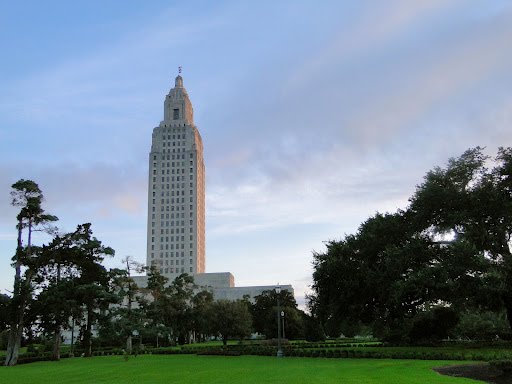
Few who grow up in Baton Rouge can ever forget the majesty of the State Capitol Building, located just north of the old downtown area. At the time of its construction the area immediately to the south was a bustling center of commerce where most came to shop, work, see a movie or attend a function at the old Heidelberg Hotel. From anywhere downtown the Capitol is in clear view, rising tall above all else. It was also a place where teachers from around the state brought their students on day-trips to study and experience a big piece of the state’s history. And for some of us, it provided a huge and rambling playground full of trails, hills, old cannon and a nineteenth century Arsenal overlooking a lake.


Each time I return to Baton Rouge a part of one day at least is spent driving downtown to visit once more (for perhaps the thousandth time) the State Capitol Building, a National Historic Landmark. If nothing else, it’s always eye-opening to have a look at the city from the observation deck of the 27th floor, with its panoramic views of the Mississippi River to the west, and in the south the gardens and downtown below, in the distance Louisiana State University. And after so many years I still take joy in sitting on the big cannon and looking out over the lake.


The Capitol Building began as the dream of Senator and future Governor, Huey P. Long in 1928. As part of his gubernatorial campaign, Huey Long advocated the construction of a new, modern capitol building to replace the Old Louisiana State Capitol, built in 1847. A tremendous and ill-timed project, it became a symbol of the pride, history and spirit of Louisiana’s people. Only a powerful politician could have made this dream a reality. Constructing a large and expensive state capitol building during the Great Depression was testimony to the will and influence of a fierce politician. Call it irony that in 1935 Governor Huey P. Long was gunned down in a hallway of the Capitol Building.


Huey Long hired architects Dreyfous and Seiferth Weiss to design his dream capitol. The architects took as their model another architect’s design for the Nebraska State Capitol Building. The work was done during the depression and completed in March of 1932. Remarkably, it took only fourteen months to put up a magnificent building in the art deco style reaching a height of 450 feet (137 meters) with thirty-four stories. It cost the state five million dollars and included an apartment on the 24th floor for Huey Long.


Twenty-five hundred rail cars were needed to bring in the limestone used on the exterior and the interior marbles from places as far away as Vermont and Italy. Architects used symbolism throughout the design of the building, and as the square tower rises it cuts away to an octagon at the 22nd floor. At this point four allegorical winged figures representing Law, Science, Philosophy and Art guard the four corners. The building is approached by grand steps leading up to the fifty foot high main entrance. The steps are carved with the names of all US states in the order of admittance to the union. The forty-ninth step carries the names of both Alaska and Hawaii. The top step is carved with E Pluribus Unum (‘One from Many’) from the Great Seal of the United States.


Trees native to Louisiana, such as magnolia, live oak, and palm are prominent around the capitol grounds. The gravesite and memorial of Huey Long is a focal point of the park grounds, with a statue of Long standing before a model of the capitol. After being shot in the Capitol Building on September 8, 1935, Long was rushed to the hospital where he died two days later. His last words were, “God, don’t let me die. I have so much to do.”

Thursday, April 5, 2012

Crawdads & Alligators

April is a time in Louisiana when the air is full of festival fun, when feet are itching to “cut da rug” at Zydeco hoedowns in Lafayette, milk wild cows at Angola or get together at crawfish boils in backyards everywhere. An old saying in south Louisiana goes, “A Cajun will eat anything that won’t eat him first.” Po-boys, fried catfish, alligator and crawfish pistolettes are around every corner and it’s all a part of what makes Louisiana cooking famous.


Crawfish are an inseparable part of Cajuns and the culture that grew up around those French Canadians who settled in southern Louisiana in the mid-1700s. These mud-burrowing crustaceans—alternately called crawdads, mudbugs or crayfish—are enjoyed roughly from March to November (they go dormant in winter) and taste something like a cross between shrimp and lobster. You’ll find them in a few dozen recipes, but the most popular way of eating Crawfish in Louisiana is boiled, straight out of the shell.


Crawfish can be bought pre-boiled and clean, but most prefer to do it themselves, soaking the crawfish in an ice chest full of fresh or salted water prior to cooking. This soaking both cleans their exterior and forces them to spit up the muck in their intestines. Ideas differ on how to season a crawfish boil, with an equal number of opinions as to which one is best, but a large pot of boiling water seasoned with salt, cayenne pepper, lemon, garlic, bay leaves and Cajun seasoning is a good start. Other additions include potatoes, corn on the cob, onions, garlic, sausage and sometimes mushrooms. The boiled shellfish are generally served at a gathering known as a crawfish boil. Other popular variations include crawfish étouffée, fried crawfish, crawfish pie, crawfish dressing, crawfish bread and crawfish beignets. Outside Louisiana, Sweden is the only place in the world where crawfish are widely consumed. Swedish crawfish boils are called Kräftor, ‘crawfish’ in Swedish.


The incredible crawfish étouffée


Eating boiled crawfish involves a tricky series of twists, cracks, and pinches that spill the red-brown juice over fingers and hands. Some eat only the tail, which is actually the crawfish’s abdomen, but most in Louisiana begin by breaking off the tail and sucking the head with its rich juice, which the locals call fat.


Crawfish Pistolette, a piece of heaven from the bayou


Fossils suggest that crawfish have been around for 285 million years. They are not usually rare in Louisiana, at least when there are no Katrinas or oil spills in the gulf. Most crawfish live short lives of less than two years, a brief life span that means quick, high-volume reproduction is important for continuation of the species. Because the eggs look something like berries, the egg-bearing females are described in May and June as being “in berry.” Eggs hatch in ten to twenty weeks and the newly-hatched crawfish stay attached to their mother until shortly after a second molting of the shell.


Louisiana supplies ninety-eight percent of the crawfish harvested in the United States. In 1987 the state produced ninety percent of the crawfish in the world, seventy percent of it consumed locally. In 2010, the Louisiana crawfish harvest was about 88 million pounds, almost all from aquaculture. Wild crawfish from the Atchafalaya Basin accounts for about twenty percent of Louisiana’s harvest, about 15.5 million pounds in 2010. From seventy to eighty percent of crawfish in Louisiana are red swamp crawfish, the remaining twenty or thirty percent white river crawfish. Despite the large-scale production in Louisiana, most frozen crawfish available in supermarkets outside of Louisiana are imported from China.

Wednesday, April 4, 2012

Houses

Some talk yesterday about the passage of time and its effects on the changing face of hometowns and the confusion, surprise and sense of loss that these changes foster in old eyes looking back through the filter of youthful memories. There’s a pretty good chance the surprise is multiplied when eyes are turned to the house you grew up in, if it happens to still be standing. And I suppose for many of us that is the case.


My family moved to Baton Rouge from Mississippi in 1948, Daddy Clyde going to work in a lumber company on Florida Boulevard. The five of us moved into one of Aunt Emmy’s houses across the street from Coco Lumber, rooms where earlier tenants had left their shades upon closets and bedrooms. I was too young to notice the arrival in Louisiana, and my first memories of 340 Wabash come at a later time.


The images are strongest some years later, those between twelve and eighteen when I had my own room thanks to Daddy’s decision to build an addition onto the house when two bedrooms became too few for five. Not surprisingly, life changed after I got my own room. And it’s those changes and those days and nights that captured my attention on Tuesday.


In 1996 my sister and I made a visit to Baton Rouge for the purpose of resolving issues with the old house on Wabash. Since our mother’s death it had been home to a string of temporary part-timers, and was in dire need of serious attention. The last renters had run out, leaving the place with a post-tornado look. Not the solution we’d expected, but within a couple of weeks a buyer turned up and we sold the old Childhood Library of Memories for a fair amount. For my part, in selling the house a hard kernel of sadness came with the relief.


Back for visit I was eager to return to the old neighborhood and see where time had taken that house, the ark of a thousand memories. My last sight of the house on Wabash was years ago, not long after its renovation. The first impression yesterday was of tree growth—the entire neighborhood now overhung with giant live oaks swooping down upon the street. But the house, despite a certain charm that came with its earlier renovation, is beginning to look lived in. Nothing exceptional, only the average signs of life spilling through windows and cracks into the front yard. Hard to say how these things work, but I got that old feeling of home-ness that I remember from throwing my bike down in the front yard and tumbling inside just as Mamma called supper.


A different time, a different family, but the chord stretching forward from long years back still resonates with a feeling of home. Pictures, then and now…

Tuesday, April 3, 2012

Trails

The fact of having grown up in this or that city is oftentimes weak support for the returnee finding his way through the post-childhood development that ravages the landscape of memory. We tell ourselves that we know this, remember that, but when conjecture comes face to face with a street grid, many of our suppositions crumble like a house of cards. But in fact, the falling house of cards on Monday wasn’t a matter of badly remembered streets, but one of walking on ground once thick with forest growth and wetland, a place Daniel Boone might have charged into, but one most of the non-pioneer types stayed out of. But then a lot can happen in fifty-two years over which new streets and highways rise out of dirt and neighborhoods evolve to tweak a city impatient for growth.


Back in the days when the only Elvis around was not named Costello the area of Baton Rouge bordering Jefferson Highway in the southeast was woodland waiting for the developer’s axe. One or two connecting roads cut through the green, but it was land earmarked for a future we couldn’t yet see. A large tract of the land belonged to the Ollie Steele Burden family and was in the 1880s site of Windrush Plantation. At the time of his death in 1995, Steele Burden bequeathed the land to Louisiana State University with a stipulation that it be used for agricultural and horticultural research with minimal development otherwise.


Today this large tract of 440 acres is home to the Burden Center-LSU Agcenter. In addition to research plots devoted to agriculture, the property includes a rose garden, camellia garden, five miles of walking trails, the Windrush Gardens, the Rural Life Museum and grounds offering a look at plantation life in the nineteenth century. Unmentioned in the center’s brochure is a meditation garden, one focused solely on a lotus-filled pond.


For the past several days walking has been confined to Sevenoaks Avenue, but hearing about the Burden Center’s nature trails widened my options. An easy drive from Old Goodwood and I found everything exactly as described, with plenty of parking. The several nature trails branch off from a spot very near the parking area and within minutes the chosen path is wrapped in wall-to-wall green. But the first yards of walking are confused by the sound of cars on I-10 just off the eastern edge of the Burden acreage. Apart from sky every corner of the walker’s view is enclosed in a rumpled green blanket sprinkled with wildflowers, and over the wall of green comes the whoosh of high speed traffic headed for New Orleans. Walk around the next curve in the trail and there through a thin mesh of trees are the cars skimming over the unseen interstate, and then just as quickly lost again around the next clump of swamp cabbage. And in the next moment a long-lost earthy musk of Louisiana rises to my face.


Lost in the middle of all this protected land, somewhere off the marked trails and wandering a crushed shell road, I came upon a scatter of gargantuan iron cogs and wheels, a thrown down sculpture of giant parts from an archaic industry. The road passed along an assembly of old wooden buildings behind split rail fencing, and thinking it unremarkable I ducked between the fence rails to have a look. Two people, standing nearby and startled, told me the gate was off thataway, at the rear of the Rural Life Museum and that I had saved $6.00 by coming in the back way. To mark my savings I took a photo of the “old slave” statue just in front of my secret entrance. Despite the lack of a blue visitor’s tag no one bothered me as I walked about the church and slave quarters of the old Windrush Plantation, but I didn’t push my luck by venturing too near the museum.


Not five minutes after crawling back out the split rails and once again on a marked trail, payback came in the form of a sudden downpour. Too much rain and too much distance made it clear getting wet was the only way back. Back in the car my glasses were running and my shirt sopping, but my pedometer showed almost four miles of walking. Enough to make wetness a secondary concern at the end of a happy day.


Trailing off into green along the Palmetto Trail

Monday, April 2, 2012

Sunday Afternoon

A hundred people can tell you a hundred different ways to make a Bloody Mary. Or at least that’s the case in New Orleans and Baton Rouge. The famous watering holes hereabout swear by their somehow secret recipe while others gladly call out the ingredient that makes their Bloody Mary superior. Most of us line up some vodka, store-bought mix, a lime, some celery, maybe some spicy seasoning and call it done deal. Still there are those who like a touch more and bring out the beef consommé, Worcestershire Sauce, pickled okra or string beans, olives, and a dash of lemon. Whatever the secret or special ingredient, most times the Bloody Mary served in south Louisiana is a mouthful of good.


Sunday in Baton Rouge was an afternoon of sublime weather with the freedom to squander hours on a breezy, sun-dappled patio, a setting almost incomplete without a Bloody Mary or two. No fancy cocktail recipe around here, but instead an uncomplicated mix of vodka, Tabasco Bloody Mary mix, a squeeze of lime, another of lemon, a dash of Cajun seasoning and a stalk of celery in a tall glass brimming with ice. Our back porch patio Bloody Mary wouldn’t make the grade at Lafitte’s Blacksmith Shop in the French Quarter, maybe not at the Palace Café, but for the locals on R’s patio the mix is Triple AAA.


Someone started whispering about oysters on the half shell and our designated driver-chauffeur piled us in the car for a drive to The Chimes, a popular eatery with two locations in town, one of them not far from Goodwood. Before long we sat crowded around a table piled with raw oysters, seafood gumbo, crab stuffed shrimp and a platter of red beans and rice. Here in Louisiana the table always ends up overflowing with food, all of it a heavenly blend of flavors that have made the state famous.


The Chimes has found its niche in Baton Rouge, taking over a drugstore and clothing store just off the campus of Louisiana State University in 1983, soon expanding into the old Varsity movie theater. Live music is offered two or three nights a week, a big draw for the crowd of LSU students, but the food is no less an attraction for many locals. Since opening the original restaurant the owners have expanded with another Chimes in east Baton Rouge and one more in Covington, an hour and a half away.


For many in Louisiana football is a big part of life between late August and January, and The Chimes has become one of the places where LSU fans like to gather for games on TV. Popularity of the game is embodied in a handsome painting of old-style football on one wall of the restaurant.

Sunday, April 1, 2012

Cottonwood

Using the excuse of waiting out the late afternoon traffic, returning from Breaux Bridge on Friday we dodged into one of the independent bookstores to pass some time in browsing. “Dudley” and I make good bookstore companions, each understanding the rituals involved and the ugly sound of someone at your elbow saying, “Hurry up.” Cottonwood Books is located on Perkins Road in Baton Rouge and is owned by Danny Plaisance, in business for twenty-six years. He keeps enough stock to hold the dedicated book browser on point for long stretches.


I went into the bookstore not really looking for anything, no clear titles in mind, nothing new at least. You know how that goes—inside the store for five minutes and three books were on a maybe list. Didn’t fare too badly though, enjoying more than an hour of picking through dusty shelves packed with treasure. Danny is especially helpful with answers and guidance through the narrow labyrinth of aisles and shelves. About one book, he looked in several different places to show me a less expensive used copy before pulling out a new and more expensive copy for $7.00. For customers with a true interest in books he is the best of owner-guides you could wish for. He knows his business.


Four books followed me out the door, one remembered in the act of walking out. Read somewhere the other day a short piece on Rudyard Kipling’s 1901 novel, Kim and had since been thinking of it, so made that last-minute purchase at Cottonwood. Also got a first edition of Richard Wright’s Black Boy, the autobiography he published in 1945. Two other purchases are under today’s spotlight.


First of the two is a somewhat shaggy copy of Lysistrata translated from the Greek of Aristophanes with Illustrations by Norman Lindsay. The classic play is one title from the Illustrated Edition series put out by The World Publishing Company. The book includes an introduction by illustrator Jack Lindsay, an author and translator in his own right. It bears no date of publication, but is either a 1931 or 1932 edition.


Lysistrata is often called the best work of Greek playwright Aristophanes. First produced in 411 BC, it tells a story of women who withhold their favors from the men in order to stop war and solve the world’s worst troubles. The idiom is never a crude mode of expression, but the playwright’s lines are lusty and ribald, describing a condition as familiar to the women of ancient Greece as it is to contemporary women everywhere.


In Lindsay’s illustration, Lysistrata, history’s first feminist stands defiant separating the men from their women.


The other surprise find was a special edition of Samuel Butler’s The Way of All Flesh with pictures by Robert Ward Johnson and introduction by Theodore Dreiser. It’s a copy of The Heritage Press 1936 edition that includes a slipcase and the original Sandglass insert. The book has for many years been high on my role call of Best Books, and the Heritage edition is beautifully done and in fine condition.


Above shows an illustration from Chapter 49 when Mr Hawke stiffens his charges with prophecies of fire and brimstone.

About Me

My photo
Oak Hill, Florida, United States
A longtime expat relearning the footwork of life in America