Showing posts with label Coastal Birds. Show all posts

Thursday, March 22, 2012

Feathered Punk

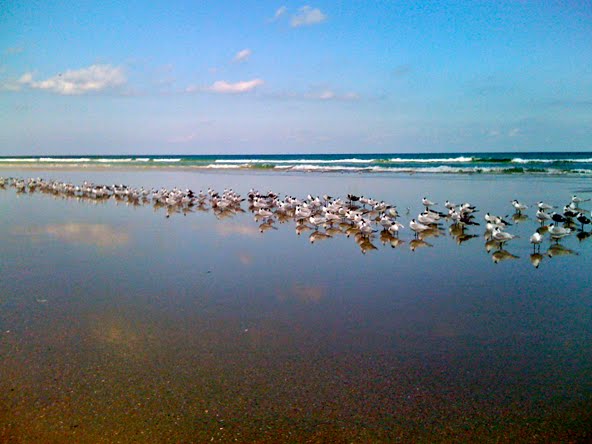
One bird common to this stretch of coastal Florida has for a long time caught my eye, most of the time raising a smile with its punk rock feather-do. Not at all a rare sight most months of the year, it mingles freely with the more common gulls and is visible on most walks up and down the beach. I have wanted for some time to find out more about this bird, but have been stymied by lack of a name to start with. The other day, during a visit with nearby friends, I was invited to have a look at a bird book laying out on the coffee table. No plan, no thought, the book fell open to a page showing this familiar bird of the wacky crown. “So, that’s what it is!” I exulted, “a royal tern.”


In my case at least, shyness or aloofness in any creature of legs or wings tends to heighten curiosity. Try to creep a little closer and they edge away, or approach within even slight proximity and see them dash or flitter away. The royal tern is perhaps the shyest of birds and won’t stand still at any advance. Without a telephoto lens, good photos are hard to get. In most situations I swear by the camera on my iPhone 4S, but it’s next to useless in capturing a good close up of the royal tern.


The appearance of the royal tern in both sexes is similar. It has a white face, neck, breast and belly, with black legs and a thick bill of bright orange. The back and upper wings are pale gray, the rump and tail white, often with dark edgings. The tail is long and deeply forked tail. Average wingspan in an adult is 51 inches (130 cm). Length is from 18–20 inches (45-50 cm) from beak to tail, and average weight anywhere from 12-16 ounces (340-450 grams). The royal tern’s most interesting feature is its black cap with the spiky crest at rear of its head, or what I call punk rock spikes. This spiky cap is more prominent during breeding season and in winter becomes a little patchy, a sort of ornithological call for Rogaine.


Feeding is sometimes in small secluded bodies of water like estuaries, mangroves and lagoons, but the royal tern will also hunt for fish in open water, typically within a hundred yards of shore. When feeding in open water the bird dives from heights near thirty feet, usually alone or in groups of two or three. When tracking large schools of fish they can be seen feeding in large groups. Most often their prey is small fish such as anchovies, weakfish, and croakers. Fish is the main source of food but they will also eat insects, shrimp, and small crabs swimming near the water’s surface.


The females lay one or two buff or whitish colored eggs with brown blotches in an unlined shallow depression in the sand. The eggs are incubated approximately one month. After the eggs hatch the chicks remain in the ‘nest’ for about a week. About two weeks after hatching the chicks gather into groups called a crèche and are fed primarily by their parents who recognize offspring by voice and looks. When the chicks are a month old they start to fly.


With a dab of new knowledge about these standoffish and spike-headed denizens of the water’s edge, my enjoyment of their presence on walks can only be enhanced. There is the sense of a small opened window that will now widen my appreciation of one more feathered member of this sandy environment.

Wednesday, December 15, 2010

Cold Sculpture

Not long after climbing out of bed this morning a new sound muscles its way through the walls. It is the grind and chomp of big machines chewing up the parking lot 500 feet away. There is promise of a new parking lot by the end of this week, a Christmas gift of shiny new surfaces with newly painted lines and numbers. Cold work for the Santas riding those machines, as temperatures continue to slide around between 25 and 39° here on the edge of the water. Cold, though no one can say it’s not beautiful. The view from this hand hammered work table under my elbows is scintillating, as it normally is when the morning light is strong and clear.


But the cold. Following my recently changed custom of exercising later, about an hour after lunch I spend some time walking on the beach. No other person in sight, north or south for a distance of about five miles. Even the bird life is sparse and over the course of miles, the most seen are maybe ten or twelve birds. By now the unexpected has become what could be called the ‘expected unexpected,’ a matter of almost knowing that something along the sandy path will surprise me in an unforeseeable or unpredictable way.


Not long into my windy ramble I come across a bird in the familiar pose of sleep or rest, legs tucked under, breast down on the sand. I think it odd that the bird doesn’t spring up and either fly or scamper away at my approach. But then, how does a frozen bird fly away? Soon after I begin to notice catfish, first one, then another and soon a dozen dead or dying at surf’s edge. A thought comes that maybe for this particular fish the coldness of the water triggered some ancient instinct, telling them to seek warmer, shallower water warmed by sunlight. That might lead to the fish being washed onto dry sand by the surf. Whatever the cause, I notice over a dozen catfish washed up, and only one or two of those carcasses providing a meal for the scant birds on this cold day. What would normally be a feast for the gathered birds is now too much for those remaining.


New to me is the tiredness that comes sooner from walking any distance on a cold beach. The sweater, jacket and hood are fine, but the unceasing wind is a ball and chain on the legs. The press against such wind is wearing, but all around me the wind creates what looks like beautiful bas reliefs in the sand, shapes that resemble powdery temporary sculptures shifting and reshaping themselves by the hour. They are arresting designs perhaps special to this time of year when the wind gusts and swirls in a singular way. Though cold and beginning to drag, the sight of these natural designs adds something extra to this December walk.

Tuesday, December 7, 2010

Waiting For Hitchcock

Hey, Lamar, when is this guy supposed to get here?

I don’t know, Bob. I think he shoulda been here by now.

What time is it, Maureen?

Time to return to the nest, birdbrain. My feet are killing me standing for hours out in this cold water.

Wednesday, September 29, 2010

Fickle Sky

The rumble of thunder wakens me early in the morning. Eyes blink open at the same moment a sweep of rain slaps against window glass, and a second later wind beats the palm trees into an angry clatter. Sitting up, I get a wide angle view through an unshuttered window that offers a view of sky, ocean and sand melting together, a view severely limited by the wet turmoil of water and cloud.


I stand at the window wondering about this stormy violence, trying to gauge a path or direction it might follow. In this climate weather is fast moving, here in a moment and blown away after a few agitated minutes. This time the storm has found a comfortable center, a place to stop and pound itself against land and water, flinging defiance at the smug assurances of local weathermen who smile and promise sunny beaches.


Thirty minutes pass before the wind and rain blow themselves out and off to a farther stretch of beach. It’s enough to fool me. I am unwilling to easily give up my routine walk and so hurry out to the soggy sand and point my feet south. From there the view is clearer, stretching away north and south. Apart from myself, not another person is in sight for miles in either direction. A half mile offshore isolated walls of rain stretch from dark clouds to a darker ocean, but rays of light have found a way through the gloom to etch portions of sky and cloud with silver lining. There is no rain now and I settle into an unthinking pace across sand that is smooth but spongy.


From behind, or far ahead—I can’t tell—a soft growl of thunder catches me off guard and eyes swivel in each direction looking for the flicker of lightning. Few want to be on a beach in a lightning storm, and I take comfort in the absence of any ominous winks or flares. Walking is still easy and seemingly safe, so I ignore a second roll of thunder and the light sprinkle of almost-rain that begins spotting my T-shirt.


A mile from home the light sprinkle has a sudden personality change, and instantly, magically becomes a torrential wall of water that drenches me in the blink of an eye. The rain pounds craters in the sand all around me and poor visibility takes away everything but the fifteen or twenty feet of space I stumble through. Still no lightning, but there’s little room for comfort in this predicament. And now I have the good sense to turn back toward home.


Water sloshes in my shoes, trunks and T-shirt like a second skin plastered tight against my body, and I am worried now the water is going to wreck the iPhone in my pocket. Phone be damned, it’s the loss of pedometer, camera and half a dozen other functions that unsettles me more.


Some distance ahead I vaguely make out the palm trees that landmark home. The rain is no longer pelting, less a curtain than ordinary hard rain. I notice that the birds, the sanderlings and the willets are untroubled by this weather and without pause go about their business of darting through the receding surf, eye out for a sand hopper or small pigfish. Sky once more morphs into puffs and swirls of clouds doing a light and dark waltz. The light wins out and then with the flick of a switch the rain stops. I am fifty feet from home.


I climb the stairs relieved to have something more substantial than sand under my feet. For a minute I stand and stare out at the settling face of ocean and beach. Looks like it might be a beautiful day.

About Me

My photo
Oak Hill, Florida, United States
A longtime expat relearning the footwork of life in America