Showing posts with label Nabisco. Show all posts

Thursday, May 3, 2012

Hold the Mustard!


Dr John Harvey Kellogg, the inventor of corn flakes was something of a oddball, and among his mostly edgy recommendations was a focus on nutrition, yogurt enemas and exercise. An advocate of sexual abstinence, he believed that a bland diet would curb the sexual appetite. But Kellogg got many of his ideas from an earlier nutcase and health lecturer who ranted fanatically about unhealthy carnal urges and ‘self-abuse.’ Presbyterian minister Sylvester Graham (1794-1851) believed and taught that excessive carnal exercise would cause indigestion, headache, feeble circulation, pulmonary consumption, spinal disease, epilepsy, insanity, and the early death of offspring. He warned that men should remain virgins until the age of thirty, and making love after that only once a month—though not at all if they were sickly. He also believed that the use of mustard and ketchup led to insanity.

Raised by a succession of relatives, Graham worked as a farm hand, clerk and teacher before ill health led to his embracing Christian ministry. Apart from thoughts on carnality, he also preached a strict vegetarian diet, hard mattresses, open bedroom windows, cold showers, loose clothing and vigorous exercise. Certain that a firm control of lust could be managed by a special vegetarian diet, he began recommending “Graham bread,” made from a combination of finely ground, unbleached wheat flour with the wheat bran and germ coarsely ground, then put back in to provide nutrition and flavor.

From the Graham flour and the resulting Graham bread, it was a short jump to crackers, but a type far, far from the Graham Crackers of today. Sylvester Graham’s original was developed in 1829 in Bound Brook, New Jersey, made of course with Graham flour. Though the original was a much healthier recipe than what you find inside a box of Honey Maid Graham Crackers today; the early crackers probably tasted like unsweetened brown sand. More than a few bakers tried to market Graham crackers, but it wasn’t until 1898 that the National Biscuit Company (Nabisco) made a dent in the market with Nabisco Graham Crackers. The market took a big jump in 1925 with the introduction of the Honey Maid line, which boosted flavor with the addition of honey.

The continuing popularity of Graham Crackers in North America is undoubtably related to the use of bleached white flour and greater amounts of refined sugar and honey.

Friday, February 3, 2012

Under the Fig Tree

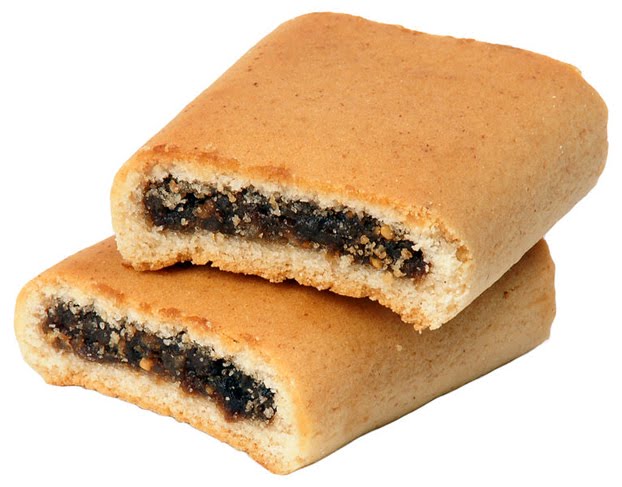
Growing up in south Louisiana, figs and fig trees were no more uncommon than the Fig Newton cookies Mamma brought home from the market. Hard to count the times I sat up in the branches of a fig tree pulling the fruit off limbs and stuffing it in my mouth. But when it comes to cookies, like most Americans I grew up with Oreos, chocolate chip cookies and Fig Newtons. In our house it was either that or Ginger Snaps, which more often than not went into the grocery bag because they were the dog’s favorite cookie. Growing out of childhood I leaned toward Fig Newtons as a favorite, something that has remained a lifelong preference.


The fig tree originated in Asia Minor around the region of northern Turkey, and was an important food source in ancient cultures. Its mention 239 times in the Bible gives some indication of its place in near eastern cultures of old. But it was the Egyptians who first made a kind of pastry filled with a paste of figs. The Greeks believed the fig was a gift from the goddess Demeter, and a fruit made sacred to the god Dionysus. The term ‘sycophant,’ meaning a servile, self-seeking flatterer, translates in Greek to “one who shows the fig,” and dates back to the early Greek fig trade where sukophantês referred to a person who informed on fig smugglers. Our word for the fruit comes to us from the Latin ficus. Brought by the Spanish in 1520, figs were introduced to America through the island of Hispaniola, modern day Haiti and the Dominican Republic.


A cookie maker from Ohio, Charles M. Roser is credited with creating the Fig Newton recipe and selling it to the Kennedy Biscuit Works, which would later become Nabisco. Roser’s fig-filled cookie was helped greatly by the invention in 1891 of a machine that made mass production possible. Invented by James Henry Mitchell, the machine worked like a funnel within a funnel; the inside funnel supplied fig jam, while the outside funnel pumped out the dough. The result was a long length of stuffed cookie that was then cut into smaller pieces.


Kennedy Biscuit Works had a tradition of naming cookies and crackers after the surrounding towns near Boston, and originally the new cookie was called simply the Newton, after the Massachusetts town of that name near the bakery. After the fig-filling got glowing reports from customers Kennedy Biscuit changed the name to Fig Newton.


Supermarkets everywhere now carry Fig Newtons, and some stores offer a variety of brand choices. Somehow though, the cookies don’t impress me as being as moist and rich in flavor as those we ate in childhood. Very probably the ingredients have been altered over the years. No question that artificial fig essence and aroma have entered into the recipe. Some insist that Walmart fig bars (Great Value) have the most moisture and purest fig flavor of all the current brands.


Today, Fig Newtons are number three in popularity worldwide, ranking just below number one-ranked Oreos and number two, chocolate chip cookies. Americans alone eat over one billion Fig Newtons each year.

About Me

My photo
Oak Hill, Florida, United States
A longtime expat relearning the footwork of life in America