Showing posts with label New Orleans. Show all posts

Saturday, April 14, 2012

Hidden in Plain View

New Orleans is a fun place to spend a day, or two or three. Find a parking place to leave the car that’s either in, nearby or convenient to the French Quarter, tighten the laces on your walking shoes and strike out. In a matter of minutes you’ll find yourself moving among a throng of fascinating types, most in a friendly and gregarious frame of mind. It is the oldest part of the city and every street corner, every building whether freshly painted, hung in giant ferns, drab or reeking of history is worthy of a moment’s appraisal.


Some of us go for the bookstores, others for the antique shops, and probably a majority for the food and drink. Even the smallest of restaurants could turn out to be the hight point of a day, and the number of friendly watering holes is beyond counting.


For many, afternoon and early evening is a time for meeting friends, new or old at one of those friendly watering holes. If conditions are right you will find a comfortable spot at or around a table on the patio or sidewalk and in no time at all meet four or five people straight out of John Kennedy Toole’s picaresque novel of New Orleans life and dialect, A Confederacy of Dunces.


Whatever time you end up at Café du Monde for coffee and beignets—and everyone does at some juncture of the day—you’ll find a hundred or more crowded tables dusted in powdered sugar and watched over by more waiters than anyone would have thought possible. Those not patrolling sit lined in chairs waiting for a summons and counting their tips. Don’t be surprised if one of them is a long time finding your table hidden in plain view. For this day weary reveler the best time is late at night just before paying the ransom on the car and driving the seventy miles home.


Thursday, July 28, 2011

Perfume and Oranges

During the Reconstruction years following the Civil War, in a building dating from 1832 two New Orleans sisters opened a notions shop at 613 Royale Street in the French Quarter. The structure included three stories, an attic, and a generous inner courtyard. Members of a proud and aristocratic Creole family, Emma and Bertha Camors outfitted many of the city’s finest women with formal gowns, lace and perfumes imported from Paris. Today, the former notions shop is a restaurant set in a large wisteria covered courtyard named Court of Two Sisters.


The poem below, “The Court of the Two Sisters” is from Phillip Lopate’s recent book of poetry, At the End of the Day (2010) and brings together the majority of his poems, most written during his youth. Lopate describes it this way: “Though I am known today mostly as an essayist, occasionally as a fiction writer, for about fifteen years I wrote poetry…When I look back at those years during which poetry formed such an important part of my identity, I am tempted to rub my eyes, as though recalling a time when I ran off and joined the circus.” He is also the author of numerous essay collections, including: Notes on Sontag (2009), Portrait of My Body (1996), Against Joie de Vivre (1989), and Bachelorhood (1981). Getting Personal (2003) includes both the writer’s prose and poetry.


THE COURT OF THE TWO SISTERS

The slow green fans turning in the courtyard

Of the classy restaurant in New Orleans;

The green napkins and the Negro waiters

Advancing in their bright green uniforms, superiorly

Filling the large water goblets dusty in the sun.

The hot rolls with curled butter shells like snails

And the enormous breakfasts served at all hours

Of Eggs with lemon sauce, asparagus, ham and toast points;

Cold creamed shrimp soup, oranges.

I read two newspapers at once, starting with sports;

Crowding the tablecloth with unwanted sections.

And when I was too stuffed to go on

I ordered a chickory coffee, dark and bitter

And a Charlotte Russe bursting with whipped cream.

Thursday, March 31, 2011

Swamp Floor Pantry

‘John Folse, born in St James Parish in 1946, learned early that the secrets of Cajun cooking lay in the unique ingredients of Louisiana’s swamp floor pantry. Folse seasoned these raw ingredients with his passion for Louisiana culture and cuisine, and from his cast iron pots emerged Chef John Folse & Company.’


The above comes from the 2004 book by Folse & Company, The Encyclopedia of Cajun & Creole Cuisine, a huge collection of Louisiana history and culture and hundreds of recipes from the world famous chef and restauranteur, John D. Folse, CEC, AAC. The book has had nine printings since 2004, the most recent June of 2010.


Raised in Louisiana, I am a big fan of Cajun-Creole cuisine but only now beginning to test the waters of preparing it myself. Having read by now only a handful of pages in the 9.5 pound 852 page ‘Encyclopedia’ my understanding and appreciation of Louisiana’s native cuisine is not yet very deep. The book’s first 125 pages are a history of Louisiana and the origins of people, ideas, and culture that so heavily influenced the region’s development of a unique cuisine.


But why not just open the book to one of many ‘delicious-looking’ recipes and jump into preparing it? I expect there are many who do just that, but my guess is it leaves the cook with little to say about the recipe other than a recitation of ingredients and method of preparation. In all probability, if the ingredients and cooking are accurate the dish will turn out good, but there’s a chance that a deeper appreciation of Mr Folse’s recipe will be difficult without an understanding of the origins and culture that produced it. A more thorough reading of the book’s early pages will give the cook a certain degree of fluency in Creole-Cajun history and opportunity for interesting mealtime conversation.


With this thought in mind, I will skip including here one of Chef Folse’s recipes until I can comment more knowledgeably on its background. But there’s little problem in offering a drink recipe from the book’s beverage section, one that has long been famous in New Orleans. One of my lasting memories of visits to the Crescent City’s French Quarter is the sight of so many people wandering the streets with the familiar large tulip glass from Pat O’Brien’s containing the bar’s renowned Hurricane cocktail.


From the book…

‘Everyone who visits New Orleans eventually goes to Pat O’Brien’s for one of the bar’s famous Hurricanes. The drink, with its fruit punch taste, has packed a wallop on many unsuspecting parties. To my knowledge, this is the original recipe and not quite the same as the one served at Pat O’Brien’s today.’


INGREDIENTS:

1 ounce lemon juice

4 ounces dark rum

4 ounces red passion fruit cocktail mix

crushed ice

orange slice for garnish

cherry for garnish


METHOD:

Pour lemon juice, rum and cocktail mix into a cocktail shaker. Shake vigorously 1-2 minutes. Pack crushed ice into a 10-ounce highball glass. Pour drink mixture over crushed ice. Garnish with an orange slice and cherry.


Cheers! Salud! Prost! Santé! Saluté! (and Campai! to those in Japan)

Sunday, December 5, 2010

Mumbo-Gumbo

Recent travel has put into my head a new challenge. Gotten it into my noggin that Louisiana gumbo is a delicacy that by hook or crook must be added to my stovetop skills. For the sake of those one or two anonymous readers of these pages living in Bosnia and Finland, better that I explain what this ‘gumbo’ is. More than anything else, gumbo could be called Louisiana’s signature dish. One definition describes it as: ‘a soup thickened with okra pods or filé and containing meat or seafoods and usually vegetables.’ The only thing is, there are enough varieties of gumbo to fill up a cookbook. Recipes vary according to the area of Louisiana, and from restaurant to restaurant. Those living along the Gulf of Mexico and the countless bays that wrinkle Louisiana’s southern coast favor a gumbo of crabs, oysters and shrimp. Slightly north, on the prairies and bayous of south and southwestern Louisiana, the Acadian people prefer a gumbo made with chicken and sausage. You could eat gumbo every day in New Orleans alone and experience a different flavor and style every one of those days. In her book, Gumbo Tales: Finding My Place at the New Orleans Table, Sara Roahen describes the dozens and more subtleties she has discovered in her study of this Louisiana staple.


Novice that I am, the first goal in my challenge is to learn the basics. I have a sister who could impress the Michelin Guide committee with her cooking and she has loaned me a book to get started with. It’s a collection of recipes from The Times Picayune of New Orleans called Cooking Up a Storm.


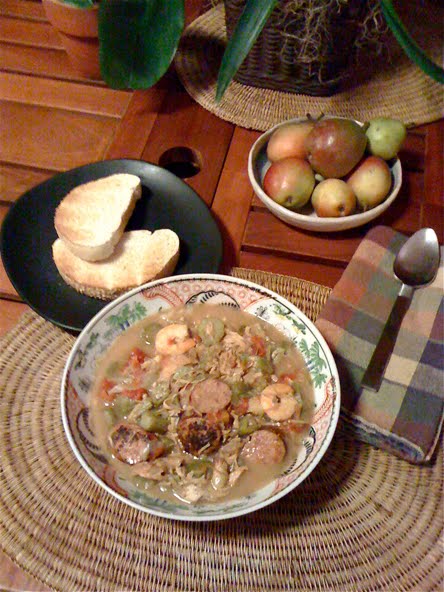
Before detailing the recipe for chicken and sausage gumbo from that book, let me explain that the gumbo in the photo here is NOT that recipe, but my sister’s own recipe, which comes from her head as she cooks. She has assured me that the recipe below is an excellent start for those learning to make this Louisiana favorite.


CHICKEN AND SAUSAGE GUMBO

Ingredients:

1 chicken (4-5 lbs) cut into serving pieces

Salt

Cayenne pepper

1 cup vegetable oil

1 cup all-purpose flour

2 cups chopped yellow onions

1 cup chopped green bell peppers

½ cup chopped celery

About 2½ quarts chicken broth

2 bay leaves

½ teaspoon thyme

1 lb andouille sausage, sliced ¼ inch thick

¼ cup chopped green onions—both white and green parts

2 tablespoons chopped fresh parsley

Hot cooked rice for serving


What to do with it all:

Season the chicken generously with salt and cayenne and set aside. In a large Dutch oven, make a roux by combining the oil and flour over medium heat. Stirring constantly, cook for about 30 minutes, or until the roux is dark brown. Add the onions, bell peppers and celery and cook for 5 to 10 minutes, or until the vegetables are very soft.

Add the broth and stir to blend well. Add the chicken, bay leaves and thyme. Bring it to a boil, then reduce the heat and simmer, partially covered for about 2 to 3 hours, or until the chicken is fork tender. Add the andouille and cook for another 30 minutes. Adjust the seasonings and add the green onions and parsley. Remove the bay leaves. Serve immediately over rice.


This gumbo cook-up is on my to-do list, and I only hope it turns out to be as good as the gumbo from my sister’s kitchen. For those who have never had the experience of gumbo, give this recipe a whirl. Guaranteed you will like it.

Wednesday, November 24, 2010

French Quarter Idyll

Not long back from two days in New Orleans, city most recently famous for Katrina, and long famous for its cooking, its jazz, Mardi Gras, French Quarter and excellent bookshops. Spent the time there with my lifelong friend, Raymond, and it was a grand two days and nights. The best of times it was, but with all that we arrived back in Baton Rouge tired and road beaten.

Large amount of walking during the New Orleans hours, but how else can you absorb the fullness of the streets with all their sounds, sights and smells? A dozen or two reasons make Raymond and I the best possible travel mates, and we are especially in tune with and about the art of book buying and collecting. That pursuit was a big part of the hours we roamed and rested. Crescent City Books is a book lover’s dream, The Librarie Bookstore, Beckham’s, Octavia Books and perhaps the best of the lot, Garden District Book Shop, where a superb collection is watched over by a friendly and helpful crew. Raymond has better control of his wallet than I do. He came home with two books to my seventeen.

There’s little need to crow and croon about the food in New Orleans, which is famously good. Any way you turn it’s easy to find good spots for local specialties like crawfish, stuffed softshell crab or red beans and rice with boudin sausage. We had it all and the very best was at Pontalba House on Jackson Square. On the way south yesterday we stopped in LaPlace for lunch at the Bully Bar and had a couple of great po-boys, crawfish and catfish.

We wandered in and out of French Quarter bars all day and night, and in the process of testing our endurance, met a few people who made the good time better. Unlikely that any of those people will ever see these words, but I’m shouting out anyway… You entertained us, assisted us, explained and smiled—Appreciation and thanks to Melanie, Jake, Michelle, Frank, Julie, Corvana and T’meeka. We brought a little of your smile back to Baton Rouge. Hats off to the Marriot Hotel for platinum-like service; you all did good.

Raymond says he’s too tired for lagniappe tonight. That’s our loss, and we’ll be looking for more later.

Top photo: A house on Chartres Street that caught my eye; in the bottom photo Raymond studies a menu in the Garden District, visualizing a Cuban sandwich.

Tuesday, November 23, 2010

1000 Words


Afternoon in the French Quarter, New Orleans—Tuesday, November 23, 2010


Saturday, October 9, 2010

Ole Man River

Always a good feeling to come across a book and a writer you like, but it’s made even better when you know there are other books by the same writer that you can follow through with. This was exactly my experience with Elise Blackwell and her 2007 novel, The Unnatural History of Cypress Parish. The book was recommended to me by a friend whose opinion I respect, and not long after our conversation the book landed in my mailbox.


Pretty much a habit for me to open a book and read the first paragraph, or first page, a way of helping determine where to put the book in my to-read stack. Ms Blackwell’s first paragraph in The Unnatural History of Cypress Parish was such that I reread it three or four times and then put the book on top of my stack. It’s what I call an opening you see only once every year or two in the course of daily reading.


“I am a man far removed from his origins—by miles, by years, and by more intangible measures. Every piece of wood, no matter how refined and sanded, is marked by the conditions where the tree was grown. The mix of nutrients in the soil and air, the shifts in temperature and humidity, high winds and lightning, the damage from insects and wood-boring birds, and cultivation—the human history of the land—leave their evidence. Who I am remains intimately gnarled with where I came from. And where I came from is the place making the news, the place in the line of fire, soon to be the eye of the storm. Though I’ve pruned from my speech all traces of accent, I’m from south of south. I am from Cypress Parish, Louisiana.”


On the eve of Hurricane Katrina, an elderly Louis Proby, recalls the great flood of his small Louisiana town in 1927, the year he crossed from boyhood to manhood. Louis is the son of Cypress Parish’s superintendent, William Proby, a man who after climbing the ranks in local logging finds himself forced by circumstance to compromise himself in deals with laborers as well as casinos in order to please the wealthy barons of power. A dutiful son, Louis is a reluctant witness to his father’s deals. The boy’s understanding of life is green, while at the same time his senses are blurred by first love for the French girl, Nanette Lançon. Louis is offered the job of driving lumber company official Charles Segrist to and from New Orleans, and thereby given entree into the posh but seedy clubs of New Orleans. Through Segrist his eyes are opened not only to prostitutes and hard drinking, but to back deals with Isleños bootleggers and plans to blow up a Cypress Parish levee, thus flooding the area in order to save New Orleans. He learns too that his father is not unaware of this plan that threatens the lives and homes of Cypress Parish residents. As an old man, Louis is still haunted by regrets from that year in his life, still trying to understand clearly and proving that the old adage, ‘hindsight is twenty-twenty’ is not always the case.


As I read the novel, one of the first questions that arose was the meaning of ‘unnatural’ in the title of the book. It takes a good part of the novel, but it becomes clear that the life and property of Cypress Parish were unnaturally sacrificed to protect business interests in New Orleans. We learn near the end that the loss of life and property brought on by dynamiting the levee was unnecessary in saving New Orleans. Exploding the levee prevented a natural, less costly outcome of the Mississippi River’s swollen threat of inundation. There were no blasted levees with Katrina seventy-eight years later, but the parallels are obvious.


The major character in the book could almost be called the Mississippi River. The story is heightened by the writer’s coloring of the mighty river, and what is almost an endowment of personality. The currents, the magnificent house-swallowing whirlpools, the muddy churning highlighted by colors you least expect, and the geography-shifting behavior of alluvial silt violently, magically thrusting newly created islands to the surface.


The young narrator Louis is a burgeoning naturalist who keeps journals on the natural setting he lives in. One of his favorite writers is Pliny the Elder, and Blackwell enriches her story by juxtaposing Pliny’s writings on the eruption of Mount Vesuvius in 79 AD with the building ‘eruption’ of the Mississippi upon Cypress parish. It is skillful interweaving of natural histories, ancient and modern.


The boy Louis has a faulted character for which we have the greatest sympathy. He is a young man who takes pride in his understanding of the natural world, but in his youth possesses minimal and immaturely skewed understanding of why his father and others do the things they do. Blackwell has given her narrator a host of dichotomies to deal with—torn between city and country, art and science, family vs the girl he loves, home and the world outside, and finally past and future.


As readers, we all like a good story with richly layered characters. Most of us also look for a style or prose that stands apart from the bland narrative of too many ‘bestsellers’ touted by booksellers and celebrity reviewers. Elise Blackwell writes in an elegant, yet natural style that propels her story, enlivens her characters, and yet at the same time stops her reader on occasion with a need to reread a particularly well-wrought passage of plain unadorned beauty. Briefly said, the woman can write. Like those on Pliny the Elder, the interludes of history about the leprosy hospital in Carville, Louisiana are shimmering in Ms Blackwell’s hand.


As one who grew up in Louisiana, I am drawn to stories about the state, with all its mistakes and foibles and crooked politicians. The Unnatural History of Cypress Parish however is a story I would encourage any book lover to read, with a guarantee that the chances of disappointment are slim.

About Me

My photo
Oak Hill, Florida, United States
A longtime expat relearning the footwork of life in America