Showing posts with label Brown Ink. Show all posts

Tuesday, May 24, 2011

Capricorn the Goat

The only thing that surprises me about the heightened interest in sepia and other brown inks that has flared over the past year is its lateness in coming. There was a time centuries ago when sepia ink was the norm, as common as royal blue ink is today. But then fads change and eventually traditionals are replaced with something deemed more right for the time. There is probably a good chance that royal blue ink will fall out of favor, to be replaced with another sober and conservative color of ink suitable for business documents and important signings. It might even turn out to be a return to sepia-like browns.


I’ve had a thing for brown inks for some time, and back when there were few to choose from among available stocks I had them mixed by Osamu Ishimaru, premier ink blender at Sailor. The opportunity to have custom inks mixed on the spot is something I lament about no longer living in Tokyo. In a city the size of Tokyo, where fountain pen and ink hobbyists are well served by pen clinics and festivals occurring several times a year, and where pen shops are numerous, the events and opportunities provide a near paradise for pen and ink enthusiasts. Sadly, where I live now it’s an Internet fueled hobby for the most part. Can’t say that has cured me of a mania for ink. A new ink, manufacturer or shade still has the power to set heartstrings humming.


The other day I pulled from an out of sight corner in my stacks of ink a shade of brown mixed for me by Sailor’s Mr Ishimaru maybe fours years ago at a pen clinic sponsored by Maruzen Department Store in Tokyo. At this remove it’s hard to recall my description of the brown I was looking for at the time, but surely it was something ‘woody, darkish and robust with a hearty splash of black.’ Whatever the description at the time, Mr Ishimaru as always was game for a mix and match, dip and dab search for the desired shade. The result was an ink that he suggested we call Capricorn. No idea where he came up with that name but it suited me fine. I still have a bottle half full of that woody, robust and blackish brown Capricorn.


Not a lot of critical commentary this time, but more a sampling of what the color looks like. Sailor Jentle Ink is well represented among the bottles on my shelves and I honestly cannot recall even one among them disappointing in terms of saturation, shading, purity and smoothness. If you look at the 1-3-5-7-9-10 drying time samples in the top photo, it’s clear that this Sailor ink at least is not especially quick drying. Even after nine seconds some wetness remains, though ten seconds are enough for non-smear dryness.


But look at that chocolate pudding richness in the swab in the top photo. It looks quite different from the Capricorn in the comparative brown swabs in the second picture. Fact is, the ink looks much, much better in lines of script on a page than in any quick and doubly saturated Q-tip swab. A page full of writing in Sailor Capricorn ink is a beautiful sight.


For us here in the US, the ability to acquire this ink is not so easy, since Sailor doesn’t send its ink blenders on tour to America. But for those living in Japan the difficulty evaporates when you have the ink’s mix code and the chance to attend one of the many pen clinics in most large Japanese cities. The mix code for Sailor Capricorn is: 070313031. Give this number to any Sailor ink blender and he should be able to mix up a bottle of Capricorn in about ten minutes.


The writing in the top photograph was done with a Pelikan Souverän M1000 with a broad nib.

Tuesday, May 17, 2011

From Fidel with Love

Been three years at least since I bought a bottle of Waterman Havana ink. For a couple of months after that I used the ink regularly, never overly fond of it, but then not really disappointed either. I liked having seven or eight pens inked with a variety of colors and the Havana fit well into that custom. Some months passed and for one reason or another the Havana slipped into the background among the bottles on my shelves. In all honesty, it began to collect dust from lack of use and when the day came to pack it all up for shipping to Florida, the Havana got dusted off, wrapped carefully and nestled safely among its brothers and sisters in a big packing box. Unpacked and resettled on its new shelf it once more began to collect dust. Until I read something the other day about Waterman Havana on Peninkcillin.


Chances are good that Peninkcillin is already a familiar site to many, but if not then let me be one to recommend it. Especially for pen and ink lovers it’s a good read. But back to the Waterman Havana…

Reminded of the old bottle on my shelves, long unused and nearly forgotten, the urge came to once more dust it off and give it a wake up scribble. Since it's a Waterman ink I decided to fill a Waterman Carene medium nibbed pen with Havana and see if it balanced out with my earlier impressions.


The challenge that Waterman faces with this ink is the recent popularity of brown inks and the dozens of new colors in the brown range that have been introduced in the last couple of years. There was a time when brown ink was uncommon and there weren’t more than one or two companies producing it, but that has changed and these days brown ink is battling traditional colors for place. Sepia ink especially has enjoyed a boom, and with the appearance of Pilot’s Iroshizuku series the bar has been raised. Their Tsukushi (Horsetail) and Yama-guri (Mountain Chestnut) are top of the heap. Then came Maruzen’s Athena ink and a limited edition (1000 bottles only) of a hard to beat Sepia. Noodler’s has entered the competition with their class A Walnut ink and Diamine Chocolate is no less impressive than Chocolate Truffles from Godiva.


The result of all that leads to a slippery slide for Waterman Havana. The first swab I made today reminded me of nothing more than Shinola brown shoe polish, a comparison I have also used to describe Montblanc Sepia (or here in the US, Montblanc Toffee Brown). Surely there are many who like the particular brown typified by shoe polish, and for them the Havana will meet expectations. As one who especially likes brown ink, color-wise the Waterman Havana leaves me lukewarm.


Waterman makes high quality ink, of that there is no question. Like my favorite Waterman, Florida Blue, the Havana performs well in all the areas that draw attention. The shading is good, neither too much nor too little, and on both white and cream colored paper the result is a good balance. Saturation is good, and on the paper I used for testing—bright white copy paper and Rhodia Webbie cream-colored paper—drying time was exceptionally fast. Two, three seconds at most and the ink is bone dry. That might be particularly good news for left-handed writers.


I allowed the example in the second photo here to dry for an hour and then put it under running water for close to forty-five seconds, allowing it to lay submerged in cold water. At the end of that every word was perfectly legible. Let no one tell you Waterman ink is not waterproof.


In the end, chances are good I will go back to my favorite browns in the Iroshizuku and Maruzen families after using the Havana now in the Carene fountain pen. Waterman of course has never pretended to be a frontrunner in the production of ink, and the feeling now with the Havana ink is that the Waterman ink blenders have allowed it to be superseded by other inks in the brown spectrum.


Keep an eye out for a future Waterman Havana review from Peninkcillin. His review will most likely be more thorough than the one here.

Thursday, November 11, 2010

Tea & Walnuts

Two very warm and individual brown inks arrived yesterday from Brian Goulet’s Inkdrop. This time Brian has selected an assortment of samples which he very aptly calls, “Mudslinging,” and which includes five shades of ‘muddy’ brown ink, plus a bonus sepia ink new from Private Reserve. Of the six samples, the Lie de Thé from J Herbin grabbed my attention right off, because it’s an ink long on my wish list. The other color that struck me as bold and off the curve is the Noodler’s Walnut.


Hard to speculate on what is prompting the interest, but judging from all the variety out there now, brown ink has suddenly become the new thing in ink colors. Look back as recently as two years ago at what was then available in brown, and you’d have difficulty seeing more than three or four brands offering a brown ink. Seems now that every ink maker out there is stirring up pots of brown.


But in my opinion brown is a hard color to get right. I expect that mixing up a batch of something in the ‘brown’ family is pretty basic at this point, but getting it right, getting all the desired qualities working together in an original shade is perhaps where the challenge lies. And to my delight, there are a few of them who have gotten it bang on target.


J Herbin’s Lie de Thé is one of those, and Noodler’s Walnut is another—one milk chocolaty, the other dark and bold. No hesitation in describing the Walnut ink as dark and bold, but I have sat staring at the Herbin ‘related to tea’ ink for forty-five minutes and still can’t settle on an accurate comparison. It does not look especially like tea, even tea with milk; it doesn’t look like coffee, nor milk chocolate. Because of a faint yellowish cast, what I am most reminded of is a spoonful of water stirred into soil from China. What I can say about this color is that—for those partial to brown—it is a pretty shade, and one that is standard enough to be rated useful, and not merely a mood ink. You could sign your mortgage with this ink and illicit no more than “Mmm…pretty color” from your banker. In the same sense, the Noodler’s Walnut is dark enough to pass for brown-black under ‘civilian’ eyes. For my tastes these browns are a combination made in ink heaven.


Writing… I tested the Herbin Lie de Thé in a Lamy 2000 with what I believe is a medium nib. (The Lamy 2000 carries no identifying marks as to nib size.) Granted the Lamy is a most agreeable pen, but it is sensitive to an ink that lacks cooperation, and with Lie de Thé, ink and pen sort of hit it off and wove themselves into immediate partnership. Great flow of ink; the Lamy 2000 tends to be a wet pen. Shading is good, giving to the lines what most would call a good balance. Saturation is okay, but this is not a shade that invites deep saturation, though there is enough to produce the kind of written page most are comfortable with. I will give this mix from J Herbin a bunch of gold stars, and soon dial up Ink Nouveau for a bottle of Lie de Thé.


For the Noodler’s Walnut I chose a Sailor Professional Gear, medium nib. This pen is what I call picky about inks, and is often quick to stubbornness with certain inks. I have on occasion felt like it was flashing signals telling me to change the ink. But it took right to the Noodler Walnut, and I admit to being surprised at that. With notable exception, Noodler ink has been less than cooperative in many of my fountain pens. Not so with the Walnut, and this too is one I will buy, or beg from Santa. With this one you will get tremendous saturation that leaves the backside of your paper free of all but the faintest show through. Shading is hard to discern, though it is there when you look carefully. Darker inks tend to not advertise their shading.


I scribbled a lot with both these inks and never had a problem with slow drying time. Reasonable and not an issue, though left-handed writers may have some concern.


My conclusion? Click on Goulet Pens and get yourself a bottle or sample of these well-rounded mudslinger browns.

Friday, October 29, 2010

Shoe Polish for Beavers

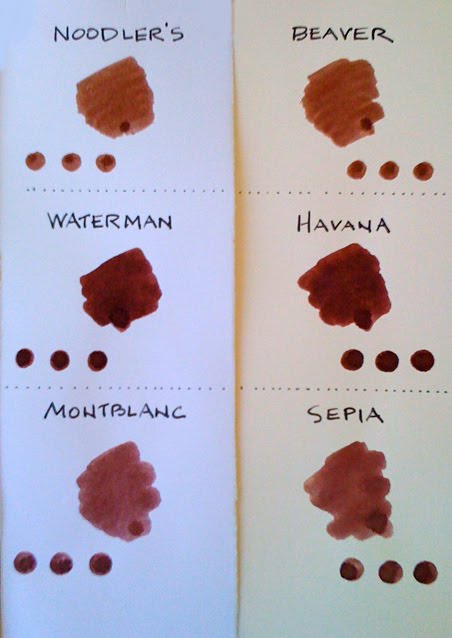
About the recent thread of autumn tinted inks in these pages, today is something like a U-turn, a looking back at the brown I jumped over last Tuesday. That particular brown is NOODLER’S BEAVER, and at this point, after an hour or two of playing with the ink on two different kinds of Clairefontaine paper, in a Sailor Professional Gear fountain pen with medium nib, and with Q-tip, I have to say in all honesty that I am only moderately impressed.


Like green, brown is another color I’ve chased after for a long time, always searching for the one that fits my preferences as closely as possible. In that search I’ve found three that fit the bill, three that I’m happy with, but those inks are not on parade here. The spotlight this time is on Noodler’s Beaver.


The color—Let me say right off that all the red in the Beaver works to push the shade toward what I call shoe polish brown. There will be some who like this particular reddish Shinola brown, and for them I would say go for the Beaver. But memory works against me, as I am reminded of the Saturday nights I had to polish my father’s shoes for church on Sunday. While it isn’t my kind of brown, the same is not true for everyone, and Noodler’s Beaver could be the one for you.


I lined Noodler’s up alongside two other browns and found all three to be close. Side by side, Noodler’s Beaver, Waterman Havana and Montblanc Sepia (Toffee Brown) almost look to be from the same ink pot, or the same shoe polish bottle. So close in fact, you might have difficulty in telling them apart. Feel like I would be stumped if you showed me unlabeled samples of the three tomorrow.


Brian Goulet has some good things to say about the Beaver, and I tend to agree with his remarks about the shading of the ink. Yes, it does shade well, and it also flows smoothly. With my Sailor pen at least, it lays down a line of well-balanced wetness, neither too wet nor too dry. In this sense, I found the drying time reasonable, but must caution left-handed writers that drying time could be a problem.


Everyone has this or that little something that draws them to a particular brown, or green or any color ink. Experience has taught that an ink displaying the finest of all qualities is rare. I have to think that getting it all right is a matter of delicate balance. Noodler’s Beaver has some excellent qualities, but the color, be it autumn or otherwise is not what I look for in a brown ink.


In my book the three top brown inks are: Maruzen’s Athena Sepia, Iroshizuku’s Tsukushi and Yama-guri. All the qualities we look for in ink are superior in these three. They are examples of that delicate balance personified by the harmony of color and performance.

About Me

My photo
Oak Hill, Florida, United States
A longtime expat relearning the footwork of life in America