Showing posts with label Iroshizuku. Show all posts

Wednesday, October 5, 2011

Seven Oranges

Prompted by Brian and Rachel Goulet’s October inkdrop from Goulet Pens, I went digging in my ink stacks pulling out some resonant oranges to line up beside their “Autumn Leaves II” October inkdrop palette. Pretty much a sucker for inks in the orange range, and with shades enough to satisfy any Halloween or Autumn theme I have probably wasted money on some I too rarely use. But addiction to ink being what it is, the phrase ‘waste of money’ doesn’t easily get through to me.


In one important characteristic, orange inks are like their distant cousins, the grays. For both colors to work well they must have good saturation, otherwise the words wash off the page and a reader will have to squint to read. No matter how beautiful an ink is in the bottle, or in a swab test, if it produces hard-to-read lines of writing, then you don’t have an ink that is very useful. I could name a half dozen orange inks that fail the test—I have a few bottles gathering dust—but for this comparison I left those inks out and lined up seven oranges that have rich saturation and are not difficult to read on the written page.


Another thing about the seven inks displayed here is that each one comes from a reputable company consistently producing quality inks. The range is broadly international, covering inks from the US, Switzerland, Germany, England and Japan.


A word about each…

The inks on the chart here are by no means listed 1-7 in any particular order of preference or quality. It is a totally random arrangement.


1. Private Reserve Orange Crush: I lied. Private Reserve’s Orange Crush is one of my longtime favorites that has as much to do with a childhood full of Orange Crush pop as it does with the richness of the color. This one is perhaps the most saturated of the seven and produces lines that can almost be called delicious.

2. Caran d’Ache Saffron: Similar to Diamine’s beautiful Pumpkin ink, this one too has the needed saturation, and a softness not seen in the Orange Crush. Part of the Earth Colors series from Caran d’Ache, it is a perfect fit, looking much like something squeezed from the earth.

3. De Atramentis Buonarroti Michelangelo: De Atramentis has long been a favorite ink maker and this one comes from Dr Jansen’s Historic Persons series. Very close to butterscotch and not terribly far from its Saffron neighbor, this ink definitely has a renaissance flavor, a color familiar in the works of Michelangelo.

4. Diamine Sunshine Yellow: Perfect name for a near golden yellow-orange. Sprinkle some orange zest beside this ink and it would be a match. This is one in the October inkdrop which arrived yesterday and there hasn’t been time yet to try it a pen, so I am trusting the saturation will be similar in a written sample.

5. Sailor Custom Mix Persimmon: Another ink that is always in one of my fountain pens, it was mixed by Osamu Ishimaru at a Tokyo pen clinic. I placed a persimmon on the table and asked him to match the color. No question he hit the bullseye. It is the color of late autumn persimmons hanging on trees in Japan.

6. Iroshizuku Fuyu-gaki (Winter Persimmon): No argument with Pilot and blenders of the Iroshizuku inks; they too have captured the essence of persimmons. My tiny complaint about the color is that it is closer to the color of the fruit in autumn and not winter. As the fruit ripens you will see more red.

7. Iroshizuku Yu-yake (Sunset): Another ink I like despite not using very often. That isn’t because of anything that bothers me specifically, except that it always looks better in a swab than it does in a letter, journal or notebook scribble. Saturation is fine and it has all the good qualities of Pilot ink.


For those with a penchant for orange, red-orange or yellow-orange inks, any of the above seven will do the trick and have your pens drunk on smoothness. Except for the De Atramentis Buonarroti Michelangelo they are all available at Goulet Pens, where the service is No. 1. If you are interested in the De Atramentis ink, it is available at Art Brown.

Friday, July 1, 2011

Laughing Out Blue

Among the fountain pens that I keep inked and lined up ready for use is a Lamy 2000, a pen I consider to be a hallmark in design and stripped-down functionality. The design is simple and inarguably beautiful in its uncluttered matte black and silver. It writes every time in a smooth and flowing line and cleaning, filling and maintenance are all trouble-free. In 1966, when Gerd Alfred Müller handed over to production his designs for the Lamy 2000 a new star joined the ranks of fine writing instruments.


A detailed review of the Lamy 2000 appeared here in March of 2010, shortly after receiving the pen as a gift from longtime friends. I was smitten with the pen from the very beginning, but the months since have deepened my liking and appreciation of Müller’s design. Unfortunately, a stupid accident on my part interrupted regular use of the 2000, and caused it to be sidelined for some time. As a part of his minimalist design, Müller used a small cap ring with two tiny ‘ears’ protruding slightly from the lower barrel as a means of holding the cap on. This cap ring is only visible as two silver ridges hardly noticeable at the grip point of the barrel. The pen unscrews at that spot, separating nib and feed from the upper barrel. At a time I can’t remember, I lost that small, thin cap ring when I had the pen apart for cleaning—a piece so tiny I failed to notice its absence. I reassembled the 2000 and laid it aside. The next time I picked it up the cap fell off in my hands. It took a while but I finally figured out the problem was that missing cap ring. With a cap forever falling off, I decided to give the pen a rest until I could get a replacement cap ring.


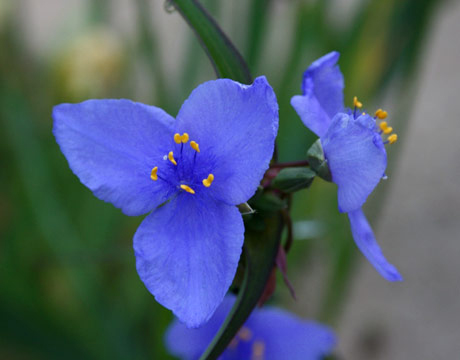
A new cap ring arrived yesterday from a friend in Japan and put my 2000 right back into action. (Anyone in the US with a similar problem, try here.) Simple part, simple fix and now the pen is laughing out blue. I looked through the bottles of Iroshizuku and settled on Tsuyu-kusa, a color too long out of circulation around here. More often than not blue inks don’t light much of a spark for me, but there are a few that fit the mood at times and the Iroshizuku Spiderwort or Dayflower is one of those. About the name, the Japanese tsuyu-kusa is literally ‘dewflower’ but the blue spiderwort is a good match for the color and some use that flower’s name. I have an idea that the ink blenders at Pilot might have chosen the name from a passage in Japan’s classic, The Tale of Genji — “It was true then: he had after all the shifting hue of the dewflower. She had heard about that. She had heard, albeit in general terms, that men were good at lying, that many a sweet word went into the pretense of love.” The dewflower, or dayflower, with its bright blue petals open at dawn and wither at dusk, making it a suitable analogy for fleeting affections. The pretty plant is quite hardy and can often be seen thriving along roadsides.


The Tsuyu-kusa and the Lamy 2000 sample is a selection of four tanka poems by Tawara Machi from her collection, Salad Anniversary.

Tuesday, May 24, 2011

Capricorn the Goat

The only thing that surprises me about the heightened interest in sepia and other brown inks that has flared over the past year is its lateness in coming. There was a time centuries ago when sepia ink was the norm, as common as royal blue ink is today. But then fads change and eventually traditionals are replaced with something deemed more right for the time. There is probably a good chance that royal blue ink will fall out of favor, to be replaced with another sober and conservative color of ink suitable for business documents and important signings. It might even turn out to be a return to sepia-like browns.


I’ve had a thing for brown inks for some time, and back when there were few to choose from among available stocks I had them mixed by Osamu Ishimaru, premier ink blender at Sailor. The opportunity to have custom inks mixed on the spot is something I lament about no longer living in Tokyo. In a city the size of Tokyo, where fountain pen and ink hobbyists are well served by pen clinics and festivals occurring several times a year, and where pen shops are numerous, the events and opportunities provide a near paradise for pen and ink enthusiasts. Sadly, where I live now it’s an Internet fueled hobby for the most part. Can’t say that has cured me of a mania for ink. A new ink, manufacturer or shade still has the power to set heartstrings humming.


The other day I pulled from an out of sight corner in my stacks of ink a shade of brown mixed for me by Sailor’s Mr Ishimaru maybe fours years ago at a pen clinic sponsored by Maruzen Department Store in Tokyo. At this remove it’s hard to recall my description of the brown I was looking for at the time, but surely it was something ‘woody, darkish and robust with a hearty splash of black.’ Whatever the description at the time, Mr Ishimaru as always was game for a mix and match, dip and dab search for the desired shade. The result was an ink that he suggested we call Capricorn. No idea where he came up with that name but it suited me fine. I still have a bottle half full of that woody, robust and blackish brown Capricorn.


Not a lot of critical commentary this time, but more a sampling of what the color looks like. Sailor Jentle Ink is well represented among the bottles on my shelves and I honestly cannot recall even one among them disappointing in terms of saturation, shading, purity and smoothness. If you look at the 1-3-5-7-9-10 drying time samples in the top photo, it’s clear that this Sailor ink at least is not especially quick drying. Even after nine seconds some wetness remains, though ten seconds are enough for non-smear dryness.


But look at that chocolate pudding richness in the swab in the top photo. It looks quite different from the Capricorn in the comparative brown swabs in the second picture. Fact is, the ink looks much, much better in lines of script on a page than in any quick and doubly saturated Q-tip swab. A page full of writing in Sailor Capricorn ink is a beautiful sight.


For us here in the US, the ability to acquire this ink is not so easy, since Sailor doesn’t send its ink blenders on tour to America. But for those living in Japan the difficulty evaporates when you have the ink’s mix code and the chance to attend one of the many pen clinics in most large Japanese cities. The mix code for Sailor Capricorn is: 070313031. Give this number to any Sailor ink blender and he should be able to mix up a bottle of Capricorn in about ten minutes.


The writing in the top photograph was done with a Pelikan Souverän M1000 with a broad nib.

Tuesday, May 17, 2011

From Fidel with Love

Been three years at least since I bought a bottle of Waterman Havana ink. For a couple of months after that I used the ink regularly, never overly fond of it, but then not really disappointed either. I liked having seven or eight pens inked with a variety of colors and the Havana fit well into that custom. Some months passed and for one reason or another the Havana slipped into the background among the bottles on my shelves. In all honesty, it began to collect dust from lack of use and when the day came to pack it all up for shipping to Florida, the Havana got dusted off, wrapped carefully and nestled safely among its brothers and sisters in a big packing box. Unpacked and resettled on its new shelf it once more began to collect dust. Until I read something the other day about Waterman Havana on Peninkcillin.


Chances are good that Peninkcillin is already a familiar site to many, but if not then let me be one to recommend it. Especially for pen and ink lovers it’s a good read. But back to the Waterman Havana…

Reminded of the old bottle on my shelves, long unused and nearly forgotten, the urge came to once more dust it off and give it a wake up scribble. Since it's a Waterman ink I decided to fill a Waterman Carene medium nibbed pen with Havana and see if it balanced out with my earlier impressions.


The challenge that Waterman faces with this ink is the recent popularity of brown inks and the dozens of new colors in the brown range that have been introduced in the last couple of years. There was a time when brown ink was uncommon and there weren’t more than one or two companies producing it, but that has changed and these days brown ink is battling traditional colors for place. Sepia ink especially has enjoyed a boom, and with the appearance of Pilot’s Iroshizuku series the bar has been raised. Their Tsukushi (Horsetail) and Yama-guri (Mountain Chestnut) are top of the heap. Then came Maruzen’s Athena ink and a limited edition (1000 bottles only) of a hard to beat Sepia. Noodler’s has entered the competition with their class A Walnut ink and Diamine Chocolate is no less impressive than Chocolate Truffles from Godiva.


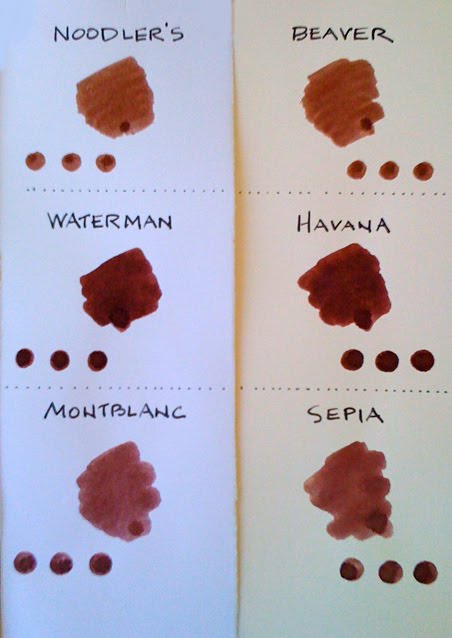
The result of all that leads to a slippery slide for Waterman Havana. The first swab I made today reminded me of nothing more than Shinola brown shoe polish, a comparison I have also used to describe Montblanc Sepia (or here in the US, Montblanc Toffee Brown). Surely there are many who like the particular brown typified by shoe polish, and for them the Havana will meet expectations. As one who especially likes brown ink, color-wise the Waterman Havana leaves me lukewarm.


Waterman makes high quality ink, of that there is no question. Like my favorite Waterman, Florida Blue, the Havana performs well in all the areas that draw attention. The shading is good, neither too much nor too little, and on both white and cream colored paper the result is a good balance. Saturation is good, and on the paper I used for testing—bright white copy paper and Rhodia Webbie cream-colored paper—drying time was exceptionally fast. Two, three seconds at most and the ink is bone dry. That might be particularly good news for left-handed writers.


I allowed the example in the second photo here to dry for an hour and then put it under running water for close to forty-five seconds, allowing it to lay submerged in cold water. At the end of that every word was perfectly legible. Let no one tell you Waterman ink is not waterproof.


In the end, chances are good I will go back to my favorite browns in the Iroshizuku and Maruzen families after using the Havana now in the Carene fountain pen. Waterman of course has never pretended to be a frontrunner in the production of ink, and the feeling now with the Havana ink is that the Waterman ink blenders have allowed it to be superseded by other inks in the brown spectrum.


Keep an eye out for a future Waterman Havana review from Peninkcillin. His review will most likely be more thorough than the one here.

Thursday, May 5, 2011

Splish Splash

Always a noteworthy day for us ink mavens when a new batch of inkdrop samples arrive from Goulet Pens. Of course, after one look at the ink already stacked up in my workroom almost anyone would write me off as hopelessly obsessed. I remember chatting with nibmeister Nobuhiko Moriyama in Tokyo one day, and his casual comment—with a smile and the experience of having seen it often enough—that I was suffering from an ink malady. I plead guilty, if guilty is the correct word. I like my ink and sometimes feel undressed if there aren’t multi-colored ink stains on all ten fingers.


As is the case in each and every aspect of business at gouletpens.com, the inkdrop samples go out in the mail promptly on the first day of each month. Not the first time to say it, but no one beats Brian and Rachel in customer service. They do it all so very, very well. As is usual, the samples arrived in my mailbox before the fifth day of the month. Unlike last month however, the five samples this month arrived with the names of each sample attached. April was “Guess What” month as far as the brands and names went, an experiment that didn’t work for me, but in defense of Brian and Rachel’s unnamed mail outs, they did include labels this month for the unnamed ink last month.


The five inkdrop samples this time are: (1) Noodler’s Apache Sunset, (2) Diamine Majestic Blue, (3) J Herbin Poussière de Lune, (4) Iroshizuku Kon Peki and (5) Noodler’s Cactus Fruit Eel. Forget for a moment the individual colors and consider what a impressive set of inks this is as a group. Brian calls them the ‘Goulet Favorites’ and in response to that I am prompted to say the man has perfect pitch in putting one ink against another and another. The five shades seen in the photo here are well matched—the spicy orange Apache working so well with the dusky purple from J Herbin, the Iroshizuku blue a perfect sidekick to the richness of the Diamine Majestic, and that matchless Cactus Fruit tying the knot.


No attempt here to evaluate the in-pen-on-paper qualities of the inks, too much enjoyment this first trial just splashing and dabbing, swishing and smearing with brush and Q-tip. The Iroshizuku Kon Peki is an old friend, one that has impressed for a long time with its behavior in a number of different pens and on different paper. Thanks to recommendations from Brian I’ve come to know that Diamine is a class ink, rarely failing to please in saturation, shading and depth of color. Noodler’s ink has on one or two occasions disappointed when it comes to performance, but that is by no means a write off. Several Noodler’s inks are among my regulars. J Herbin in my experience has never performed as anything but an excellent high quality ink in all the fountain pens I’ve paired it with. Why should the Poussière de Lune be any different?


I look forward to filling a few pages with each of the five inks and getting an idea of what they look like coloring words and not just splotches. The Cactus Fruit especially is calling my name.

Monday, January 10, 2011

Steadfast is Right

Opening a package of five black, or near black inkdrop samples from gouletpens.com this week, the initial feeling was disappointment. Four of the samples are black, a choice of ink that I use very little. But I do understand Brian and Rachel’s decision to showcase the black inks; a whole lot of people use black ink every day of the week, and next to blue it may be the bestselling ink. They call the samples this month ‘Steadfast Resolutions.’ The ‘steadfast’ is a well-chosen word because it describes something fixed or unchanging, something steady. Good description of black ink.


Disappointment with the samples evaporated when I got a closer look at the one sample that isn’t a pure, true black. That one is Noodler’s Lexington Gray.


As far as ink goes, gray is a difficult mix. Too often it turns out to be a shade difficult to read easily on the page. As much as I like Pilot’s Iroshizuku ink, their Fuyu-syogun and Kiri-same inks are ultimately unsatisfying. Why? Anything more than a card or memo, both are hard on the eyes. Des Atramentis solved that problem in their ‘Charles Dickens’ with a touch of green and the perfect measure of black. Noodler’s Lexington Gray reminds me of the De Atramentis ink.


Lexington Gray has what some would call an antique look, or a feeling of ink you might find in a dusty box of letters from the attic. Of course, it’s only opinion, but it’s this aged quality that makes me feel the Lexington Gray works best on paper less than pure white. Oh sure, it looks good on a snowy Clairefontaine paper, but to my eyes it looks even better on other backgrounds. Strong on cream, impressive on wheat or pale green…Noodler’s got this ink to work well across a wide spectrum of paper types.


Quick drying, this one should please left-handed writers. In my trial, the ink didn’t smear a bit after a count of one-one-thousand. How does it stand up against water? Think invincible. I held a sample under an open tap for thirty seconds and the Lexington Gray didn’t budge; with neither runs, drips or smears, the words remain wholly legible, even clean.


Shading is negligible, but more noticeable on white paper. Saturation excellent, which is one reason this gray works where others don’t. My testing was with a Pelikan Souverän 600, which is fond of Noodler inks. The flow is good, never a concern. Some might call it a wet ink, but this kind of generous flow is a quality I prefer.


Quick to order a bottle of this impressive mix from Noodler, I am already thinking one bottle wasn’t enough. Lexington Gray has been added to my regular rotation of favorites.

Friday, October 29, 2010

Shoe Polish for Beavers

About the recent thread of autumn tinted inks in these pages, today is something like a U-turn, a looking back at the brown I jumped over last Tuesday. That particular brown is NOODLER’S BEAVER, and at this point, after an hour or two of playing with the ink on two different kinds of Clairefontaine paper, in a Sailor Professional Gear fountain pen with medium nib, and with Q-tip, I have to say in all honesty that I am only moderately impressed.


Like green, brown is another color I’ve chased after for a long time, always searching for the one that fits my preferences as closely as possible. In that search I’ve found three that fit the bill, three that I’m happy with, but those inks are not on parade here. The spotlight this time is on Noodler’s Beaver.


The color—Let me say right off that all the red in the Beaver works to push the shade toward what I call shoe polish brown. There will be some who like this particular reddish Shinola brown, and for them I would say go for the Beaver. But memory works against me, as I am reminded of the Saturday nights I had to polish my father’s shoes for church on Sunday. While it isn’t my kind of brown, the same is not true for everyone, and Noodler’s Beaver could be the one for you.


I lined Noodler’s up alongside two other browns and found all three to be close. Side by side, Noodler’s Beaver, Waterman Havana and Montblanc Sepia (Toffee Brown) almost look to be from the same ink pot, or the same shoe polish bottle. So close in fact, you might have difficulty in telling them apart. Feel like I would be stumped if you showed me unlabeled samples of the three tomorrow.


Brian Goulet has some good things to say about the Beaver, and I tend to agree with his remarks about the shading of the ink. Yes, it does shade well, and it also flows smoothly. With my Sailor pen at least, it lays down a line of well-balanced wetness, neither too wet nor too dry. In this sense, I found the drying time reasonable, but must caution left-handed writers that drying time could be a problem.


Everyone has this or that little something that draws them to a particular brown, or green or any color ink. Experience has taught that an ink displaying the finest of all qualities is rare. I have to think that getting it all right is a matter of delicate balance. Noodler’s Beaver has some excellent qualities, but the color, be it autumn or otherwise is not what I look for in a brown ink.


In my book the three top brown inks are: Maruzen’s Athena Sepia, Iroshizuku’s Tsukushi and Yama-guri. All the qualities we look for in ink are superior in these three. They are examples of that delicate balance personified by the harmony of color and performance.

Thursday, October 7, 2010

Steeped in Orchid

I never win anything. When I got word the other day from my friend Julie at Whatever that I won her Wancher ink giveaway, I figured something went wacky with the stars and planets. Maybe the moon is in the seventh house, as the flower children used to say. Such a rare phenomenon, I almost emailed Julie to say she’d better have Vanna White spin the wheel again just to be sure.


The ink arrived today, and I’ve been playing with it for the past couple of hours, testing it, comparing it to similar inks, and generally getting my hands so messy it looks like I’ve been squishing grapes in my hands. The ink is from a seller in Tokyo who makes (at least for now) only five colors: Matcha Green, Asuka Brown, Tenmoku Black, Imari Blue, and the one I have here, Ebine Violet. Believe it or not, he sells a 50cc bottle for $3.50.


The ‘violet’ in the ink Wancher has named Violet Ebine tôyôran was inspired by the purple of the Calanthe orchid. Let me include a brief of the explanation found on the Wancher ebay site:

‘This purple is the color of the Japanese tôyôran, which is ‘Calanthe orchid’ in English. In Japan the orchid has a long history dating back to the Edo Period (1600-1867). Orchids were loved by the rich nobles of the time, and the plants were often covered by a gold or silver net for protection. Flower viewers were required to cover their mouths with paper so as not to breathe on the orchids.’


Personally, I like very much the orchid-like beauty of this Wancher Violet Ebine. From first glimpse I recognized it as an ink I would go back to again and again. The only thing is, color and shade wise, there is not really anything to call completely individual about the color. In no time at all I pulled five other colors from my ink shelves that bear a close resemblance. But in saying that I intend no criticism. These days, it is quite difficult for even the top ink makers to come out with a color that is totally individual. Just too many out there, from Diamine, Noodlers, Private Reserve and J Herbin, to expect that one of them will release a never before seen color of ink. Subtlety, nuance and a hint of native color are what we can expect in the ink market of today. And of course, an ink that behaves well in more than one pen, on more than one kind of paper.


At first look, I thought the Wancher Violet Ebine resembled Private Reserve’s Plum. A little longer look and I thought of PR’s Arabian Rose. So, I decided to line up five inks beside the Violet Ebine. As it happens, all five are close enough to fool even the likes of Brian Goulet. The six inks in the photos here are from top to bottom:

(1) Private Reserve Plum

(2) Private Reserve Arabian Rose

(3) Diamine Syrah

(4) Wancher Violet Ebine tôran

(5) Iroshizuku Yama-budo

(6) Iroshizuku Tsutsuji


I call the Violet Ebine beautiful, but amidst such close similarity we have to consider performance. The best way to get a well-rounded feel for the ink was to try it in three different fountain pens, on three different kinds of paper. So that’s what I did.


(A) Montblanc Meisterstück Doué on Life Noble Note cream paper—The pen moved smoothly across the page, laying down wet, but unshaded lines of ink. Noticed right off that nib creep is a problem with this ink, in this pen. On this first test, I found the Violet Ebine comparatively fast drying.

(B) Pelikano Junior on Clairefontaine 90g paper in a Rhodia Webbie—The pen and ink both move well together on this paper. However, shading is almost non-existant. The flow of ink is good and not so wet on this thicker, richer paper. Drying time not quite as fast as the first trial.

(C) Waterman Carène on white Clairefontaine Triomphe stationery—Again almost no shading, and once more a case of nib creep. Drying time is the slowest on this paper. The Carène flows smoothly with this ink, wet, but not so much as on the Noble Note paper.


I might hesitate to say that the Wancher ink is performance wise in the same category as big name inks like J Herbin and Montblanc, or Diamine and Pilot Iroshizuku, but this Violet Ebine tôran from Wancher is not at all a bad or inferior ink. I rather like it and expect it will have its share of use in my fountain pens. If you’re partial to purple, or near purple inks, this one might be for you.


And thanks, Julie.

Tuesday, June 8, 2010

Green Squiggles

The location of ink around here is for the time being haphazard. The Kugayama ink cabinet was something not shipped from Japan, and as a result there are now homeless ink bottles about, stacked in untidy rows on top of a chest. Staring at those bottles, I moved a few of them around, trying to put some order to the jumble. I’ve always been a sucker for green ink (among a half dozen other colors), so ended up with six bottles of green ink off to one side, the finalists chosen from a baker’s dozen of different greens.


I balked at the idea of filling six different pens to accommodate each of the greens, so divvied them up among pen, Q-tip, brush and folded paper. My purpose was to get a good, clean color sample, no more than a swatch of each color, and to leave out any observations about drying time, shading and such. I am happy enough offering just a simple color chart of green inks.


The attached scan may be difficult to read as far as the descriptions go. Here’s the order of colors and tools used; start at the top left and read across and down…

1. O-cha Green (Green Tea) • Sailor, order blend • scribbled with a pen

2. Racing Green • Montblanc • Q-tip

3. Conway Stewart Green • Conway Stewart • Brush

4. Frederick Chopin • De Atramentis • Folder paper

5. Shin-ryoku • Pilot Iroshizuku • Brush

6. Gin & Lime • Itô-ya Cocktail Ink • Q-tip


My favorite remains year after year the now discontinued Montblanc Racing Green. Some may find the bottom right, Gin & Lime a beautiful ink, and I would agree, but warn that it is a difficult color to read. Despite my fondness for the Iroshizuku inks, the Shin-ryoku comes off weakest in this line up. Always liked the Conway Stewart, but how can you not like that luscious blue-green. The Frederick Chopin is from the famous names series by De Atramentis, with a ‘pine green’ label attached to the ink. I like the heaviness of the green. I’ve saved Sailor’s O-cha Green for last, because it holds a special place in my nuttiness for ink. There is rarely a time when a pen loaded with this ink is not within my reach.

Wednesday, March 24, 2010

Another Nod to Sepia Ink

Possible that I may finally have found a sepia ink that I can use comfortably on more than just rare occasions. Sepia is a difficult shade of ink, and there are limitations to how far true sepia can be stretched. Different makers have various ideas about what it should look like. Compare Montblanc and Hakase to see different notions of the color. I wrote something about these two sepia inks in a blog post last January 7 called, “Legacy of the Cuttlefish.” At that time I wrote of finding little satisfaction in either the Montblanc or the Hakase sepia, the first too red, the second too pale. Though we associate the color sepia with brown, perhaps an antique brown, the basis of the color is the black we see in the ink of the cuttlefish. It was from this that the first sepia ink was made.


This morning someone gave me a bottle of Athena Sepia ink made by the Japanese stationer, Maruzen. The whole package is antique, to the extent that even the writing on the bottle is read in the old fashioned Japanese style, from right to left. The bottle’s shape is evocative of the 1920s, and the light green box is printed in a way that gives it the appearance of an old patent medicine from grandmother’s day. Receiving the gift, I was immediately impressed by the box and bottle, seeing a connection between presentation and the antiquity of sepia ink. I hurried home eager to give the Athena Sepia a trial.


Removing the cap and looking down into the bottle you get the feeling that it is a rich shade. Somehow it doesn’t have the watery look of other sepia inks. My first experiment was with a Q-tip, and that verified the richness. I then chose a Sailor 1911 Large fountain pen with a 21k ‘M’ nib, and after washing it well, filled it with the Athena Sepia. From the first words on the page I was pleased with the color, and wondered right off if the Iroshizuku blenders at Pilot had meditated upon this Athena sepia in the formulation of their Yama-guri brown. Because that’s what the Athena Sepia is close to, and it is the older ink. They are remarkably close.


In the Sailor 1911, the flow of ink is smooth, and looking closely at the samples, perhaps you will notice the nice shading it produces. Saturation is excellent. I tried it on two different kinds of paper and had good results on both. First I put a Q-tip smear and some lines on a sheet of 100% cotton based Crane stationery; satisfaction all around. No feathering, no bleed through, and not long in drying time. Next I tried a page of thick quality Japanese paper from an old journal. In this case, too I was pleased with the ink’s performance. No feathering, but a very slight bleed through, maybe not enough to count.


No question that from here on out, when the sepia mood strikes me, it’s Athena Sepia ink from Maruzen that will color my pen’s nib.


Saturday, February 13, 2010

From Blah to Bloom

Tokyo definitely not at its best on this Saturday of colorless, overcast skies, intermittent flurries of snow and freezing rain. Altogether a cheerless and dispiriting day, the kind when a brightening boost is needed to turn the mind and the eyes away from morose thoughts and murky views. To help in that department I have cheated a little on the date and call this Saturday, the 13th my Fun Ink Day. And to make it even better, I’ve spent an hour or so sprawled on my sofa idling through the pages of a typeface and font book.


Pocket Blonde’s blog post for Friday, the 12th alerted me to the delightful idea that the day had been declared Fun Ink Day, with a link to the Cincinnati blogger whose idea it was. I can’t see any reason why it has to be Friday, February 12 only, so if you missed it, go ahead and get crazy with ink on another day. I did, and often do.


In addition to the ink, I followed a link on Everyday Correspondence with its weekly list of Friday Night Favorite Reads, and lost myself for a while in the The Oscars of Type recommendation. That prompted me to drag out a book, look through pages of typeface and think about some of my own favorite and often used fonts.


Fun Ink Day and The Oscars of Type were a great recipe for turning my cheerless day in one made happy with ink and typefaces.


I doubt that anyone could accuse me of being unadventurous in my choice of what ink to use, and hardly a day passes that I don’t write something in at least three different non-standard, business-ready inks. There’s always a pen with black, dark brown or blue ink on my desk, but I also alternate filling several fountain pens with ‘fun’ or ‘statement’ inks for a variety of uses. The three colors I have used today are shown in the photo here, but I’ll try to be more specific about each one.


The top ink is a Sailor Jentle Ink custom mix called ‘Green Tea’ which this week is in my large yellow Sailor 1911. I used it this morning to write a page in my journal, because the color felt right for my mood and my thoughts. The middle ink is Visconti’s ‘Bordeaux,’ relatively new to my ink shelves, and these days the favorite among my wine inks. I had some pages to edit today, and the Visconti was a good choice, standing out well against the pencil written pages I was working on. The pen used is another Sailor, this one a Professional Gear. The bottom ink is one in the Pilot Iroshizuku series, ‘Fuyu Gaki (Winter Persimmon) in a Lamy Safari. Didn’t do much with this one today, but had to leave a short note for someone, and the orange ink was perfect for the subject of that note. I also knew that the person reading the note would like the color.


The Oscars of Type link introduced twelve fonts chosen as The Best… I thought that was a great idea, but was unfamiliar with the winners. So I got the idea of looking through the mile long list of fonts on my iMac and picking out the five that I most enjoy using, and use frequently. I doubt that any are candidates for an typeface Oscar, but at least two of them (first & fourth from the top) are highly respected fonts. From the top, the five fonts I like are: Bembo Italic, Borg 9, Budmo Jiggler, Eaglefeather Regular Italic and Herculanum.


Thanks to Fun Ink Day and The Oscars of Type, a colorless day became brighter.

Tuesday, November 24, 2009

A Bevy of Browns


The season is turning in Tokyo, with evidence here and there in the natural colors around us. Leaves have almost completed their metamorphosis from brilliant summer green to the sere brown of winter, with many fallen and scattered on walks and pathways, or blowing along streets in cold susurrous whispers. The trunks of trees seem dryer now, hoarding their last stores of sap for the coming cold, and along the banks of the nearby Kanda River cattails tilt in bent postures, dried and brown.

There are still hints and remnants among the branches of autumn orange, of darkening gold and deepening hues, but to these eyes brown is daily becoming the dominant color. Could it be the reason for an infatuation with brown inks? For one not too fond of cold weather, the approach of winter is, in that sense a somber business, and may turn the head toward filling pages with warm, woody brown inks.

In an earlier post I talked a little about Iroshizuku Yama-guri, with mention of it’s brother ink, Tsukushi. This time — and partly for my own desire to see them aligned — I’ve put a splash of six different brown inks on a page. No critical, or review-like comments this time, but merely a side by side comparison of different shades. I’m going to fudge it a little by confining the browns to swatches, with the names and makers in a blackish favorite from De Atramentis, Johann Wolfgang von Goethe. So, take a close look at all that brown and wrap yourself in the imagined warmth of wood, bark and thistle.

From top to bottom, left to right…

Sailor - Capricorn (special blend)

Hakase - Sepia

Iroshizuku - Tsukushi (Horsetail)

De Atramentis - William Shakespeare

De Atramentis - Ludwig van Beethoven

De Atramentis - Julius Caesar


On another note…

With regard to yesterday’s post featuring the Yama-guri ink, a question arose about my choice of the Pelikan Souverän 600 for showing off the ink. Was there a particular reason for choosing that pen? Apart from it being one of my earliest pens, with a B sized nib specially ground to my liking, I chose it because it handles all ink well, because it allows me to write without concentrating on the pen and what it’s doing. Kind of like being wrapped up in a story unaware of the mechanics. And I suppose that’s why I picked up the Pelikan 600 to show off the Iroshizuku Yama-guri.

In the southeast of Tokyo there is a tiny pen shop called, Fullhalter. The shop is owned by Nobuhiko Moriyama, who crafts fountain pens to fit the needs or idiosyncrasies of individual customers. Mr Moriyama worked for Montblanc for many years before opening his shop and turning his focus to Pelikan. Two of my three Pelikans, and the one Pilot pen in my collection were shaped especially to my way of writing by Mr Moriyama. None of the Fullhalter pens have ever failed to delight me, filled with whatever shade or maker of ink I choose. I often regret that my Souverän 1000 is one straight from stock and unshaped by the skills of Mr Moriyama. Certainly a fine pen, but one degree less without the Moriyama touch.

The photo above is a look at Nobuhiko Moriyama (left) in his tiny pen shop, Fullhalter.


Monday, November 23, 2009

Tis the Season for Pilot's Yama-guri

I am a big fan of the Pilot Iroshizuku series of inks, and often find I can’t settle on a favorite among the seventeen different colors available now. But then, why should one have to choose a favorite when such an abundance of colors allows room to fit or satisfy the mood you’re in, or the mood you want in a letter or card. Today I bought the second shade of brown in the series, the Yama-guri (Mountain Chestnut), which is darker and richer than the companion shade of Iroshizuku brown, called Tsukushi (Horsetail). I’ve scribbled some lines, made some comparisons and sort of arrived at an opinion of this Yama-guri. In the end, I could summarize this ink in only two words: “Bravo, Pilot!”


Clicking on the photo below might bring up a larger and easier to see picture of the comments about the Iroshizuku Mountain Chestnut.


About Me

My photo
Oak Hill, Florida, United States
A longtime expat relearning the footwork of life in America