Wednesday, November 3, 2010

Pumpkins & Dress Up

We are now a few days past Halloween, but in my little corner at least, the really good stuff didn’t show up until this morning. I got email from a friend with some photos of carved pumpkins attached. Almost couldn’t believe my eyes looking at pictures of these fantastic creations. Very obviously, the art of pumpkin carving has come a long way since the days of a zigzag mouth, a triangular nose and eye holes. This kind of halloween fun is clearly unrelated to the half-sharp knife and Mommy’s help that many associate with carving pumpkins. The wonderfully ghoulish pumpkins in the photos here are the work of Scott Cummins and Ray Villafane in Bellaire, Michigan. The background of these October marvels is rooted in Ray’s work with D.C. and Marvel comics designing models. The two artists use such tools as spoons, garden spades and scalpels to carve and slice their vegetable monsters.


Ray says that the choice of a pumpkin is critical, that weight plays a big part. A lightweight pumpkin is indication that the wall is not thick enough for the extreme carving. He also likes irregular pumpkins, those that have knobs and ridges which can enhance the ugly misshapen features.


Ray got his start carving pumpkins as an art teacher when the school asked him to do some Halloween decoration. His inspiration was to treat the vegetable as a piece of clay with infinite possibilities. Well, it worked.

••••••••••


Still dazzled by the pumpkins, I read a story on CNN by their weekly columnist David Frum, telling me that the origins of Halloween are not to be found in Celtic folklore—as many have long believed—but in modern gay culture. Huh? Wait a second. Run that by me again. Quoting directly from the former GW Bush aide’s CNN article… ‘To understand the GLOBAL APPEAL of the Halloween holiday, go back to it’s origins. Those origins are not found in mythic Celtic folklore, but in modern gay culture.’ Ah, okay. It’s the origins of the holiday’s global appeal the writer is getting at.


Mr Frum reminds us that Halloween has become overwhelmingly an adult holiday, with adults spending substantially more on costumes for themselves than for children. He traces the “adult dress-up party” to San Francisco’s Castro neighborhood, which blossomed as a gay mecca in the 1970s. According to the writer, the craze for “Gay Halloween” spread to other cities, and by the 1980s had reached West Hollywood, Key West and Greenwich Village. Apparently Frum drew some of his evidence from a 1994 book by Jerry Kugelmass, Masked Culture, which describes Halloween (in 1994) as an emerging gay “high holiday.”


And now, he says, the straights are imitating the gays.

Complete article here.

Tuesday, November 2, 2010

Can’t Shake it Loose

Despite great strides made over the past six months toward acclimating to a different, and in part less familiar culture, there are things I miss almost daily about Tokyo, my city of twenty-eight years. A look at the calendar tells me that 184 days have passed since arriving in this little Florida town on the beach. Half a year, quite a lump of days, but even still, few days pass when I don’t say to myself, ‘Wish I could run out to Tower and pick up a Monkey Majik CD.’ Or maybe, ‘Sure would like to have some ebi tendon at Futaba.’ ‘Maybe I’ll go to Maruzen tomorrow and check out the new Sailor ink.’


I wrote to a friend in Tokyo yesterday asking if she would mind sending something I badly need and can’t find here. Leaving Tokyo in late April, I packed six of the notebooks long used for both journal and first drafts of writing projects. Guess it’s because of more free time here, but now all but the last pages of the last Life Noble Note notebook are filled.


Been unable to find in my area here, a café or coffee shop where I can pass an hour or so doing a John Lennon—watching the wheels go round, scribbling in my journal and occasionally blotting errant drops of iced coffee from the pages. I miss the sunbright third floor of Doutor Café in Kugayama…miss that late afternoon coffee hour.


Think too about the numbers of young Japanese boys and girls I so often passed among, those of the green hair and pierced lips, the boys in skirts, the girls in hot pink hightop Keds. The hooked-up youth nose down in cell phones, plugged into iPods, draped in chains and dragging bushel-sized tote bags. The college kids on trains locked into comic books, wearing boots big and heavy enough to cross the Amazon jungle. I miss them all.


Shimizu-san was for years my regular supermarket checkout cashier at Peacock near the Kugayama apartment. She sent a New Year’s card each January first, and never a Valentine’s Day passed that she didn’t give me a box of chocolates. Now I think of her as I stroll the aisles of my beachtown Publix, remembering a faithful friend and wondering about the cost of soy milk at Peacock these days.


I had my hair cut last Friday, and not a bad job either, but it will take a lot to erase from my wants a few more haircuts from Hikaru at Minato 3710. Hardly a time that I look at my hair in the mirror and don’t miss the skill and caring service given by my Japanese barber. I wonder often enough what color Hikaru’s hair is this month. He pretty much switched colors once a month, from black to yellow, and then to orange and maybe the next month the ever popular favorite tea-brown chapatsu.


These Florida days continue to be crowded with thoughts of the daily, weekly sights and sounds that soothed and jangled my long passage through Tokyo and the whole Japan experience.

Monday, November 1, 2010

Red Communists

Every once in a while we come upon a name or figure with historical relevance that has somehow, despite school, books and Internet escaped notice. Obviously, we can’t know about, or be aware of everyone in the pages of history, and so it happens that we bypass the occasional interesting character. For me, early 20th century journalist and activist, John Reed was one of those. His life, writing and influence passed me right by until just recently.


John Reed was born in Portland, Oregon in 1887 and attended Harvard, where he got an introduction to socialist causes. After graduation in 1910 he set off to see England, France and Spain, returning to the US after six months to take up residence in New York’s Greenwich Village. There he began making a name for himself as a socialist minded journalist. Given his location and the tenor of New York’s liberal society at the time, Reed moved in circles that included radical journalist Lincoln Steffens, poet Edna St Vincent Millay, playwright Eugene O’Neill and anarchist Emma Goldman. They were heady times and saw the first stirrings of an American Socialist Party.


In 1916 Reed met and fell in love with Louise Bryant, who left her husband and moved to New York to be with Reed. The next year saw the two of them off to Russia, where they found themselves smack in the middle of the 1917 October Revolution, the globe changing event in which Bolsheviks, led by Lenin toppled the Russian government and established a communist state. This experience became fodder for Reed’s most popular and enduring book, Ten Days that Shook the World. (The photo above shows a marvelous cover on the 1922 German edition.) Reed died in Moscow in 1920 of spotted typhus, Louise Bryant at his bedside clasping his hand.


In 1981, Hollywood stepped in and Warren Beatty wrote, directed and starred in a movie covering the years of Reed’s and Bryant’s lives from 1916 to 1920. It was this movie that brought John Reed to my attention, and I was fascinated by Beatty’s sensitive handling of his material. It is an exceptional film, though it’s 194 minute length requires a comfortable chair. The movie is called Reds and stars Beatty as John Reed, Diane Keaton as Louise Bryant and Jack Nicholson as Eugene O’Neill. Maureen Stapleton won an Academy Award for her portrayal of Emma Goldman, as did Beatty for his screenplay and his direction. Reds is one of those epic films that has been beautifully crafted to achieve the best possible harmony in what is a huge collaboration. Watching the picture you get the sense that every element was lovingly mixed to create symmetry with the next. One of the better touches was the way the director interspersed commentary on Reed and Bryant and the social era from notable people of that time.


This film is great entertainment for an evening, if you can handle the two-disc length. It is especially informative on the socialist movement both here and abroad during the years between 1916 and 1920. And the whole thing is so very pretty to look at.

Sunday, October 31, 2010

In the Lamplight

Unusual in my often laid back life here at the beach, but this Saturday has been a non-stop day, leaving me little time to muse upon those things I most love. No thought for ocean scenery, for local color or fountain pens; no spare seconds for book browsing or dabbling in ink.


The usual pattern of my days more often than not allows me to read throughout the morning, corral some thoughts, and give most of the afternoon to writing or researching a topic relevant to a story or other writing project on my work table. That wasn’t in the cards today, and too much of the day has been taken up with issues that even now in this quiet solitary corner dominate my thoughts and scare off the quiet contemplation I am used to.


With a minimum of planning and too little to color in the details, here is a list of books that I have enjoyed, books that have not been previously reviewed or commented on at any length in past pages of this blog. In most cases the books listed below are titles I have either read more than once, or would happily do so.


Some exceptional books that have enlivened my love of reading.


NOVELS:

1. The Voyage by Philip Caputo

2. The Amazing Adventures of Kavalier & Clay by Michael Chabon

3. The Missing by Tim Gautreaux


NON-FICTION:

1. The Botany of Desire by Michael Pollan

2. The Gifts of the Jews by Thomas Cahill

3. The Elements of Style by William Strunk & E.B. White


SHORT STORIES:

1. Flannery O’Connor, The Complete Stories by Flannery O’Connor

2. Things You Should Know, a Collection by A.M. Homes

3. “All Boy” by Lori Ostlund in Best American Short Stories 2010


POETRY:

1. Bone Palace Ballet: New Poems by Charles Bukowski

2. ten poems to change your life, compilation and commentary by Roger Housden

3. Bashô, The Complete Haiku by Matsuo Bashô, translated by Jane Reichhold


MYSTERY OR SUSPENSE:

1. Farewell My Lovely by Raymond Chandler

2. Burning Angel by James Lee Burke

3. The Power of the Dog by Don Winslow


To sit alone in the lamplight with a book spread out before you and to hold intimate converse with men of unseen generations—such is a pleasure beyond compare. —Yoshida Kenkô, Essays in Idleness (1340)

Saturday, October 30, 2010

Golden Days

Cold this morning, land and seascape all but empty. Wind skates across a flattened beach raising phantoms of sand that shift and swirl in a wind-driven blanket of powdery white. Involved in their secret motives, the birds, unlike last week, this time all face due north. The thought comes to mind that it is the wind that determines their orientation flocked there at the water’s edge. Facing into the wind prevents the ruffling of feathers.


Odd to see so few people on a morning bright with sun. The two men surf fishing in the same spot every morning are today nowhere in sight. Off in the distance two or three small silhouettes are visible, nothing at all to the north. The chill of what is October’s last blow is perhaps the reason for all this sparkling space empty of people. Empty too, of seaweed and the occasional blemish of washed up bottles or stray plastic. This time the sand is flat and clean, clear of all but shells and the restless skitter of Ruddy turnstones digging for breakfast.


For the distance of a mile and a half I walk south, like the gulls, head on into the wind, waiting for the eye of white sun free of clouds to warm my sleeveless arms. I’m grateful that the hard flatness of sand allows a faster pace, a pace that I know will soon enough send a flush of warmth down my arms.


And so it happens. I slip into automatic steps uncounted and beyond awareness, thoughts flying away over the tumbling waves and deep blue water. Almost by accident I look to the right some time later and see the familiar landmark, a weathered brown gazebo set on top of dunes half-shrouded in sea oats. I am warm again and turning back feel the south wind pushing now at my back.


It surprises me that even now the long stretch of hard white is clear of figures for as far as I can see. Friday usually brings a few more people to this paradise of blue and white, but I can only guess that they are still indoors, leaving me to enjoy in solitude this blessing of autumn morning on the outer edge of Florida. I pass a man riding south on a bicycle, not realizing it is my neighbor, Dietrich. Too late now to wave a hello, but then, like me he is focused on other things, wondering perhaps at the absence of pelicans. Just as well, since I am one who lacks the skills of conversation at this early hour on the beach.


Almost unaware of the last hour’s hard walking, I am back at the familiar grouping of palm trees that spell home. I notice how the wind has completely re-drawn in one hour the lines and ripples of sand at my starting point. The peculiar beauty of that earlier sandy design has been blown away, leaving me and my camera to make something of nothing.


The moral, if there is one is this: A morning on the beach in late October is worth a week in August.

Friday, October 29, 2010

Shoe Polish for Beavers

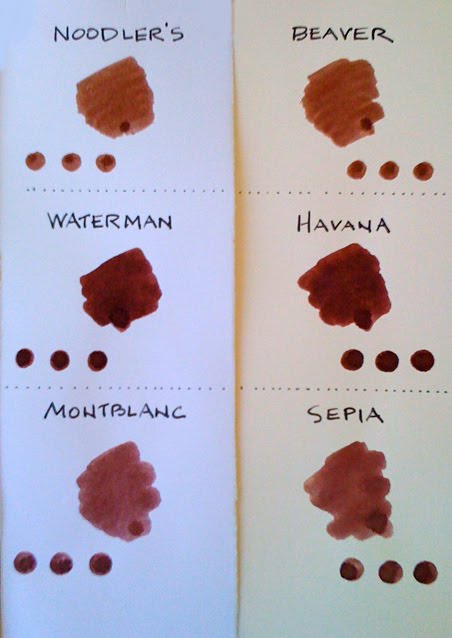
About the recent thread of autumn tinted inks in these pages, today is something like a U-turn, a looking back at the brown I jumped over last Tuesday. That particular brown is NOODLER’S BEAVER, and at this point, after an hour or two of playing with the ink on two different kinds of Clairefontaine paper, in a Sailor Professional Gear fountain pen with medium nib, and with Q-tip, I have to say in all honesty that I am only moderately impressed.


Like green, brown is another color I’ve chased after for a long time, always searching for the one that fits my preferences as closely as possible. In that search I’ve found three that fit the bill, three that I’m happy with, but those inks are not on parade here. The spotlight this time is on Noodler’s Beaver.


The color—Let me say right off that all the red in the Beaver works to push the shade toward what I call shoe polish brown. There will be some who like this particular reddish Shinola brown, and for them I would say go for the Beaver. But memory works against me, as I am reminded of the Saturday nights I had to polish my father’s shoes for church on Sunday. While it isn’t my kind of brown, the same is not true for everyone, and Noodler’s Beaver could be the one for you.


I lined Noodler’s up alongside two other browns and found all three to be close. Side by side, Noodler’s Beaver, Waterman Havana and Montblanc Sepia (Toffee Brown) almost look to be from the same ink pot, or the same shoe polish bottle. So close in fact, you might have difficulty in telling them apart. Feel like I would be stumped if you showed me unlabeled samples of the three tomorrow.


Brian Goulet has some good things to say about the Beaver, and I tend to agree with his remarks about the shading of the ink. Yes, it does shade well, and it also flows smoothly. With my Sailor pen at least, it lays down a line of well-balanced wetness, neither too wet nor too dry. In this sense, I found the drying time reasonable, but must caution left-handed writers that drying time could be a problem.


Everyone has this or that little something that draws them to a particular brown, or green or any color ink. Experience has taught that an ink displaying the finest of all qualities is rare. I have to think that getting it all right is a matter of delicate balance. Noodler’s Beaver has some excellent qualities, but the color, be it autumn or otherwise is not what I look for in a brown ink.


In my book the three top brown inks are: Maruzen’s Athena Sepia, Iroshizuku’s Tsukushi and Yama-guri. All the qualities we look for in ink are superior in these three. They are examples of that delicate balance personified by the harmony of color and performance.

Thursday, October 28, 2010

Speak, Memory…

Probably a great many readers have, like me, been brought to a halt by a brief passage of poetry in Stephen King’s 2008 novel, Duma Key. King very cleverly constructed the passage as a three-pointed allusion, and if nothing else illustrates that he is anything but an untutored writer, slamming out bestsellers without any thought to literary technique. I refer to a passage in Chapter 13—The Show…

“You read me poems because Wireman couldn’t. Do you remember that?”

“Yes, ma’am.” Of course I remembered. Those had been sweet interludes.

“If I were to say ‘Speak, memory’ to you, you’d think of the man—I can’t recall his name—who wrote Lolita, wouldn’t you?”

I had no idea who she was talking about, but I nodded.

“But there’s a poem, too. I can’t remember who wrote it, but it begins, ‘Speak, memory, that I may not forget the taste of roses, nor the sound of ashes in the wind; That I may once more taste the green cup of the sea.’


This exchange takes place at an art gallery as the two are standing before a painting of a young girl in a boat. The woman is referring first to a 1951 book by Vladimir Nabokov titled, Speak, Memory. Nabokov’s later book, Lolita was about a young girl. The poem quoted, which uses Nabokov’s Speak, Memory title in the opening lines is by Daubmir Nadir. The complete poem is quoted in the passage above from Duma Key.


The allusion as constructed by King adds another layer to his characters, and moves the story into its next stage with true finesse. I got that right off, as I expect most readers also do, but because the author wrote, ‘but it begins…’ I was prompted to follow it up, to see the remaining lines of an impressive poem.


As it happens, King quoted the poem in its entirety. It is one called “Cups” by the somewhat mysterious French poet, Daubmir Nadir. Interesting name. ‘Daubmir’ is ‘Rimbaud’ spelled backwards, as in French symbolist Arthur Rimbaud. ‘Nadir’ of course carries the meaning, ‘the lowest point.’ Like I said, an interesting name. Because I liked the Daubmir poem in Duma Key, I looked through his other poems, most of which are easily accessible here, but unfortunately came away from it not too terribly impressed. I read quite a few of Daubmir’s poems, but in the end felt slightly cheated. I saw too much pretense, too much clumsy juggling of big words attempting to describe inner or metaphysical tremblings, but leaving me instead in confusion as to meaning. Among the three dozen poems I read, only one reached beyond my eyes. It’s another short poem (there are many) titled “Basic Needs.”


Thirsting

for my soul

I cannot

find its shadow


Hungry

for my love

I cannot

find salvation


Weeping

for my life

I cannot

find solution


Apart from this brief work, I was left with inelegant and clouded lines like: ‘…the clogged stomata of my agitated addiction’; ‘Spiced with pomegranate between the larvae of my arillate genius’ and ‘the suppurating cavities of unrealized adventures.’


From the preview of Daubmir Nadir offered by Stephen King in Duma Key, I thought I might have found another poet to read and enjoy. It didn’t work out that way. Still, I won’t dispute that the poem “Cups” is a fine piece, well-written and rich in meaning.

About Me

My photo
Oak Hill, Florida, United States
A longtime expat relearning the footwork of life in America